-
ACNA: About That Celibacy Thing…
Edgar Noble’s piece Yes to Gay Identity, No to Gay Sex? The Concept Shaking the Foundations of the ACNA is a thought-provoking piece on a subject that, to be honest, I didn’t think would come up this quickly in the ACNA’s life. As I noted in the last post, we have TEC, why do people feel compelled to bring this into the ACNA? I’ll come back to that later.
I look at this as a “meaning of life issue.” What is life all about? What is our real purpose and goal? What are we trying to accomplish along the way? I grew up in a world–upper class and progressive at that–which put forth the idea that life was all about getting laid, high or drunk (in that order,) and that there is something basically wrong with people who didn’t subscribe to that. That’s really the core of the conflict between the “arbiters of taste” in our society and Christians who uphold the traditional sexual ethic.
If you look at the culture wars the last fifty years or so, that’s pretty much the essence of the matter. But it predates that: the ancient world was filled with fertility deities and all of the “wide open” practices that went with that. Christianity (and before that Judaism) came and and opposed that, and the pagan world has hated us for it ever since. The issue at its crudest is simple: is our God the creator of the universe, or does this deity reside between our legs?
Under these circumstances, the whole concept of celibacy is a form of secular blasphemy. If life is defined by our sexual activity, then how is it possible for us to abstain and be human? Part of the core of Christian belief and practice is that all of us have to practice celibacy at some point in our lives. The fact that such periods exist for anyone is deeply offensive to those who make sexual activity the centre of their existence.
The whole course of the current LGBT movement needs to be seen in that context. We have a group of people who are defined by their sexual activity, whose identity is bound up in that activity. How is it possible for people to be celibate and yet claim this identity? That’s a question the ACNA needs to find an answer for and not get lost in the post-modern mushiness that surrounds most of our cultural debates.
Noble mentions that people have been conditioned to view their sexual orientation as immutable. That’s being challenged by the “T” part of LGBT, that not only should our lives be determined by our sexual activity, but that domination extends up to and including changing the tools out. It’s a conflict that has led to the “TERF wars” of which J.K. Rowling is the most famous general.
And now we should consider a question we started with: why fight this battle in the ACNA and not simply move to TEC, which has embraced the LGBT community for many years. One thing the left in this country is obsessed with is existing institutions. They seldom think of starting their own; they work hard to take over ones that are already there. Evidently the ACNA, in spite of its relative youth, is an “existing institution” of sufficient prestige to warrant such demands from the left. Personally I think that the ACNA, like TEC, is a victim of its own privileged demographics. Largely white and well off, it’s a natural target for movements like this.
That being what it may, the ACNA was born in the defence of basic Christian doctrine and life. It either needs to stand for it or fold and admit that all of the money, pain and litigation were simply a waste of time. American Christianity has for too long been a popularity contest. Real Christianity has never been popular, and that simple fact needs to be understood completely.
-
ACNA, TEC and Those Social Justice Prayers
It’s worth noting that the following appears in the (relatively) new 2019 ACNA Book of Common Prayer:

For those of you who think this has its origins in that dreadful 1979 BCP, this also appears in the 1928 Book of Common Prayer:
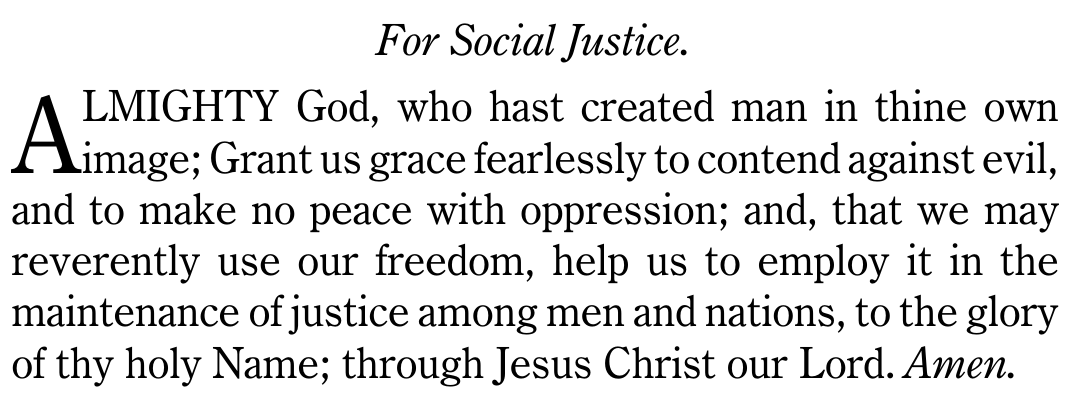
Other than the modernisation of the language and the expanded doxology at the end (one reason why the 2019 BCP is so much longer) the two prayers are the same in content. (This prayer was not in the 1892 BCP, FWIW.) What this means is that the impulse towards social justice goes back a long way in American Anglicanism and is even perpetuated in the group that split off from the Episcopal Church. I think some comments are in order because, the way the ACNA is going these days, there are elements in same that want to take it in the same direction as TEC went, which is silly because a) TEC is still there for those who want to go that way and b) it begs the question as to why the ACNA was started in the first place.
The first comment is that the existence of meaningful social justice movements depends upon the people’s freedom to express their opinion either individually or collectively in a meaningful way. This is something that gets lost between those who see social justice as a Christian imperative and those who think it is profoundly unBiblical. The New Testament was written in the Roman Imperial period, where there was really no way to petition the government to act on things like slavery, infanticide and the like. (The Republic supposedly had mechanisms like that but, as the Gracchi found out the hard way, they didn’t deliver as one would like.) Both of the prayers recognise that fact.
The second comment is that the quest for social justice is no substitute for personal regeneration in Jesus Christ. Since we are not Southern Baptists, that regeneration doesn’t end at salvation; it continues, as I note in this comment re the comfortable words. Liturgical churches’ greatest occupational hazard is in thinking that, just because we go through the liturgy and experience the sacraments, we’re okay with God and can move on to other things.
That leads to the third point: the social position of North Americans in the Anglican-Episcopal world is a two-edged sword. It makes their quest for social justice potentially more effective but at the same time makes them part of the problem. Evangelicals constantly prattle about being “influencers,” but Episcopalians (and now non-Episcopal Anglicans) are disproportionately that from the get-go. Some reflection on that before you go off and try to “change the world” is certainly in order, especially since life has probably rendered you unable to grasp the lot of those you’re trying to help.
Finally, you need to understand that you don’t need to simply ape non-Christian social justice movements just because they’re trendy amongst your peers. That’s especially important now since our moneyed interests are “woke,” and that many so-called social justice movements simply shill for those moneyed interests. Put another way, it’s hard to speak “truth to power” when you’re really just part of power.
Social justice is a noble goal; the road to it, however, has many potholes. Or, to put it in a more mathematical way, the arc of history may bend towards justice, but it may not be smooth, differentiable or even continuous.
-
When the People’s Liberation Army Marches Down Pennsylvania Avenue
If there’s one thing the Trump years and their aftermath did for everyone, it’s to disabuse people of the very American slogan of “it can’t happen here.” There are many “its” that are now in the realm of possibility. Although Americans aren’t reacting particularly well to that realisation, at least some plans for “black swan events” are on the stove, even though black swan sightings are already becoming more frequent.
One of these events is the possibility that the Chinese, whom we now recognise to varying degrees as adversaries/competitors, just might do what the Soviets could not: beat us and rule the world. Some thought they would transition to democracy: they haven’t. Some thought they’d let Hong Kong go on as it has: they didn’t. (Some of the rest of us thought neither of these would happen, and we were right, except that Hong Kong took longer than we thought.) “It didn’t happen there” has led some to think at last that “it really can happen here.”
So what if it does? What if, instead of inaugural parades, the People’s Liberation Army marches down Pennsylvania Avenue and hoists the same red banner over the White House we see over the Great Hall of the People?

I don’t know all of the ramifications of such an event, but I’m pretty sure of one of them, and it goes back to a low moment in Chinese history. One thing I found out while doing business with the Chinese is that they don’t forget slights, and this slight is a big one.
In 1900 the Chinese experienced the last major rebellion before the end of the Qing Dynasty, that of the Righteous and Harmonious Fists, or the Boxers. After that was put down, the European powers (along with the U.S. and Japan) extracted many concessions. One of those was to build in a way that would overlook the Forbidden City, the central residence of the Emperor, the Son of Heaven. Until that time it was “buxing” (forbidden) to build anything that overlooked this palace.

The French took advantage of this and began building the Beijing Hotel. By the time the French completed their part in 1915, the Son of Heaven was gone and China entered it’s period of “democrazy” that lasted until Chairman Mao mounted the Gave of Heavenly Peace and announced that the Chinese people had “stood up” on 1 October 1949.
Standing up was one thing: moving forward was another, and for that China sought the help of Soviet experts. One result of that expertise was the building of two additional wings on the Beijing Hotel, one on each side of the old French structure, as shown below.

It was the tallest wing from which I took this photo of the Forbidden City, which clearly shows what overlooking is all about.

It also provided a platform for this photo of Tian an Men Square, and also one for a more famous photograph several years later.

Today Beijing is a city of many tall buildings. But the Chinese themselves got them there; they were not imposed by “foreign devils.” Knowing the long memory of the Chinese (the Japanese know it too) I have a feeling that one of the things they would do would be to pay back for this humiliation.
In Washington there are height restrictions for the buildings surrounding the Washington Mall, to prevent the open glory of the place from being obscured. In fact, it’s fair to say that Washington, unlike New York, is a very “horizontal” place in general. (London used to be the same way.) However, in the 1980’s, when I was active in the family business, our DC area distributor told me that many of the “short” buildings around the mall were built with very high capacity foundations–and stouter structures than the edifice being built would call for–in the event that the height restrictions were lifted, taller buildings–with greater capacity for both occupancy and rent–would be built on top of what was there.
I have no doubt that, in the event that the Chinese take command, one of the first things they would do to avenge the humiliation of the Boxer Rebellion’s suppression would be to build tall buildings around the Washington Mall and house their own interests and institutions. As we have prepared the way, for many of these buildings it wouldn’t even require demolition of what’s there.
But why wait until “the day?” After his phone call with Yi Jin Ping, Joe Biden said that we needed to get with our competition with China, lest they “eat our lunch.” That ignores the fact that, after forty years of “cooperation” (to use the Chinese term) they’ve put enough money into the hands of people in Washington and elsewhere so that they’ve paid for their lunch, they have the right to eat it! At the head of this parade is none other than Hunter Biden, Joe’s son, thus the active suppression of this inconvenient fact.
But it takes more than buying off one person whose main goal in life is to get laid, high or drunk: it takes buying off many of them. The Chinese have embedded themselves in our power structure in a way that the Soviets could only dream. A few well placed lobbying efforts, and the upward construction can begin. With that the Zhong Nan Hai can empty a few cases of mao tai and another humiliation can be righted.
How this competition comes out depends upon many things. But in this case and many others, I think the distillers of mao tai better get busy.
-
Vindicated About Justin Welby
They probably admitted this a long time ago, but this admission on Anglicans Unscripted about Justin Welby’s unsuitability for his position is gratifying:
There are some of us who saw this early on. The problem isn’t as much with Welby–although he certainly has his issues–but his church and the fact that he is appointed by the state. This is the same state which enacted the Equalities Act along with same-sex civil marriage. It was unrealistic to expect such a state to appoint a truly orthodox Archbishop of Canterbury, which is one reason why I’ve felt for a long time that North American Anglicans’ desire for reunion with Canterbury was, to use a good Islamic term, a mirage.
The church is also an extension of the UK’s foreign policy as well, and the same comment applies there too, especially with his relationship with GAFCON. Rowan Williams tried very hard to put the “Humpty Dumpty” Communion back together, but he failed. I think some in the government–and Welby himself–thought that someone with some negotiating skills could do better. But the problem wasn’t the negotiation but the substance, coupled with the fact that the UK’s ability to sway its formal colonials isn’t what it used to be. So Welby has failed at this.
What the neocolonialist Anglican Communion needs more than anything else is a well-executed parting of the ways. Canterbury would probably end up with most of the provinces it has in number but not in membership. It would give birth to a truly non-Western centred part of Christianity, which is the shape of things to come anyway. Whether Welby’s successor will attempt this or continue to demonstrate that the definition of insanity is doing the same thing over and over expecting a different result remains to be seen.
-
Some Reflections on “The Ten Weeks” and Our Current Situation
Well, it’s done: my novel The Ten Weeks is now blogged. I trust that those who have followed it have been blessed and entertained. For those who have not kept up, it’s not a problem; this site’s traffic has traditionally come from its long-term content.
The novel was an ordeal for its participants; while blogging it, our country has gone through something of an ordeal of its own. When I posted the novel I made the decision to not interrupt it for current events. Although it was tempting to break that, I’m glad I didn’t. This has been a time when thoughtless–and inconvenient–proclamations were punished. But the confluence of the two was intriguing in some ways, and I’d like to make some comments regarding that.
I said at the start that the novel was started in 2006. That’s before the Obama-Biden years, and now we’re in the Biden-Harris years. Left-wing regimes have a common theme; it’s the variations that make them different. But I’ve also eschewed the label of prophet, and that’s paid off. The problem in the Evangelical/Pentecostal/Charismatic world is that prophecy, like leadership, tends to be self-validating, and that’s not a good thing. I think that recent events should convince some of our prophets that they need to find a new line of work.
Having said that, I think that the U.S. has come to its “Allan Kendall” moment. There are two important differences. The first is that it’s come to this moment without an Allan Kendall. That I think is a big part of why the left freaked out over Donald Trump. They know that they don’t have a Lenin to counter a Kornilov; they don’t have a Mao Tse-Tung to counter a Chiang Kai-Shek; they don’t have a Castro to counter a Batista. They’re more like an Azaña against a Franco, and we all know how that ended. So they freak out when a strong person comes against them. Their best hope is to lean on our tech oligarchy to deplatform their opponents, and although intra-oligarchy fights are not unknown to the left (Nicaragua comes to mind, although that type of struggle occupies the novel as well) it’s not the best way to bring power or justice to the people.
And that leads to the second question: why did it take so long? The Ten Weeks is set in 1970-1, and not a few of us in that era thought that they would roll on to triumph. It would have been easier because they had a populace who was more used to obeying the government rather than endlessly challenging it. I think the critical moment came in the wake of Watergate: the left largely squandered the moment that followed, both through laziness and electing a President who was neither invested in the revolution nor motivated by the desire to right past personal wrongs. The economy went into chaos, the Boomers went into their spectacular volte-face, and the rest, as they say, is history.
So, as always, we are left with Lenin’s question: what is to be done? For the participants of The Ten Weeks who were on the wrong end of the national outcome, the answer was simple: leave. If I were the age of those participants now, I would be making preparations to do the same. In fact, I considered doing just that back in the day. Getting Americans to consider that is hard; most are not prepared for that, either in their style or mind or their skills to make a living. But if the regulatory and legal web about to be weaved turns making a living and worshiping God into an ordeal, things might look very different.
After all, most of our ancestors came here for a better life (in many ways,) why not leave for the same reason?
-
The Ten Weeks, 20 February, Like a Twitter Thread, At The End It’s “Fin”
The weekend that came was decidedly strange. Lucian Gerland’s death and the fiasco of his funeral had made for a long week. There weren’t many on the Island alive and active who could remember a Verecunda not dominated by Lucian Gerland, and the anticipation of what life would be like without him depended upon what side of things you were on. The government was trying to make the most of it; while skirting the sensibilities of those who did admire him (and they were many,) it tried through the media to paint a rosy picture of what the future would hold in a “post-Gerland era.”
For Jack, though, the wounds inflicted by Serelian and Verecundan alike were healing. His parents had lifted his grounding in the wake of his encounter with the CPL thugs, but until this Saturday he hadn’t been in much shape to take advantage of it. Now he made a mid-morning crossing of the Dahlia Bridge in his GTO, passing most everything else rolling on the bridge. In spite of the pain that he carried with him, his thoughts were fixed on the mission he was about to attempt. After a school year dominated by his ups and downs with Denise and the disastrous consequences of that relationship, one would think that he would either settle for less adventuresome company, but he had finally gotten up his nerve—with some help from Cat—to go where no Arnold had gone before.
As he left the bridge, crossed Central Avenue and passed into the Evan Point district, he felt butterflies in his stomach, something he hadn’t felt since his first date in Lower Division. As he pulled up towards the des Cieux house, he saw his first barrier up: the garage door was open and he could see their two cars, Pierre’s 2 CV on the left and Madeleine’s Dyane on the right. He was tempted to rev the engine and announce his arrival, but he thought better, and he almost crept into the driveway like a cat stalking its prey.
He opened the car door and eased out of the car; his cracked ribs were on the mend but not quite there. He closed the door as quietly as he could and still latch it and started walking towards Madeleine’s car slowly, with a slight limp, his legs spread a little more than usual as he walked.
The visual appeal of the scene took a leap upward as he approached the Dyane. Luke had done a good job in getting most of the paint out of the interior of the car, but Madeleine was pickier. The garage had a strong odour of paint thinner, but Jack’s eyes were drawn to the sight before him. Madeleine had donned an old Izod shirt and shorts to finish the clean-up, and she was busy getting specks of paint that Terry had left on the passenger side floor. To get there, she had crawled in over the driver’s seat, so Jack was presented with the sight of Madeleine, rear up and legs out of the car as she inspected the floor for one more speck.
“Madeleine?” he called to her. In spite of the obstacles of the wheel and roof, she came out of the car almost instantly without hitting anything. As she came to stand before him, the terror in her eyes would not have been greater if Dracula had come to draw a little blood. She took a step back, her hands over her thighs.
“Don’t be scared,” Jack said. “It’s only me. I’m sorry if I frightened you.”
“It’s okay,” she replied. “I didn’t hear your car come, I was so involved in my work.”
“That’s one of the things I came to tell you,” Jack continued. “Thanks for rescuing Cat and Terry from the riot at the funeral. You didn’t have to do that. I know it messed your car up.”
“The car will be fine,” Madeleine assured him. “They were in a very sad situation. It was what I could do. . .so, is that all you came to tell me?”
“Well, no,” Jack replied nervously. Madeleine’s view of him was changing from fright to curiosity as he worked on getting the words out. “I came to tell you that I think you’re the coolest girl in the school.”
“Me?” she asked, puzzled. “How did you come to this conclusion?”
“Anyone can blow your mind,” Jack replied. “Only you can open it. I know you’ve opened mine. I just wanted to say thanks for that. I hope you have a great time at university in Europe. And,” he reached into his pocket, “I’ve got something for you.”
“For me?” Madeleine asked, more puzzled than ever.
“It’s this,” he answered, pulling out an object wrapped in tissue and handing it to her.
She unravelled the tissue to discover a wooden crucifix that was almost too large for her hand. It felt very heavy for wood.
“My grandfather helped to start the Church of Serelia,” Jack told her. “Didn’t do me much good when I was up there. Anyway, when he left to return to Verecunda, the church of St. John the Baptist in Denton presented it to him as a going away present, since he had helped them to start the church. The guy who carved it—his great-grandfather or something actually nailed the people on Avinet Beach, so he carved a crucifix. Unfortunately, they didn’t know that Anglicans don’t use crucifixes, so my grandfather stashed it, and when he died I got it. It’s made out of lignum vitae; the Serelians think that’s the tree that will grow in heaven. Guess you’re the only one in our class who will go there and find out for yourself, so, I thought you’d like to have it.”
“It’s lovely,” she said, examining it carefully. She looked at him very softly; her eyes sparkled. “Thank you.”
“Enjoying the view?” a voice came from the back of the garage. They both turned to see Pierre.
“Mr. des Cieux,” Jack said. “Nice to see you today.”
“And to what do we owe the honour of your presence in our garage?” Pierre asked.
Jack looked at Madeleine. “I hear that you’ve been known to hang out with guys at The Mangrove.”
“It has happened,” Madeleine admitted. “But today, I am going to Hallett to play tennis with Carla Stanley.”
“Have you ever been to Hallett in a Goat?” Jack asked. Madeleine looked around Jack and studied his car—which he had seriously cleaned up for the occasion—very carefully. Then she looked Jack over equally carefully. “It’s a lot faster trip,” he promised.
“Can you play tennis again?” Madeleine asked Jack.
“I’m still a little slow,” Jack said, “but I need to get going again. You know I got thrown off of the team.”
“Then perhaps you wouldn’t mind playing one of us girls. Or perhaps you would like to take us both on at the same time.”
“You’re on!” Jack exclaimed. “But I gotta go get my racket and whites. When do I pick you up?”
“In about an hour,” Madeleine said. “I need to finish cleaning my car and get ready.”
“I’ll be here! Thanks! And thank you, Mr. des Cieux, for letting me take her to Hallett.” He turned and limped back to the car with a lilt in his step he had missed for a long time. Opening the door and easing himself in, he waved to Madeleine one more time, then closed the door and started the car. Throwing it in to reverse, he peeled out of the driveway, rolling out until he was straight into the street. Then he dropped the car into low and, burning a lot of rubber, screamed down the street.
“Do you think it will be all right to go to Hallett with him?” Madeleine asked her father.
“In his state? Of course. Besides, driving like that, I will be seeing a good deal of him.”
Jack for his part felt like he was flying as he turned left onto the Dahlia Bridge and headed across the bay, once again passing everything else on the bridge as he came closer and closer to home.As Carla would say,
THE ENDor as Madeleine would say,
FIN -
The Ten Weeks, 18 February, The Rioters Even Show Up to Funerals
Terry stood nervously and alone outside of St. Sebastian’s, facing Aumonier Street. Behind her the stained glass windows of the church showed their images muted and in reverse. Her full length black dress and veil became her; her long hair was swallowed up in her dress. She stared blankly out into the street, so intently that she missed the fact that Cathy came up the side walk.
“What are you doing out here?” Cathy asked, startling Terry. “Shouldn’t you be in there with your family?”
“Should,” Terry grudgingly admitted. “But it’s real bad. I thought I’d wait for you out here.”
“What’s going on? Shouldn’t your grandfather have lied in state yesterday? He was real important.”
“Should have,” Terry replied, like a broken record. “But the family spent the entire day fighting over the arrangements.”
“Why? Didn’t he leave some?”
“He did. That’s what Uncle Ernie wanted to do. He was supposed to be laid in state at Santa Lucia. Instead the three of them—Uncle Ernie, Aunt Vickie and Mother—spent the day fighting on how to do it. My grandfather spent his whole life trying to make a bunch of Italians act like Anglo-Saxons, but now that he’s dead we’re back to the old country. Like Mother says, when we love, we hug, when we hate, we slug. We kids all sat around listening to it. It got so bad that even little Richard couldn’t stand it any longer. Daddy and Aunt Mabel sat around with us.”
“But. . .shouldn’t the wishes of the dead be honoured? Why couldn’t they just leave it to all of the help that he had?”
“The help knows that, although Uncle Ernie has the legal rights, Aunt Vickie and Mother have the political pull with the CPL and Denise’s old man. So they canned the lying in state and cut straight to the funeral today. But I’m glad you’re here.” She looked at her watch. “I guess we need to go in—the funeral starts in ten minutes.”
They turned to start down the side walk so they could go in through the narthex and be escorted to their seat, but Terry saw the side door to the nave. “Let’s go in through here,” she said, walking through the gap in the tall ficus hedges and down a short side walk and up a few stairs. They came to the side door, passing a security man who opened it.
“Good to see you, Terry,” the guard said. It was one of Lucian’s senior security people; Terry knew him well. “And you, Miss Arnold.” He turned back to Terry. “You’re not with your family?”
“You’ve seen why, don’t you?” Terry asked.
“Unfortunately,” the security man said.
“I thought we’d just go in from the side. But how come you’re not at the back, with the body?”
“That was the original plan,” he replied. “The cops showed up about a hour ago, told us they’d take care of the main security detail at the back of the church. Most of us went over to Santa Lucia to set up the wake. I stayed here at the side.” He looked around to see if there was anyone else other than Terry and Cathy. “You ask me, there’s something going on. I don’t know what, but. . .I can’t do anything about it.”
“I understand,” Terry said. “Thanks for all you’ve done. I know Grandpa always thought a lot of you.”
“That’s about the only compliment I’ve gotten lately,” he sadly replied.
“Well, we better go in. When you look like I do, nobody forgets you’re not there.” Both the security man and Cathy got a chuckle out of that as they eased the door open and went in.
The family was seated in three rows. The first were the children and their spouses, that is those who still had spouses—Vickie’s divorce had been finalised only three weeks earlier, over her father’s objections and those of the church. The second had the children—Patty and Lisa Langley, the youngest, were nearest the centre aisle, then Ken and Jack Gerland, and finally “Little Richard” Marlowe. The last had the other relatives, mostly Lucian’s in-laws, but also relatives like Shu-Yi. Terry walked over to the second row.
“I’m not supposed to be here,” Cathy protested.
“I need you,” Terry told her seriously.
“Okay,” Cathy replied. Terry stopped at the end of the pew and genuflected, then they sat down close to the outside end of the pew, Terry first in and Cathy following.
“What’s she doing here?” Richard asked, noting the intruder.
“Shut up!” Terry scolded her little brother. Eleanor turned around and glared at her daughter but said nothing. Terry settled into her seat and looked forward, not praying first but hoping for a little peace and quiet before the funeral Mass actually began. Cathy looked around to see who was there.
“You know that Denise and her parents aren’t here?” Cathy asked in a low voice. Terry looked around to see for herself that Cathy was right.
“They hate my grandfather,” Terry explained.
“Yeah, but they declared a national day of mourning. School got out. And look at those TV cameras in the back. I think this is supposed to be live on both TV and radio. Something is going on.”
“In this place, who knows?” Terry replied. It wasn’t long before Bishop Santini began the Mass by blessing the body in the back of the church, then processing into the church with the body, along with the altar boys and the small choir that they had assembled for the ceremony.
They got through the Scripture readings and the responsorial psalm without incident. The time came, however, when Ernie was supposed to get up and give the eulogy for his father. Ernie hadn’t had the chance to even rise from the pew when a shout came from the back of the nave.
“Power to the people!” the male voice cried. Everyone turned and realised that a group of protesters from the University had gotten into the church. They started yelling slogans and obscenities as they raced together down the centre aisle, carrying cans of red paint. Their technique was obviously well rehearsed, because, as they passed the front pews where Lucian’s children sat, they threw the red paint, which hit squarely on Lucian’s coffin, splattering the altar, the floor and everyone else around—including Santini—with the paint, which had been thinned slightly to make it easier to throw.
Those around the casket, seeing the onrush head on, scattered first to whatever exit they could find. Those in the pews were so shocked at the speed and brazenness of the assault that they froze in fright, although many of them began to scream in panic. A few in the back started to make their way out. The family’s reaction was mixed. Ernie was unable to speak or move from the shock of the event; he was also the recipient of some of the paint, as he was at the end of the pew. Vickie and Eleanor got up and started to yell in support of the demonstrators. The children for the most part were small enough to make a dive and get under the pews, but for Terry this wasn’t an easy option.
“We need to split!” Cathy yelled at her friend. She pulled on Terry’s right arm and they came up out of the pew. Getting into the aisle, they could hear some noise coming up the side aisle. They turned to their right to see another group of protesters, armed with paint, coming straight at them. The girls realised that their timing for getting out of the pews was too slow, for as they stood and looked at this group of yelling demonstrators same unloaded their paint right on the two of them.
By the time they had gotten enough paint out of their eyes the group that had nailed them with paint was past and busy tearing up the church with their colleagues from the centre aisle. Without saying a word to each other they made a bee line for the side door they came in, hoping to hide their humiliation the best they could.
They got to the side walk. They could hear more protesters around the corner; they knew that they would come their way shortly. At this point they looked out into the street and saw Madeleine’s Dyane rolling down the street. The car crossed over and pulled up in front of them.
Madeleine lowered the window. “You need to go now!” she told Terry and Cathy. “They’re coming!” The two girls looked at their paint drenched clothes and Madeleine’s car in horror.
“Take your clothes off!” Madeleine ordered them. Terry started immediately but Cathy was stunned at the order. “You’ve done it before!” Madeleine reminded Cathy, at which point she complied. They both got down to bra and panties and made their way behind the car to get in on the right side. Their bare feet tread very lightly on the rough conquina pavement with its embedded, broken seashells. They got the doors open, threw themselves into the car (Terry in the front, Cathy in the back) and slammed the doors. With the protesters starting to come up the street, Madeleine put the car in gear and, with all the power she could muster, drove up Aumonier Street and away from the church.
“Thanks for coming to our rescue,” Terry said. “We hope we don’t ruin your car.”
“It will be fine,” Madeleine reassured her. “Papa will take care of it”
“But. . .how did you know to come and get us?” Cathy asked.
Madeleine thought for a second. “It was a sudden urge. I could not stop myself. Since we have no school, it was not a problem.”
Terry turned around. The two passengers looked at each other with a look that mixed wonder and terror.
“Where are we going?” Terry asked, finally snapping out of the daze.
“To your father’s warehouse, non?” Madeleine asked. “You should be safe there.” By then Madeleine turned left onto the Brahman Way. She made her way across Melaleuca Street and turning right a few blocks later, landed them at the warehouse.
Madeleine pulled up as close to the padlock on the gate so Terry could get out and unlock it while treading the shortest path in bare feet that she could. She pushed the gate open and got back in the car; Madeleine wormed her way through the small opening that resulted and pulled up in front of the office. The girls got out; they turned around to say “thank you,” but Madeleine had already re-engaged the clutch and wheeled around the lot to get back to the narrow exit.
“I can’t believe she did that,” Cathy said.
“I can’t either,” Terry said. “Let’s get inside and see what we can find to wear.” -
The Ten Weeks, 16 February, Death Brings the Worst Out in Families
The next day, Terry was leaving her last class and heading to the locker room to get ready for tennis practice when Shu-Yi intercepted her in the hall.
“You must come quickly,” she told her granddaughter. “Your grandfather’s condition is very grave.”
“But I’ve got tennis practice,” Terry protested. “I’m in enough trouble already.”
“I think he is dying, Terry,” Shu-Yi replied. “You’ve got to go.”
“All right,” Terry moaned. She saw Alicia down the hall. “Alicia!” she cried.
“What?” Alicia replied, turning around.
“Tell Coach Dorr I can’t make practice today.”
“Her and Denise’ll be mad at you.”
“I know. But my grandfather is very sick.”
“He’s been sick for a long time.”
“I think it may be the end, Alicia.”
“Oh,” Alicia replied. “Okay, I’ll tell ‘em.” Alicia turned and went on. Shu-Yi almost drug Terry to the Mini for the trip to Santa Lucia.
Alicia got on her tennis outfit and went out on the courts. Coach Dorr was working with some of the players warming up; Denise and Vannie were talking on the side. Alicia walked up to them.
“Terry told me to tell you that she’s not going to be here today,” Alicia said to them.
“Why not?” Denise snapped. “What’s her little excuse now?”
“She said her grandfather’s dying.” Denise went silent at that, looking out at the court.
“Thanks for telling me,” Denise finally said. “Go over with Coach Dorr.” Alicia turned and went.
“So what does that mean?” Vannie asked.
“Let the games begin,” Denise replied very deliberately. “I’ll be back,” she said and turned to go back to the school.
“Where are you going?” Vannie asked.
“I gotta make a phone call,” Denise replied. She left Vannie standing there, mystified as usual at her friend’s ever-hidden agenda.
Shu-Yi wasted no time speeding down Bolton Street, making a hard left onto Dravidian Way, and heading down to Santa Lucia. Located between the hotel and the country club, Santa Lucia was the centre of Gerland’s empire in just about every sense of the word. Never for an office, Gerland governed his properties and lived his life from the palatial estate that he had built as much to honour his Italian ancestors as to provide both luxury and significance for himself.
The Mini was readily waved through the gate. Shu-Yi did some odd work at the estate, and was well known there, especially when she had Terry with her. They pulled up near the front entrance. Shu-Yi once again took to pulling her granddaughter away from the car, towards the entrance and into the main lobby of the mansion as the doorkeeper dutifully opened the gateway for them.
The lobby was empty; usually Lucian had a receptionist there, but she was missing and her desk was unoccupied. There was a strange silence that draped itself around the place.
“Let me go and see what is going on,” Shu-Yi told Terry. “You go and wait in the office. I will be back.” Shu-Yi went on to Gerland’s quarters while Terry went into the main office, to the side of the lobby.
The office was a large, cavernous affair, with a five metre ceiling that matched the lobby. Terry sat down on a couch that faced the large desk located in the centre of the office. She carefully place her purse on the couch and pulled her skirt up to her knees as she sat down. All around her were frescoes which Lucian had replicated from the Italian Renaissance masters, but Terry’s eyes fixed themselves on her favourite, the Disputa, which was directly behind the desk. Her mind went back to the time when, while her elders partied elsewhere in the mansion, she would come and examine the details of the fresco. Her brother Richard hated the place, which meant that she could be left in solitude or sometimes with Cathy away from him. It was also away from the eruptions that had become all too frequent at Gerland gatherings, especially leading up to and after Kendall’s taking the Presidency. Here she could get away from all of that and soak in the eternal themes that presented themselves in front of her.
As she looked at the fresco again, her almond-shaped eyes began to fill with tears which ran down her cheeks. She sensed deeply—too deeply for her own good—that another mooring in her life was about to break away, sending her out into a stormier and stormier sea where she had no control over the course of the ship. She had never been that close to her grandfather—her mother saw to that—but living in a world centred around him and the fruits of his wealth had been all she had known. Now she knew that world was about to be torn apart, and her desire to escape to somewhere—anywhere—was stronger than ever.
“Come and see him now,” Shu-Yi said from the doorway, breaking her solitude. “The priest just left five minutes ago after giving him the last rites.” Terry got up, took her purse, and went out while Shu-Yi led the way to the master bedroom.
They entered to see Lucian lying unconscious on the bed, surrounded by his nurses and Terry’s Uncle Ernie. He got up and hugged Terry.
“Where’s Ken and Jack?” she asked, referring to her cousins.
“They’re supposed to be here,” Ernie replied, “but they didn’t have a Shu-Yi to deliver them. I’ve only been here about fifteen minutes. They waited until the last minute to tell us he’s sinking fast.” Terry went around and sat down at the seat Ernie occupied. She clasped Lucian’s hand, which responded very weakly to this show of affection.
“Grandpa?” she called to him, with no response. Lucian had assumed an ashen complexion. Terry broke down in tears, burying her face in Lucian’s lower arm. The nurses even began to cry, moved by this spontaneous show of affection and grief that they found all too rare in the Gerland family. Shu-Yi and Ernie joined them in their sorrow. By the time the nurses regained their composure, they realised that he had stopped breathing.
The head nurse took his pulse and found none. They looked at each other, then, as if rehearsed, pulled the sheet over his face. Terry, who had just sat up, went back into tears, this time turning to Shu-Yi for comfort.
Ken and Jack—several years younger that Terry—had crept in just as Lucian had expired.
“He’s gone, boys,” Ernie informed his sons. The three men stood in stony silence; Ernie was fighting joining Terry in uncontrolled grief. In the midst of this Mabel, Ernie’s wife, came into the room.
“Vickie’s coming,” she informed the mourners. “You’d better be ready.” Mabel turned to Terry. “Where’s your mother?”
“I don’t know,” Terry replied, red-eyed.
“One is enough,” Ernie noted. “You go and sit next to your cousin,” he said. Ken and Jack went over to be near Terry, although they had to sit a few metres behind her as there wasn’t a seat actually next to her. Ernie began to move towards the door when his sister Victoria stormed in.
Vickie—as everybody called her—stopped about a metre in front of the door and looked around. She stared at Lucian’s covered body for a bit, then turned to Ernie, who was walking up towards her. Terry decided to get up and was about two metres behind him when he stopped.
“So it’s all over,” Vickie said calmly. She looked around the room. “So it’s all yours now—for a little bit, at least.”
“Don’t start in on that,” Ernie said. “He’s just died. Can’t we have a little respect for the dead?”
“Respect?” she screamed. She pointed angrily at her father. “He didn’t know the meaning of the word, at least when it came to me. He took away my innocence, again, and again and again. And you talk about respect? And what did it get Eleanor and me? To get cut out of his will? To get pushed aside because you just happen to be a man? What kind of respect is that?”
“We can work something out. . .” Ernie replied.
“We don’t have to any more! Now we’re in charge. We don’t need to rely on chauvinist pigs like you to throw us scraps. Our man is now in power and you’re going to pay dearly for all you’ve done as our father’s co-conspirator. And once you’re out of the way, we’ll move on. It’s time for us to stand up and take back our bodies and take back everything else that is ours and then we’ll move out of this place and take the world! So go ahead—do your little negotiations, because the time has come for all of your animal deals to be pushed aside in the name of equality and justice!”
The room went silent. “So when do we go over the funeral arrangements?” Ernie asked.
“Eleanor and I will meet with you in an hour for that,” Vickie coldly replied, and with that she walked out of the room.
Ernie turned to the nurses, who were in shock as much as Ernie was. “Call the doctor and have him come and certify Dad’s death,” he told them. He turned to Terry. “I don’t know if you want to stay or not.”
“Not really,” she said, her countenance having been reversed like everybody else’s.
“Does Dick know?” Ernie asked.
“I don’t think so,” Shu-Yi said.
“Let’s go tell him then,” Terry suggested.
“What about your mother?” Ernie asked, puzzled.
“She’ll find out,” Terry said. “Aunt Vickie will see to that.” With that she took her purse and left with Shu-Yi.
Vickie was in the office making one phone call after another as Terry and Shu-Yi silently left the house in the same way they entered.
They got in the Mini. As Shu-Yi drove out of the estate, she turned to her granddaughter.
“This is bad,” Shu-Yi said. “I don’t like it.”
“Why can’t I just live like everybody else?” Terry asked. “Why can’t we just live with each other and love each other?”
“You have not lost the heart of a child,” Shu-Yi responded. “You will have to find your own escape.”
“You mean like Pao-Yu in the Dream of Red Mansions?” Terry asked, recalling the novel Shu-Yi had read her as a child.
“As a Christian, you can do better than Pao-Yu,” Shu-Yi observed.Pete Stanley was away from the store, seeing the Count of West Vidamera. When the cat’s away the mice will play, in this case the radio. John Agelasos was in charge, and the usual Nashville sounds gave way to Verecunda’s Top 40. The Osmonds’ singing about one bad apple, however, came to a jolting stop as the station’s news announcer came on.
“We interrupt our programme to bring you a special news bulletin. A spokesman for Gerland Properties has just announced that Lucian Gerland has died at his home in Point Collina. We repeat, Lucian Gerland has passed away after a long illness. Funeral arrangements are pending. We will announce further details as we receive them.”
John heard the shout of joy from the mechanic out back, who abandoned his work and ran in.
“Yeah! The land stealer’s kicked the bucket!” the mechanic cried in joy when he arrived at the front desk.
“Shut your mouth!” John replied. “Don’t you have any respect for the dead?”
“What do you mean?” the mechanic replied, stopping in amazement.
“You think the jerks downtown are going to do us any better? Look at the taxes we have to pay now!”
The young man looked at John blankly. “Not my problem,” he said. He turned and went out back again. John then heard a car start up and, kicking up the sand and pebbles, peel out onto the road and into Hallett.
John looked at his watch. “Probably going drinking,” he muttered to himself. He wrote down the departure time on the pad they kept at the front desk in the hope that Pete would have the nerve to dock him for leaving early. The radio settled back into its usual playlist. Janis Joplin’s gravelly voice came on.
“Freedom’s just another word for nothing left to lose. . .”
“I guess we’re going to find out what that means,” John said to himself despondently. He turned and switched the radio to a country 8-track in time for a customer to come visit. -
The Ten Weeks, 15 February, When God Touches Your Life, You Are Never the Same
 Amongst the collection of societies and clubs at Point Collina Comprehensive, its French Club was in a league of its own. Although the Republic had lowered the majority (and thus the drinking) age to eighteen, a milestone honoured in the breach, the Club had the distinction of being the school’s only student organisation where open drinking was permitted at its functions. Madame Seignet and her colleagues never gave a second thought to this practice; only the Spanish Club thought it was unfair.
The Monday night gathering took place at Alicia Decker’s house. The Keller home—Alicia’s mother had divorced and remarried—was about halfway between the yacht club and the school. It was well attended, with the students’ cars filling up the streets and making getting in and out tricky. Denise was conspicuous by her absence; her recent social difficulties forced her to more carefully select where she would make an appearance. Her absence decentralised the focus of the event; people were more likely to concentrate on each other than her, and they did as the fondue progressed in the kitchen.
Terry and Cathy were standing near the door, eyeing just about everyone that came in.
“I can’t believe that Madeleine des Cieux came to your house and prayed for Jack,” Terry told her friend.
“I can’t either,” Cathy agreed.
“You really didn’t call her?”
“No. She just, showed up, prayed, and left. Jack was back in class the next morning. Mom and Dad made him go to the doctor first to make sure he was really all right. Uncle Jeff couldn’t believe it when he arrived at his office. He’s kinda gimpy these days, but I’m just glad they didn’t kill him.”
“Where is Madeleine anyway?” Terry asked.
“I think I saw her out next to the pool. She’s not speaking to anyone. Jack says she’s still shook up about Carla Stanley getting thrown off her tennis team, and the riot and everything.”
“He still hasn’t asked her out?”
“Nah. Still too big of a chicken. They talk in the hall some.”
“Really, it’s not hard to get kicked off a tennis team these days,” Terry observed.
“Denise is a jerk. If she had had you and Maddy on the team, we could have beat St. Anne’s.”
“If we don’t get it together,” Terry replied, “we won’t beat Verecunda this Friday.”
They sipped on their wine and looked around. “How’s your grandfather doing?” Cathy finally asked.
“Not good. He hasn’t left Santa Lucia in weeks. Mother knows what’s really going on but won’t say. Little Richard and my cousins don’t know anything either. It’s like the Kremlin over there.”
“Let me know if something happens,” Cathy said. “I want to be with you.”
“Thanks.”
Cathy was right about Madeleine; she was out by poolside, sitting in one of the pool chairs adjusted as upright as possible, sipping very slowly on her own wine. She just stared out at the pool, watching the swirling patterns the circulation system made in the water. The pool was fully lit up by the lighting under the surface, which was the main light on the patio.
“You should be at the centre of this party,” a voice came from beside her. She looked up. It was James Bennett.
“I am not,” she replied blankly.
“This is not my favourite function either,” he said. Suddenly the impulse came to him. “Would you like to go somewhere else?”
“Yes, I would,” she replied as impulsively as he had asked. She arose. “Do you have that car here?”
“The embassy had other plans for it,” James admitted. “I stayed at school until I could walk here. They will come and pick me up after a while.”
“Mine is here,” Madeleine replied.
“So where would you like to go?” he asked.
“What about The Mangrove?”
“But that is a bar!” he exclaimed. “I don’t go to bars. That is why I am having trouble here.”
“It is not so bad. It is Monday night. Everyone has spent their money over the weekend, so it is quiet. And the food is good as well.”
“Very well,” James said, reluctantly. “Where is your car?”
“I must tell Madame Seignet,” Madeleine said. “I will meet you at the front of the house.”
“I will be there,” he said, very confidently. Madeleine broke the news to a mixed reception, then went out front to meet James. James watched as she walked out from the front door to the street wearing her leather jacket. Looking at the way she was dressed and carried herself, he thought he had been transported into another world. They walked a few metres down the street to the Dyane. James went to the driver’s door; Madeleine unlocked it and waited for him to open it. But he could not get get the handle to move.
“You must pull the handle up to open it,” Madeleine explained.
“This is a very unique car,” James observed. He opened the door successfully and Madeleine got in. He closed the door and went around to the other side to enter while Madeleine started the car. Putting it into gear, the Dyane’s size and manoeuvrability paid off; she was able to get out of her space and down the crowded street without difficulty.
She turned right onto Ocean Avenue. It was chilly; the 10°C temperature, combined with some ocean breeze, meant that the windows were up and the heat was on, and it only began to warm the chilly interior as they came to a stop at the intersection of Melaleuca Street.
James looked around at the car he was riding in.
“You think it’s funny?” Madeleine said.
“Of course not,” James protested.
“Yes, you do,” she said. “Everybody does.” The light turned green and she made a hard turn onto Melaleuca; the soft suspension caught him off guard and he ended up hitting the door.
“It’s not funny any more,” he said while trying to upright himself.
They made it to the Dahlia Bridge. The sun had just set to their left, leaving its dimming light over the western part of Verecunda Bay. The coastline of Collina was receding from them as they advanced across the bridge. Their voyage across the bridge was a leisurely business; the Dyane’s tiny engine wasn’t a problem on the Point or in the city, but on open stretches of road—both the bridge and those in Uranus—its limitations became apparent. They had plenty of time to see the sunset on one side and the city lights of Verecunda on the other. The afterglow of dusk was still visible on the taller buildings of the city, as it was along the coast of the Point leading up to the lighthouse. This scene, taken for granted by the locals, was a wonder to behold. James viewed a scene that he usually missed as he drove himself across the bay. It helped him to forget that he had given up his honour to travel in this tiny car driven by his sudden date.
“This is where I replaced Carla Stanley’s tyre,” James noted as they passed the spot on the bridge.
“That was very kind of you,” Madeleine observed. “She badly needed the assistance. She is usually very self-reliant, but Denise had frightened her.”
“We call such events ‘divine appointments,’” James replied.
Once their voyage over the bridge was done, it wasn’t long before they were pulling into the back parking lot of The Mangrove. As she had predicted, it wasn’t very full. James once again helped Madeleine out of her car and escorted her through the back entrance of the establishment.
There weren’t many people inside, but all eyes were on them as they made their way to a back table to which Madeleine led the way. Interracial couples were an exceptional sight in Verecunda, and these two attracted a fair amount of attention as they seated themselves and the owner himself came up to them.
“Miss des Cieux,” he said. “I’m not used to seeing you here on a Monday evening.”
“We had a school club party. It was not going well. This is James Bennett; his father Marcus is Commercial Attaché at the Aloxan Embassy. He is one of Papa’s clients.”
The owner eyed James. “You look very much like your father. He comes here from time to time.”
“Here? He never told us he comes here,” he replied, surprised.
“Everybody that does business on the Island comes here sooner or later,” the owner said. “Are you here for just coffee, or a little wine, or dinner?”
“Some coffee would be wonderful,” James blurted out. “It is cold out there.”
“East or West Island blend? The des Cieux always prefer East.”
“Then East Island it is,” James said. He coughed; he wasn’t used to the smoke that hung over the place, even though where they were sitting it was as thin as it got, being far away from the bar.
“That is fine,” Madeleine said. “It is cold. But I think we are hungry also; perhaps the usual?”
“Absolutely; the chef is here tonight to prepare it. And for you, Mr. Bennett?”
“The same!” he exclaimed. He was disoriented by his state; he had no idea about what the “usual” was, or how much he was going to have to pay for it, or how he was going to explain why he took off with a French girl from a school function his parents had already paid for, and last but not least whether the small amount of money in his wallet would cover the experience that was, up to now, decidedly semi-romantic.
“Very well. Thank you,” and with that the owner turned and left.
“Are you all right?” Madeleine said, seeing James’ distress.
“I am fine,” he replied. “But, could you explain the usual?”
“Yes, it is coq au vin. We find the food on the Island rather inadequate, so Maman came down and showed them how to prepare it. The presentation leaves something to be desired, but it is tasty. Papa always has it when he eats here, which is about twice a week, when he is in town.” The coffee came; both of them doctored it generously with cream and sugar.
James watched as his date took her first sip. “I believe I am sitting across from the most extraordinary woman on the Island.” She stopped sipping her coffee, put it down, and looked a James intently. “It is my honour to be here with you. You are taking a lot of chances being with me like this.”
“I take chances no matter what,” she replied. “It is the way things seem to go these days. So what do you find extraordinary about me?”
“To start with, you are not an Islander. It’s not every day that someone who was born in a place like Williamstown gets to sit across the table from an attractive woman who has lived all over the world.”
“Williamstown isn’t such a bad place,” Madeleine replied. “Under different circumstances, it could be a place where the people who call themselves beautiful go. Your beaches are very nice, and the water is so clear and beautiful. The problem with this Island is that its natural beauty is ruined by its people. Take, for example, the Avinets. They came from France, only to have their last view of that Beran Bay while dying on crosses because they reverted to Christianity.” She took another sip of her coffee. “For those of us from France, and especially Christians, it is not a very pleasant thought.”
“There are many unpleasant thoughts here,” James replied. “So let’s talk about the miracles.”
“You don’t believe in them,” Madeleine replied, defensively. “Carla’s church has already told her that they don’t. Is yours the same?”
“Absolutely not. We believe in miracles. I have seen them myself, prayed for them as well. We believe that you have done these things. What we don’t understand is how you did them.”
“You have not heard. . .I invoke the Trinity, pray in the name of Jesus Christ, usually put my aloe vera on them to anoint them when I can touch them. Don’t you?”
“Yes, but beyond that it is entirely different. Listen, we believe that the Holy Ghost is working the same way he did in the Book of Acts. It includes healings, casting out demons, all kinds of miracles. But we pray, we fast, we have altar services. Then we have many rules for our people for holiness: we do not drink, smoke, our women don’t wear jewellery or make-up of any kind, and we generally don’t go to the beach. You, you drink your wine, you go to Mass, your father smokes his pipe, you wear rings for your ears and fingers plus the bracelets, and you come to the beach in your shorts, like you did the day you came to Beran to watch tennis.”
“This was obviously important to you.”
“Important? It was the talk of my church and the Beran church for weeks. But that’s the problem: why is it that you, living as you do, can do the things that many of our saints do not?”
“Perhaps the problem is that your God and the God of your ‘saints’ is too small,” Madeleine came back, desperate enough to quote an Anglican.
“Perhaps the real problem here is that your idea of what God can do in your life is what is far too small here,” James replied deliberately and slowly.
Madeleine stared into James’ black eyes in shock. She and Carla had been in a state of retreat since this whole adventure began, and even before that. Now she was staring in the face of someone who was putting in front of her the proposition that forward movement was possible, and that robbed her of a comeback, something she was almost never without.
“God has picked you out for something special,” James resumed, realising he had the floor to himself. “It is obvious. And there is no limit to what he can do in your life. You could become a great healing evangelist, travelling to all parts of the world seeing more blind eyes opened and more people rise from their sick bed than you can imagine. God has given you an anointing that many people in my church only dream of. Or, you could pass on this great heritage to your children.” He stopped and saw that she winced at the thought. “Children. Of course! Nobody around here talks about them. They smoke their pot, they shoot their drugs, they make love, they take love, they talk about the university they will attend, but no one talks about the children they could have. No one! Perhaps it is better, as mean as they are. But what Pentecostal kid wouldn’t give their eye teeth to say, ‘My mother healed the blind when she was in secondary school and stood up to the government in the process.’ Or you could do both of these things, or more. And of course there is no telling who you might marry. He might be black like me, in which case those beautiful children would be the colour of your coffee.” She looked down at her cup to catch the meaning of his illustration.
“Do you have a special someone in your life, James?” she asked, breathless from the discourse.
“I am happy you asked,” he said, grinning. With that he took out his wallet and handed her the picture of someone she recognised immediately. She gasped.
“It’s Elisabeth Cassidy!” she said. She looked at James wide-eyed, unable to say anything.
“We know what you did that day,” James replied. “We know you prayed for Terry Marlowe to win and Elisabeth to lose. It was very hard on us. Elisabeth was the first person in our church to be so prominent in girls’ sports in Aloxa. She was the national champion last year and will probably do it again this year. If Denise keeps getting herself in trouble, she just might win the Collina Invitational. All of our church—all Aloxan Pentecostals, really—are very proud of her, although some in our church don’t like the clothes she has to wear to play. Before the match, some of us actually went on a fast so she could win. So we were shocked when she lost to Terry. We thought God had abandoned us. We had seen you and Terry’s grandmother praying for her. But she was the first to understand that it was God’s plan to undermine Denise. Then we knew what it meant. Besides, it wasn’t so bad because she was beaten by someone who is, I hate to say this, who is not. . .”
“Really white,” Madeleine said.
“Exactly. Her father is well liked in Aloxa. I think that it is terrible the way people here treat her about her race. Do you realise that you are the first girl from PC I have sat down with for dinner? I always get some kind of lame brain excuse every time I ask one. If I had known, I would have asked earlier! But it was God’s will that I court Elisabeth, we have a lot in common and she is very sweet.”
“How long have you been seeing each other?”
“We have grown up together. But it has been difficult since Leslie became King. He is not a Christian, and his wife Arlene—Elisabeth’s sister—is, shall we say, on the fence. Many people in her family are Christians, but we must be careful because of Arlene. We would have been engaged by now but we have decided to wait until we get to the U.S., where we can marry away from everyone. We are going to college together—at a Pentecostal school, on Royal scholarships.
“Look, I know you are going to Europe to university. I don’t know what kind of church you need to be in to fulfil God’s plan for your life. But he has a great one for you. And, as far as this place is concerned, someday God will punish this place. When he does, you and Carla and everyone else who has been persecuted for Jesus’ sake will rise up and speak judgement against this country. When you do, I want to be there to cheer you on.”
“So what happens if I become a specialist in education?” Madeleine asked him.
“Then you can come back and be our Minister of Education, and I will bow to you and refer to you as ‘Your Excellency.’ We have never had a Christian Minister of Education.”
Madeleine giggled at the idea. “You are simply too charming. What will happen when Elisabeth finds out you saw me like this?”
“She already knows,” James replied, “and she wants me to be an encouragement to you. Besides, she wants to issue a challenge to you: she wants you and Carla to come to Beran again and play doubles with Elisabeth and Alice Fitzwilliam. Since you have been ejected from the teams, you two can only represent God. We will have a large crowd there. And, we will all pray before the match starts, not like here.”
Madeleine thought for a minute. “She is very brave, playing people who only represent God.”
“Like Jacob,” James replied. “But, you know, like Jacob, when God touches your life, you are never the same.”
At that point the first course of their meal arrived. They slid into a roast—of just about everyone else in school. But even this fine meal came to an end.
“Miss des Cieux,” the owner said as they finished up, “your father informs me that he is pleased that you are fine and having a good time. And,” he turned to James, “your father informs me that he will be expecting you at the embassy shortly after you leave here. Have a pleasant evening.” He turned and walked away.
James looked at Madeleine in disbelief. “So that’s why you didn’t call home.”
“It was unnecessary,” she replied. “I knew he would do that. I hope you enjoyed your dinner here.”
“It was delicious,” James replied. “But where is the bill?”
“That is also unnecessary,” Madeleine said. “It will go on my father’s account. The Kingdom of Aloxa is an excellent client and pays promptly.” James was totally speechless as they got up. He helped her into her leather jacket, then they went out to the car and she took him back on the short journey to the Aloxan Embassy.
“So how was your little detour,” Marcus Bennett asked his son.
“She is not human,” James replied. “I know the Bible talks about entertaining angels unawares, but now I have had one entertain me.”
“In a leather jacket?” Marcus asked, surprised.
“Why not? Anything can happen in this place.” -
The Ten Weeks, 13 February, The Best Solution Is to Leave
It wasn’t the fastest way to get to Hallett, but on Saturday Madeleine puttered up the road in her Dyane from Verecunda city to meet with her favourite tennis student. It was something that made her happy, but this time was a little different. There had been trouble “in the sticks,” but Carla wouldn’t give her the details and the papers were about as uninformative as her friend. It had been chilly the night before, but the day was starting to warm up. Dressed in her tennis outfit and having lived on the Island too long, Madeleine found the car heat comfortable, even at 15°C.
Madeleine picked Carla up at her house. Carla embraced her more tightly than ever, but wanted to wait until after they played a while to talk about what had happened. They headed for the municipal courts in Hallett proper. The courts at the school were better, but there had always been fewer questions at Hallett’s own courts.
They played for the longest time; Carla was impressed by Madeleine’s own recovery, and was having a hard time staying even with her. They had a larger crowd than usual; everybody in town knew what had happened. Carla and Madeleine worried about hogging the court too long, but people just kept telling them to keep playing while they clapped and cheered, telling Carla how much they loved her and appreciated the stand she was taking. Finally they found themselves needing some food, so they broke and went across the street.
There they found the Coral Café, the town’s unofficial “civic centre.” The entrance of two attractive girls in tennis outfits was enough to turn heads, but for the town’s heroine to come in meant that they had to visit just about every table, which made their hunger all the more intense by the time they sat down in a corner booth.
“What do you girls want to drink?” the waitress asked.
“Sweet iced tea,” Carla said.
“The same,” Madeleine echoed.
“I just want you to know that we’re all proud of you,” the waitress said. “We can’t believe what’s going on. My husband wants to move back to Vidamera, if we can find work.”
“You’ll be all right,” Carla assured her. She then turned to Madeleine. “Remind me, where did you learn to drink iced tea?”
“South Carolina,” Madeleine replied. “It was necessary to learn to drink it. Now I like it. So what is happening here?”
“You know I got thrown off the tennis team,” Carla said.
“Oh, yes,” Madeleine confirmed. “Vannie told me—she is Denise’s porte-parole for things like this.”
“So you think Denise is behind this?”
“There’s not much doubt about that. It is the same with Jack Arnold, and his problems.”
“I heard he went up to Serelia and trashed Denise.”
“And she responded by having him beaten up by thugs.” Their voices became lower at this line of conversation. “But he is doing better. But how were you expelled from the tennis team?”
“Mr. Noll, our new Headmaster, called me in and told me that, if I was going to represent the school, I would have to join the sensual society. I wouldn’t, and that was it.”
“You are a brave woman, Carla,” Madeleine said.
“I had to do it. I’m a Christian, Madeleine. You know that. I never thought I’d have to pay that kind of price in my own country, but the Bible said we’d be hauled before governors and kings for his sake. I guess that includes headmasters and guidance counsellors who are members of the UCPL.”
“UCPL?”
“Uranan Committee for Personal Liberty,” Carla explained. “That’s why I dumped little Sammy Connolly—his mother’s big in that, and his sister Lillith’s coming up as well. I didn’t like the idea of having every move I made ratted to the Committee. I guess this is their revenge as well. But I haven’t had a boyfriend since.”
“Neither have I,” Madeleine said. “So what happened after that? I heard there was some kind of demonstration.”
“When the team found out, all but two of the girls and four of the guys quit in protest. The coaches quit too, they’ve brought somebody from University to pick up the pieces. Everybody got so riled up about it, they planned a protest for Friday at lunch. I told them not too; it wasn’t worth it, and it wouldn’t change anything. I’ve beat my head against the wall at home and at church long enough. They did it anyway. A bunch of them—twenty or thirty, I think—got together in front of the school with signs. They were just standing around, they weren’t even picketing properly, when a group from the University—CPL people, probably—showed up with that old water truck they use. They turned the hose on everybody and started laughing. Our people tried to stand their ground, but they couldn’t, and things got worse when we got that downpour about ten minutes later. The CPL people got back in the truck and left.”
“Were there any police around?”
“One or two. They just watched. They knew better than to fool with a CPL group. The school did the same. Then they wrote the demonstrators up for being absent from class and put them on detention. Now some of them are mad at me for not showing up.”
The waitress came and took their order at this point. They had an empty booth behind them, so they were able to continue.
“Obviously people here in the town are more sympathetic to you.”
“They knew it was useless from the start,” Carla said. “The whole mood around here is souring. I go out on deliveries, and it’s the same thing; everybody complains about how this government’s done them. It’s obvious we’ve been had by this government of ours, but no one knows what to do about it.” She sipped her tea for a long time. “Can we change the subject, Madeleine?”
“Of course,” she replied. “I find it depressing myself.”
“I have a confession to make.”
“Confession? How can you make a confession if your church does not have priests?”
“You’re the only one I want to confess to,” Carla said. “Besides, it involves you anyway.”
“Me?”
“Let me explain. When we first met and you started to come up here to help me with my game, I knew you were French, and you were Catholic, and you were different. We didn’t drink wine at home like you people do. We didn’t drink it anywhere. In our church, we’re supposed to come to the place where we make a decision for Jesus Christ to be our Lord and Saviour. After that, we get baptised and join the church. I remember when that happened. But I knew you hadn’t been through that. A lot of people at church—my parents, Sunday School teachers, preacher—wanted me to witness to you.”
“Witness?”
“Yeah, present the gospel to you so you’d get saved. And then they wanted me to get you to leave the Catholic Church. But I couldn’t bring myself to do that. There was something about you that was, well, special, and I couldn’t put my finger on it. You were so patient in getting me though all of those lessons you gave me—I know you found it frustrating.”
“Not at all,” Madeleine corrected her. “You are a good student and an excellent tennis player. It is a tragedy what has happened to you and the team. I enjoyed being with you and teaching you. I’m to the point where I find myself happier teaching others than playing myself; it is too difficult for me to understand all of the things that surround competition in this place.”
“When you got sick, I was scared that you would die and I wouldn’t know how you stood with God. That’s one reason I prayed for you so hard.”
“Your concern was wonderful, but there was no reason to worry,” Madeleine said.
“After the miracles started, our preacher got up and said that they were not from God, that miracles ended with the New Testament and were not for today.”
“How can this be?” Madeleine asked. “God has not changed. Why should there be no more miracles? Besides, how is this different than how Denise and the government feel?”
“It made me mad that he said that. I knew what kind of person you were, and I knew that what you were doing—for Terry Marlowe, for the Yedd girl, and for me—didn’t come from the other place. I told him that and he became very angry. So did my father. But I didn’t care.
“What I want to say—and please don’t take this the wrong way—is that I have had to realise that you are born again, Madeleine. I don’t know how or when it happened, your life is so different, but somewhere you made a decision of some kind to follow Jesus.”
“I have always been a Christian,” Madeleine said. “I cannot think of myself otherwise.”
“More than that,” Carla continued, “what you have done in the last few weeks—the miracles, taking the heat for them—you have done in Jesus name. All of it. The Bible says that ‘If we suffer, we shall also reign with him.’ You’ve paid the price, Madeleine. That’s more than a lot of people have done.”
Madeleine sat thinking about what Carla had said. “So, are you going to ask me to join your church?”
“I can’t,” Carla said. “They don’t believe in the miracles. I don’t know what to do.”
“Neither do I,” Madeleine said. “Papa always said that you people here were good people, but your religion was strange. What you have said was difficult for you to say, and you are very kind to say it.” She stopped again. “As for myself, I don’t know what to do either. I know that Papa loves me, and Maman loves me. . .but I don’t know if my church loves me any more or not.” Carla caught something that she had never seen before, namely a tear emerge from Madeleine’s eye. “All my life, I have tried to be faithful to the Catholic Church—I almost never miss Mass, keep up with confession, until I moved here I prayed the Rosary regularly. I did everything. Madame Seignet, my French teacher, is an atheist. She thinks I am crazy—as many French people do—about my religion. And, of course, our church teaches chastity and purity, which is becoming impossible in this country, as you know. Since the miracles, our bishop has put pressure on everyone he could—including my own father—to have me deny that the miracles took place when it is undeniable that they did. Now, last night, Papa told me that he has discovered that Bishop Santini has written a letter to the university I am admitted to in Belgium, telling them about all of the miracles and how the church here does not believe they actually happened. They are trying to discredit me, and it is serious because this is a Catholic university. Fortunately Papa has many connections, so he does not think it will be a problem. But I cannot understand why they have treated me in this way.” She got her handkerchief out in an attempt to dry her face; it was all Carla could do to stop from going to pieces herself.
“My church doesn’t like me either,” Carla said, “although I’ve been kinda rude lately. But don’t give up. God loves you, Madeleine. . .and I do too.” Madeleine’s crying stopped at that statement; she stared at Carla in wonderment. “The Bible says that ‘there is a friend that sticketh closer than a brother.’ I guess you’re the closest thing to a sister I’ve ever had. I guess I’m so weird I had to import one, but. . .thanks.”
At that point their food came out. The waitress detected the two girls were under duress. “Are you two okay?”
“These are hard times we live in,” Carla said, trying to cover. “We’ll be all right.”
“They sure are,” the waitress agreed, and left.
“You pray this time,” Carla said. “This food looks like it needs a miracle,” and that set the girls to laughter. Once they got through that and their prayer, they started in.
“Are you planning to come back here after you go to university in Europe?” Carla asked.
“No, I am not,” Madeleine admitted. “You know my visa was changed after Carol’s healing.”
“I remember that.”
“So my parents—and you—will need to come see me. I have lived in Anglo-Saxon countries for a long time. But I have never seen anything like this. Even without the visa change, it is too dangerous now. Besides, I have many relatives in Europe; there is no urgency to return.”
“I’m not coming back either,” Carla replied. “Never.”
“Never? Why?” Madeleine said, a little shocked. “Your family is here, most of it. This is your home. How can you not come back at all?”
“I do have relatives in the U.S. But that’s not the point. I’ve had enough of this. I’ve had enough of a country that’s trying to destroy Christians and turn this place into a people’s republic, and I’ve had enough of Christians who are too busy trying to be ‘respectable’ and ‘good citizens’ to stop it. That includes my parents. I can’t tell you how many nights I have argued with my father and mother about how I should respond to all of this. I think they’re finally getting the idea—me getting thrown off of the team did it—but now it’s too late. We’ve lost too much time. Now the taxing authorities came to our church last week and stated they want to audit our books.”
“For what?” Madeleine asked.
“They say they want to make sure we are operating properly and not defrauding our members. Madeleine, Baptist churches are self-governing. We elect our deacon council, we call and vote on our pastor, we pass our budget, we do everything. We don’t need some stupid bureaucrat from downtown to tell us what to do. They’re just trying to find fault so they can seize our assets and shut us down. But there are people in the church who think it’s okay, that we’ll get through. But it’s not okay.”
“They are looking for an excuse to close the church and take your property,” Madeleine said.
“That’s exactly right. But what can one girl do? The school has hated me since I decided to go to that very conservative Christian university. The next thing you know, they’ll flunk me out so I won’t get a diploma. Didn’t they threaten you with that?”
“Of course,” Madeleine said. “But there are other ways for both of us.”
“Promise me you’ll stay in touch and won’t forget me,” Carla said impulsively.
“How is it possible for me to forget you?” Madeleine asked.
“Then promise me that you’ll show me Paris someday,” Carla added.
Madeleine thought for a second. “I wouldn’t miss the opportunity for the world. You, Carla, are something the Parisians have not prepared for.”
Sailing the Last Voyage with Newton and Pascal
 Positive Infinity