-
Stand, Therefore

One of the reasons that the ACNA was founded—one for which I was eager to sign up after our church had been sold to a mosque—was so that the whole counsel of Scripture, God’s Holy Word, could be proclaimed and obeyed without apology and without anxious worry about getting in trouble over it. The post…
Stand, Therefore -
Squaring the Circle of Anglican/Episcopal Ministry
At the end of Dante’s Paradiso, in his vision of God, he says the following:
Like a geometer wholly dedicated
Paradiso, XXXIII, 133-139
to squaring the circle, both who cannot find,
think as he may, the principle indicated–
so did I study the supernal face.
I yearned to to know just how our image merges
into that circle, and how it then finds place;
But mine were not the wings for such a flight.“Squaring the circle” was a favourite pastime of geometers; it became a proverbial way of saying that something was impossible.
Now we mourn the sudden passing–a classic “challenges infinity and is soon gone” moment–of Thomas McKenzie, rector of the ACNA Church of the Redeemer in Nashville, TN. McKenzie was on the more progressive side of the ACNA, one that was making itself known–and entering into conflict with more conservative people in the church who thought, “wasn’t getting away from this kind of thing what we’re all about?” Escaping such is easier said than done, and I think that McKenzie’s life and ministry is a good way of forcing some of us to face reality on some things that we were hoping weren’t true.
I followed McKenzie from a distance like many people: on Twitter, in earlier times on his podcast, and of course his blog. There are many things he said I didn’t agree with and some I did. I think what needs to be done is to consider his ministry–and that of many others in the ACNA–in the context of the people he faced every Sunday and ministered to then and during the week. (Some of the things he set forth made me ask myself, “Why did he leave the Episcopal Church?” but I digress…)
I’ve noted before some important things about the demographic of the Episcopal Church: it’s largely prosperous, educated and white. That demographic basically replicated itself in the ACNA, and it did so at a time when those who were in that demographic were less inclined to be Christians or go to church than in the past, back when Christianity (in whatever form) was the “way up.” This presented pastoral challenges for the minister whose flock was drawn from this demographic, and McKenzie met those with gusto. In doing so he ran afoul of some of the political and theological sensibilities of people inside and outside his parish.
McKenzie sometimes spoke disparagingly of the Anglican/Episcopal world of the recent past, but ultimately he followed the lead of those who, faced with the same demographic, made the same activist response, i.e., people such as Ian Mitchell, James Pike and my high school chaplain. In doing so he was aided by the influx of the “exvangelicals” (the “C4SO types”) whose aversion to their past fuelled their own “way up” both ecclesiastically and socio-economically. (We’ve also seen that in the Episcopal past.)
But doing that butts into the obvious (to me at least) problem: the elevated, white demographic was and is part of the problem, not the solution. For all the social activism in and out of churches, income inequality has generally increased during most of the last half century, the benefits accruing to those in churches such as his. Critical Race Theory types say that ills such as this are due to systemic racism; this is arguable since many of those at the bottom are white. But according to the “Hoyle” of the present hour, churches such as TEC and ACNA are part of the problem and no amount of angst can fix that, which is why it’s hard to understand why ministers in both take up woke causes and ideas.
But appealing to Hoyle is ultimately unnecessary. After so many years of trying, I think it’s safe to say that the Anglican/Episcopal paradigm of SJW ministers and privileged laity is unfixable. North American Anglicanism is stuck in this “lather-rinse-repeat” cycle, and until the secular circumstances change, the cycle won’t. Like squaring the circle, the attempts by people like McKenzie to make the church relevant to this demographic will insure that it is incapable of real change, either in its laity or in society in general. This doesn’t mean that all ACNA churches will experience this; however, Episcopal experience teaches us that, if enough do, the rest will be taken down with them.
So is it really that hopeless? Well, yes, but outside of the wholesale importation of secular ideologies (which some have done) there are two approaches our ministers can take to address this problem.
The first is to teach our people to be equitable, fair and “team player” elites. This is the classical Episcopal approach and has been for generations, embodied in the “give back” principle that George Conger advocates. I’m not sure it’s done as much for their eternal destiny as they think, but it’s made for a better society: we only need to look around us to see what happens when it fades away.
The second is to do what Our Lord did to the rich young ruler: tell him to sell all. That will go over like a lead balloon, and the current substitute for it–be the “quit” in “equity”–won’t go over much better.

To push back against that ignores how Our Lord came into the world in the first place. As Bossuet notes:
Let us once again go over these words of the angel: You will find a child in swaddling clothes, on a manger; you will know by this sign that it is the Lord. Go to the court of the kings, you will recognize the newborn prince by his covers embellished with gold, and by a fancy cradle which we would like to make a throne. But in order to know the Christ who was born to you, this Lord so high, that David his father, king as he is, calls his Lord, you are only given as a sign the manger where he is lying, and the poor swaddling clothes where his weak childhood is enveloped; that is to say, we only give you a nature similar to yours, infirmities like yours, poverty below yours. Who of you was born in a stable? Who among you, however poor he may be, gives his children a crib for a cradle? Jesus is the only one we see abandoned until this extremity and it is by this mark that he wants to be recognized.
If he wanted to use his power, what gold would crown his head? What purple would burst on his shoulders? What gems would enrich his clothes? But, continues Tertullian, he in turn judged this false splendour, all this borrowed glory, unworthy of him and his family: thus, in refusing it, he despised it; by despising it, he proscribed it; in proscribing it, he has categorized it with the pomp of the devil and of the age.
This is how our fathers the first Christians spoke; but we, unhappy, breathe only ambition and softness. -
Phillips an Early Translation? Hardly.
Robin Jordan makes an interesting statement about translations of the Bible into English:
I have been reading J. B. Phillips’ translation of the Gospels into modern English. It is one of the earliest translations of the Gospels into the vernacular. The Gospels are the part of the Bible with which I am the most familiar. I have read the Gospels dozens of times in several different translations. The Gospels are the part of the Bible to which I turn again and again.
Translations of the Bible into English have been done since the days of Wycliffe and Tyndale, but what I think he’s referring to is “modern English” translations. Unfortunately his statement doesn’t pass muster, because, once we get past the flurry of KJV revisions such as the RV and ASV, the first “modern” translation to get widespread currency was the Twentieth Century New Testament. The copyright dates on this are 1900-1904; I have a copy. This translation is a favourite of mine, and I “reissued” it in my Positive Infinity New Testament.
On the other hand Phillips’ translation of the Gospels is copyright 1952, and the entire New Testament 1958. I also have a copy of this as well. Phillips revised the translation in 1972; the whole story of Phillips and many other translations from the last century (including the TCNT) can be found in So Many Versions? Twentieth-Century English Versions of the Bible. (For a “successor” book to this, you can read my book review here.)
I agree that the Sermon on the Mount gets the short shrift in Evangelical focus. As to whether Robin and I adhere to this, take a look at the comments section of this post and decide for yourself. It’s easier said than done, although the attempt is worth the effort.
-
Two Defeats, Two National Nervous Breakdowns
A few years back I did a review of Andreas Killen’s 1973 Nervous Breakdown. It’s hard to argue against the fact that what we went through in the late 1960’s and early 1970’s was in fact a national nervous breakdown. Two years later, of course, came the fall of Saigon and the real end of the Vietnam War, complete with Chinook helicopters evacuating the American embassy. Our enemies at the time (principally the Soviets) took notice.
As Yogi Berra used to say, it’s deja vu all over again. We’ve had another national nervous breakdown, followed by another defeat in Asia with Chinook helicopters once again evacuating people from the American embassy, this time in Kabul. Don’t think what we’ve been through is a nervous breakdown, after what we’ve been through with Antifa, COVID-19, and the redneck storming of the Capitol? As Ayaan Hirsi Ali notes:
In today’s perverse American culture, however, more attention is devoted to the use of preferred gender pronouns than to the plight of women whose most basic rights — to education, personal autonomy, the right to be present in a public space — are either removed or under serious threat.
And the Chinese, along with the other power challengers in the Islamic world, take note.
In both cases, the national nervous breakdown precedes the national defeat. We lost at home before we lost abroad.
So why does this keep happening, twice in the lifetime of some of us? I don’t have a neat explanation, but perhaps a couple of thoughts are in order.
The first is the perfectionistic streak in our culture. I discussed this in our current state in my recent piece Teaching Secular Blasphemy, but to some extent it’s always been that way. Boomers’ parents, worn out by going through a depression and a world war, wanted to create something of an earthly paradise for their children. Same children have never known how to handle that, as evidenced from Berkeley onwards. Their children and grandchildren are likewise challenged.
The second is that our elites, especially our foreign policy elites, are trained in an unreality formed by a long-running, successful form of government. For all of their pseudosophistication, that renders them narrow-minded and provincial when crunch time comes. All of our efforts for “democracy in the Middle East” and “democracy in Afghanistan” have been expensive failures. It seems that, the more moralism we try to inject into our foreign policy, the less real morality we end up with.
The result is disheartening. How many major defeats can we endure before one takes us down for good? Is the much-vaunted patriotism my father shoved down my throat really justified? How much more do we have to go through before enough people (and more importantly the right people) have a reality epiphany to stop the madness?
Some people blithely tells us that “we’ll come back from this.” Coming back from the last one wasn’t a given and it is less so now than it was then, given the condition of the country and the multiplicity of the opposition. Our last comeback was a great one but I’m not counting on the next one being inevitable.
During the last breakdown, I turned upward, to God, for the ultimate deliverance. That’s what I’m trying to do now. Additionally I try to honour those who have given their best to the service of our country, specifically the veterans I come into contact with. I have at least one Afghanistan veteran in my class this semester; I added a “thank you for your service” to her and the other veterans in the class during the syllabus review, which I have done before. Our country is not worthy of the sacrifices the men and women who have put on the uniform have made.
So we move onward, uncertain of the future that’s in front of us in spite of the vacuous assurances of our elites, remembering this:
-
How the Assemblies of God Have Succeeded
An interesting article in Christianity Today discusses the success of the Assemblies of God:
At most denominational conferences these days, leaders have to recognize and reckon with the challenge of continued declines in membership. But for the US Assemblies of God (AG), which drew 18,000 registered attendees to its General Council meeting in Orlando last week, it’s a different story.
The world’s largest Pentecostal denomination, the Assemblies of God has been quietly growing in the US for decades, bucking the trend of denominational decline seen by most other Protestant traditions.In the current climate, it’s certainly something that needs our attention, especially with these two trends, which the conventional wisdom deems a contradiction:
It’s difficult to pinpoint exactly why the Assemblies of God has continued to increase over the past 15 years. Research shows that membership of the Assemblies of God has become more politically conservative and more religiously active today than just a decade ago, but its own numbers indicate that it has achieved incredible racial diversity—44 percent of members in the United States are ethnic minorities. A confluence of these trends may be factors in its ability to keep its numbers up.
On top of all that, that recent General Council elected an Executive Presbytery which is mostly either non-white or female. How did all of this happen in one denomination? I think there are three reasons why the AG’s have bucked so many trends at once.
The first is the cornerstone of modern Pentecost: the people are united in the belief that God is still active in their lives and acts on their behalf on a daily basis. In many ways the entire Holiness-Pentecostal movement was started in reaction to the loss of one or both of these beliefs. People focus with good reason on the speaking in tongues, but the idea that God still does the same things he did in the Old and New Testaments drives just about everything. As a an opposing example, consider what I call the The Baptismal Covenant: The Contract on the Episcopalians, where the shift from what God does to the believe to what the believer does for God is visible. It wasn’t so long ago that all Christian churches were united in this, but times change…
The second is that the AG’s congregational structure dodges the authority issue, which makes it easier for women to advance to leadership positions and keeps the denomination out of that brawl. Modern Pentecost is predominantly (but not entirely) a descendant of the Wesleyan tradition, which has always elevated women to ministry roles more easily than other parts of Christianity. Modern Pentecost also redefines the whole business of authority in churches, something that’s not really appreciated.
The third is that the AG has by and large gotten around the ethnocentricity issue that dogs many American demoninations. The promise of Pentecost, from Acts 2 onward, is that the Spirit would be poured out on all flesh, but unfortunately the fact that Christianity ended up centred in Europe made the predominant culture primarily European. Getting past that with the realities of the world as it really is has eluded many Christian organisations; it is entirely appropriate that a Pentecostal church like the AG should show the way.
One thing that the author of the CT article found surprising was the continued political conservatism of the majority of the AG’s laity. This is indicative of the simple fact that same laity is voting in accordance with their moral compass and pocketbook rather than their genitals, as our elites would have them to do. An elite that endlessly trumpets their commitment to social justice while at the same time allowing the Gini coefficient to increase and small businesses to die like flies during COVID needs a reality check.
It’s also worth noting that the AG’s growth is not only in the face of the secularisation of our society; it is also in the face of independent, predominantly Charismatic churches, many of which are headed by ex-AG and other Pentecostal ministers.
The Assemblies of God’s success should be commended and emulated; let’s pray that others will stop and consider how it is being done.
-
Teaching Secular Blasphemy
Well it’s that time of year for academics (at least those on a semester system) when we begin another term of teaching and learning. This Fall I am somewhat officially retired from full-time teaching (if the university had started me sooner it would be official) but I am back teaching my Foundations course.
Towards the end of that course I get into a topic that is relatively new in engineering: Load and Resistance Factor Design (LRFD.) LRFD is a fancy technique that attempts to quantify uncertainty in both the way structures are loaded and how they resist that loading, Loads on civil structures include the dead weight of the structure, what the structure carries (traffic on a bridge, for example) and loads such as earthquake, wind and impact loads. The structure resists it by having material that doesn’t either break or move excessively during use, and that material ultimately includes the soil, rock or what’s in between that supports the structure.
In the past we used something called Allowable Stress Design (ASD,) which involves using factors of safety, a concept familiar to people even outside the engineering profession. Typically the literature states that we have moved from “deterministic” design (ASD) to “probabalistic” design. I don’t agree with that: we’ve always “played the odds” and built into our structures additional material to deal with uncertainties, including what one Australian engineer called a “factor of ignorance.” The difference is how we do the calculations: LRFD is supposed to be a better way of quantifying those uncertainties, although I have one colleague who disagrees with that.
In the course of teaching that, I present the following graphic.
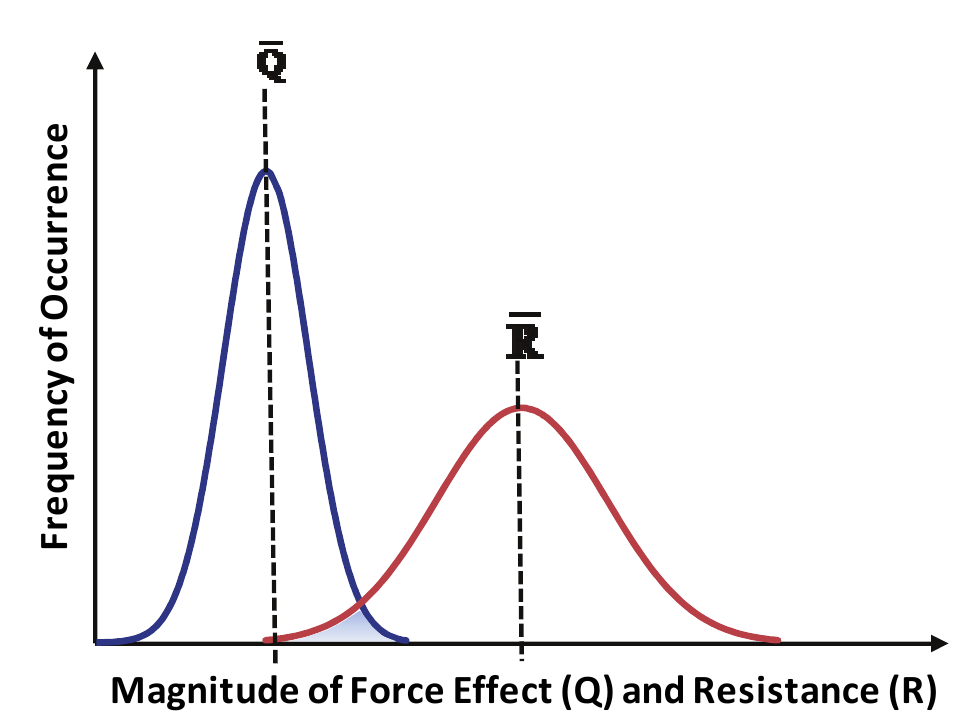
Diagram showing the magnitude of Loads Q and Resistance R vs. How Often a Specific Load or Resistance Might Occur This shows two bell curves (see, I’m already in trouble) of various loads and resistances. The idea is that the ability of a structure to resist loads and stay together/in service is greater than the loads it’s subjected to. Notice two things:
- There is no one load or resistance for a structure. There is a distribution of possible loads, which includes the fact that those loads can vary over time.
- There is always a blue shaded region where the two overlap. That’s the region where the loads can overcome the resistances. There is no way to get rid of this; we can only minimize the region.
The last point is, in the context of our society today, secular blasphemy. Why is this? Because we as Americans have been conditioned to believe that life is supposed to be perfect and without adversity. Failure to achieve this leads to most of the bile we see in the streets and on social media.
Considering the case of COVID-19, although coronaviruses have been with us for a long time, the unique characteristics of this one meant that we went into the pandemic with greater uncertainty. This meant that the “load” bell curve tended to be flatter and broader (if not in reality at least in our perception) than with other diseases. On the other hand those uncertainties extended to the way we resisted the virus, so that curve is flatter and broader too. To put it like the public health officer at our university did, our response was like building the plane while flying it at the same time.
The result of both of these is that the blue shaded overlap region is larger than we’re used to seeing. That meant that bad things happening were inevitable until our knowledge of what we were up against and how we planned to counter this were better known, the curves sharpened (and hopefully further away from each other) and the blue region shrunk. This is not an instantaneous process with any assault like this; it takes time, especially with something that is a moving target (mutations, uncertain interactions with the populations and environment, etc.)
You’d never know that from the rhetoric that comes out of our society. On the one hand we hear that, if we do such and such, the virus will completely go away. On the other we have a prosperity teaching type of denialism which tells us that these adversities are illusory. Neither of these is realistic. We can do things to improve the situation. Sometimes these things are a “breakthrough,” sometimes they are incremental. In football we can either get to the goal with one “Hail Mary” pass or we can grind from one first down to another. Anyone who has watched the game knows that, with well matched teams, the latter is more likely to succeed.
Unrealistic expectations make our society insufferable, and decrease the desire for longer life, which may explain our rising suicide rate. (There is a better way.) They’re also profoundly unscientific, and this reminds us that, in spite of the gaudy rhetoric, those who run our society are profoundly unscientific as well. Our adversaries are better prepared in that regard, which doesn’t bode well for the global conflict that is shaping up.
Unhappily living with that reality is, I suppose, the price for teaching secular blasphemy.

Sailing the Last Voyage with Newton and Pascal
 Positive Infinity