-
Science for all? Maybe not…
The recent bombing (and attempting bombings) by physicians and engineers in the UK may have a greater casualty than just snarled airport security and throwing more people in jail. The fact that most of the current round of bombers are physicians, engineers and others with scientific training should put to rest the secularist lie that, if we just had more science and "reason" in education, we would have a better world.
In celebrating the tenth anniversary of a website for geotechnical engineers, I made the following observation:
Engineers, more than those in the pure sciences, are painfully aware that they and the decision makers for the technology seldom overlap. The responsible use of technology is generally the province of others. Linked to that responsible use is a reasonably rational economic and political system, without which technology doesn’t get put into use well if at all. In other words, really crazy systems tend to get in their own way. Those who want their destiny to be better need to take the proper decisions to make that happen, one way or another.
Let’s take this a step further: science and technology are neutral in that their benefit or harm derives both how they are applied and even how the concepts of "benefit" and "harm" are defined. Ultimately these all must be delineated and executed within some kind of frame of reference. The results you get will depend upon the frame of reference you’re working from.
Many of the terrorists come from scientific and technical backgrounds. Secularists would like us to think that such deep exposure to science–and the underlying logic–would demonstrate to them the "error" of their religious ways. Physicians, for example, just about have to give superficial assent to evolution to get through their course of study, and as we all know evolution is the elixir of knowledge for the secularist. But in the case of these terrorists, things did not go according to the secularists’ plan. Beyond that, their technological studies rendered them more proactive than many of their Islamic forbears, who tended to be fatalistic. That’s a major sea change for Islam; advocates of free will in Islam lost that battle in the early centuries after the Hejira. It’s a change that most in the press have missed.
Let me repeat: how you view science and its application depend upon the frame of reference you approach it from. Last summer I wrote a piece entitled Coming Home from Heathrow, where I compared my own journey with that of another engineering student at about the same time, Osama bin Laden. The training and temptations were very similar, but the outcome was different. It is the choice of everyone trained in the sciences has to make.
-
Who Shall Spread the Good News: As the Rain
 The podcast of Who Shall Spread the Good News? ends this week with the final track, As the Rain.
In the piece The Baptismal Covenant: The Contract on the Episcopalians, we expressed the following sentiment:
…we strongly suspect that the last covenant was strongly inspired by Peter Scholtes’ 1966 song “They’ll Know We Are Christians by Our Love,” which sings of “And we ‘ll guard each man’s dignity and save each man’s pride.” For our part we prefer Roger Smith’s “As the Rain,” which speaks of “Breaking our pride/And making us whole.”)
It has been our pleasure to present these songs to you. The 1960’s and 1970’s posed many problems for the Anglican and Catholic worlds, but this album wasn’t one of them.
-
The Proposed Anglican Covenant: The Club Chimes In
It’s impossible to resist making some comments about Responses Offered by the Executive Board and Clergy and Lay Deputations to General Convention of the Diocese of Southeast Florida to Questions contained in A Short Study Guide to Aid the Episcopal Church in Responding to the Draft Anglican Covenant as Prepared by the Covenant Design Group, both because of its content and certainly where it’s from.
- In one sense, it’s refreshing to see liberals in TEC lay it out so baldly after years of "conversations" and waffling. Perhaps they are emboldened by their new Presiding Bishop, who is capable of this when she thinks the occasion calls for it.
- The statement "Members of The Episcopal Church who supported the consecration of Gene Robinson as Bishop of New Hampshire and advocate for greater inclusion of gay and lesbian persons in the church have adopted these positions as a response to their “faithful, respectful, comprehensive and coherent” handling of Holy Scripture", indicate that the Diocese’s level of Scriptural understanding has not advanced since Bethesda-by-the-Sea’s vestry booted the ladies’ rummage sale from the premises forty years ago.
- As long as the Diocese’s demographics are as they stand, statements such as "Missing from the draft document is any real consideration of the place of “justice” in the life of the Church and how to protect the “marginalized” and “weak” whom Jesus clearly called the church to serve" will ring hollow.
- The statement that the Thirty-Nine Articles "were never authoritative for the Protestant Episcopal Church of the United States" is absurd when one considers that a) they were included in every prayer book the church authorised until 1979 and b) they took the trouble to modify them and make them applicable to the situation the church faced in the U.S. The statement that "Asserting that the member Churches were “led by the Spirit” in developing flawed or false Articles of Religion is a serious problem that reflects a significant theological chasm between the drafters of the Draft Covenant and The Episcopal Church" won’t hold water either, because the Articles were promulgated by the Church of England before there were any member churches. And TEC’s communion with the CoE is something they’re doggedly holding onto, for both legal and other reasons.
The report ends up by recommending "…that no body or governing structure of The Episcopal Church be party to this Covenant, or accept or sign the current Draft Anglican Covenant." This is unsurprising; however, conservatives should look at this with caution. The problem with centralising structures is that their integrity largely depends upon those at the top. The whole history of TEC over the last half century has been one where those at the higher level of the denomination have gained control of its structure and propagated their idea over the organisation. As things stand now, the Covenant would shift the authority in the Communion to the Third World provinces, an improvement over the present state. But if this were to ever change, we would be worse off than we are now. The report states that "…the order of the Communion is in many ways only “apparent” and is, in any event, already ruptured." It would serve the long-term integrity of the conservatives better to formalise this event rather than try to repair it with a covenant.
-
Ten Years of a Companion Site: vulcanhammer.net
Ten years ago today, I went online, logged onto my new GeoCities site, and uploaded the first page and images of “The Wave Equation Page for Piling,” my first website. That website—which is still a part of the companion site vulcanhammer.net—was the beginning of a long odyssey which led to the site as it is today.
The original purpose of the site was to present a broader view of the whole subject of the wave equation as it is applied to piling, a view that was inspired in part by two decades in the pile driving equipment industry and in part by the recently completed thesis Closed Form Solution of the Wave Equation for Piles. There were other personal factors as well. Eight months before, our family had let go of Vulcan Iron Works after 144 years of ownership. The future in the deep foundations industry looked problematic; the website was one attempt to remedy that.
Having a site on pre-Yahoo GeoCities was an interesting experience. GeoCities was divided into communities with community leaders. The sites were free but ads were inserted which usually had nothing to do with the content of the site. GeoCities could be slow too; one community leader likened a T1 connection in those days to be like driving a Formula One racer on a Los Angeles freeway at 1600. The site did well in spite of its clumsy URL; the community didn’t do much for it but it didn’t hurt either, and there were other geotechnical sites out there too. Some of the earliest articles are still with us, such as A Short History of the Wave Equation for Piles and Efficiency and Energy Transfer in Pile Driving Systems.
Although the wave equation is what got things started, two additional factors led to the growth of the site.
The first was Vulcan’s complete lack of web presence, even to them allowing the vulcanhammer.com domain name to lapse in January 2000. Even before that, in May 1998 I began to offer some materials related to Vulcan on the site such as field service manuals and the Offshore Tips. The construction industry was slow in warming up to the Internet, but the potential of having product information online was irresistible even in the late 1990’s. Picking up the domain name drove moving the site to paid hosting, which helped the site’s visibility (and definitely its speed!) greatly.
The second factor was the addition of downloadable geotechnical documents to the site. These in turn were an outgrowth of the free computer software offered such as WEAP87, MICROWAVE and SPILE. No change wrought such an instant upsurge in traffic as the addition of such documents as NAVFAC DM 7.1 and 7.2 and other similar materials. In many ways this formed the long-term vision for the site as a place where engineers, students and others could freely access such information without having to spend money for it (except to print it out!) They transformed the site from an overspecialised spot on the web to a regular stop for those both in research and in the field.
The new decade saw a steady stream of new documents and other pieces of information, recitation of which would be a long business. Some of the highlights are as follows:
- Use of the site for the geotechnical courses I taught at the University of Tennessee at Chattanooga in 2001, 2002 and 2005 led to the creation of an entire section of the site to hold the course materials, accessible to students and teachers alike around the world. Both the use of PowerPoint and posting them on the Internet were pioneering in 2001.
- Acquisition of the vulcanhammer.com domain name by IHC/Vulcan Foundation Equipment in 2001 made vulcanhammer.net the main domain name for the site.
- Vulcan related items have been added on a regular basis. They include Vulcan: The Offshore Experience in 2003, The First Hundred Years in 2004, and many other articles on the subject. They led in part to the 2006 appearance on The History Channel.
- This year documents have been added that weren’t in data format previously, such as Lysmer’s classic dissertation on soil dynamics and Soviet documents such as Vibro-Engineering and the Technology of Piling and Boring Work.
And the future? If we think about how much the world has changed in the last decade, we understand how difficult it is to predict what might happen next. The first purpose of vulcanhammer.net is to provide free information on geotechnical and marine engineering, and as long as Divine providence will allow it, it will be done.
Without a doubt the greatest jolt in the road in the last ten years has been 11 September 2001 and the events that have followed it. When the geotechnical documents first went up, the idea was to provide free information so that those who could not afford it—students, engineers in Third World countries whose company/agency could not afford it (or those elsewhere whose employers were too cheap!) and the like could have access to important information necessary in the construction of civil works of all kinds. No field of human endeavour has brought more benefit to daily life and human health at less cost than civil engineering and the water, sewer and transportation systems that have followed. A world where everyone has a reasonable chance is one where this knowledge is widely disseminated and used, and experience at Vulcan demonstrated that the best way to accomplish this was to put the necessary tools in the hands of those who would benefit the most.
The combination of the continuing inequity of the various parts of our world suggests that the need for vulcanhammer.net. But there are those on its “home front” that might take exception to such things being so freely available. The course of the war in Iraq and Afghanistan provides a good example. We know that the information is used by the U.S. military (they put most of it out to start with,) sometimes from the site. We also know that many in the surrounding countries visit the site. Is this dangerous? Geotechnical engineering, while employing many computerised advantages today, is not considered “high tech.” But no structure on earth can be built without a foundation.
Experience in the engineering profession teaches that knowledge cannot be kept locked up indefinitely. The geotechnical and marine engineering communities, while relatively small, are worldwide and diverse. Engineers, more than those in the pure sciences, are painfully aware that they and the decision makers for the technology seldom overlap. The responsible use of technology is generally the province of others. Linked to that responsible use is a reasonably rational economic and political system, without which technology doesn’t get put into use well if at all. In other words, really crazy systems tend to get in their own way. Those who want their destiny to be better need to take the proper decisions to make that happen, one way or another.
And that leads to the last point. We mentioned that vulcanhammer.net continues by “Divine providence.” There are those who would brutally separate the scientific from the spiritual to the end that the latter would wither away. But there are many people of faith who visit vulcanhammer.net as well: Christians, Buddhists, Muslims, Hindus and many others, and that faith animates their lives and their work. The spiritual will not wither away any more than the state withered away under Marxism.
Although there are many of what we call “general humanitarians,” as mentioned elsewhere vulcanhammer.net is ultimately a Christian endeavour, driven by the belief that humans are created in God’s image and likeness with the dignity and potential the goes with it. If the information here goes to those who don’t share this conviction, so be it. Secularists want to construct a society based on purely “scientific” considerations, but there’s nothing scientific about wanting to redress the inequities in our world, or even wanting to improve it. Some environmentalists have been telling us for many years that there are too many of us here, but problems are made to be solved, and solving them constructively is always the best. Whether you agree with these ideas or not, without an external impulse there would have never been a vulcanhammer.net.
So we thank you for visiting our site, for supporting us by your encouragement and visiting our advertisers from time to time, and don’t forget to come back and visit again.
-
A Tale of Two Iraqs
While doing research on other matters, I stumbled upon the following map, which dates just before World War I:
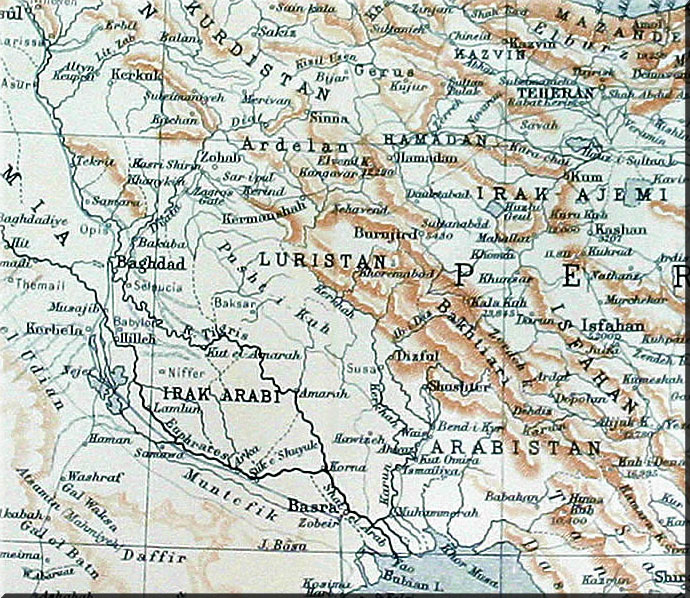
On the left, where one would expect it, is “Irak [sic] Arabi,” between the Tigris and Euphrates Rivers. But, if you look to the left, south of Teheran, you will see “Irak Ajemi” right in the centre of modern Iran. In the middle is Arabistan, the Arab region of Iran the British have been trying to destabilise. So what gives? Even in those times, the two Iraqs were parts of different nations, Arabi under the Ottoman Turks and Ajemi in Persia. The one thing the two places have in common are the holy Shi’ite cities in or around them: Arabi has Najaf, Samarra and Karbela (Karbala) and Ajemi Kum (Qom.)The purpose of showing this map is to illustrate the basic truth about modern Iraq: it is an artificial creation, one concocted by the British after World War I. With the Sunni and Shi’ite Arabs, the Kurds, the Assyrians and all of the other groups, real nationhood as understood in the West is, to misuse a good Muslim term, a mirage. Only when a strong man is in charge is Iraq able to really hold together. That’s why the Iraqi government has found itself unable to get a grip on things: its people think in terms of tribe and sect first, nation far down the list.
Until our people in Washington themselves get a grip on this, the efforts of our valiant troops in Iraq will not have, to put it mildly, found their highest and best use.
-
Who Shall Spread the Good News: Lamb of God
We end the portion of the album taken from the Mass with the Lamb of God.When in college, I made the girls giggle by showing that the folk version we used could be sung as easily in Latin as it could English. It’s somewhat trickier with this rendition. So be forewarned.
Sailing the Last Voyage with Newton and Pascal
 Positive Infinity