-
Conflict Resolution, Then and Now: the Indian River School District Decision
I have to confess that I was a little "buffaloed" by the story of the school district in Delaware which (mercifully) came to a settlement in litigation concerning religious expression in schools.
One line, however, caught my special attention:
Mrs. Dobrich’s decision to leave her hometown and seek legal help was made after a school board meeting in August 2004 on the prayer issue. Hundreds showed up to protest her position.
Her son, Alex, then 11, had written a short statement that said in part: “I feel bad when kids in my class call me ‘Jew boy.’ I do not want to move away from the house I have lived in forever.”
Contrast this with the following (from my 2005 piece Join the Club (Maybe Not!):
All through my years in school in South Florida, Jewish and Gentile kids were together. I had many Jewish friends and classmates. Sometimes things didn’t go according to plan. My brother made the mistake of calling a Jewish classmate a "Jew boy," and same son of Abraham, Isaac and Jacob responded by fracturing his jaw. (That’s one way to deal with anti-Semitism!)
Needless to say, my brother’s Jewish friend had no thought of leaving Palm Beach!
-
Starbucks’ Transformation and Leonard Sweet
One of the objectives of many "post-modern" Christian authors is to faithfully echo the style (if not the message) of our culture. But, even though I read and reviewed Leonard Sweet’s book The Gospel According to Starbucks, I never appreciated how successful he was in doing that until I saw Starbucks’ Chairman Howard Schultz’ address to his baristas in anticipation of their brief shutdown yesterday evening:
Aged Sumatra … that’s what I’m drinking as I write you this note. Hands down, it’s my favorite coffee. Aged for three to five years in a warehouse in Singapore, then shipped as green coffee to our plant in Kent, Washington, and roasted to perfection. The result is a stunning cup of coffee. The velvety mouthful, the full-body of one of our classic Indonesian coffees, and the subtle but ever-present earthiness and spiciness brought to life by our proprietary aging process. It’s rare, it’s exotic, and it’s ours. What a gift … and we get to share it with one another and with our customers…
As Starbucks partners, we are bound together by the passion we have for our coffee and the customer experience. More than 170,000 of us stand for quality and an uncompromising ethical standard. We uphold our guiding principles by demonstrating respect and dignity for one another, and for our customers.
Sweet replicates this kind of "upward" prose throughout his book. But there are a few points that need to be made.
- Schultz has just resumed his post as CEO to help turn things around. For Christians, our CEO hasn’t changed. And, like Schultz, he expects excellence in what we do.
- Schultz also says that "We are the third place in the lives of millions of our customers." Our CEO wants the experience people have in our churches to transform them and make him first place in life. (The key to that, BTW, is that that experience needs to come from the CEO and not from somewhere else!)
- Sumatra is my favourite blend too, but don’t forget to pray for the Christians and Muslims that live there. Some of them have to harvest the beans!
- From a practical standpoint, the best news is that Starbucks will restore free wifi, so I can do things like this while enjoying their coffee.
Sweet’s response to this was as follows:Thx! for the link. I think the church ought to consider doing the same: shut down the building/campus for 3 weeks or 3 months or even 3 years to reboot . . . to rededicate ourselves to our lost first love, and to retrain ourselves in the "love, passion and commitment" (in Howard Schultz’s words) to the Christ experience (not the "Starbucks Experience")…
I’m tired of "leadership seminars" . . it’s time for "followership seminars;" it’s time for the lost art of discipleship.
Yes indeed!
-
A Lift From the East
Every time I get discouraged at the way U.S. Evangelicals operate, it’s good to see some sense coming from somewhere else, as is the case with Sunny Lee’s article about the North Korean commando turned South Korean pastor Kim Shin-jo:
Kim believes that foreign aid to North Korea has its limitations and that true change should come from inside. For example, he suggested that North Korea send talented people to the South to receive education and then return to improve North Korea’s society. Kim said the North should even consider sending young people to study in the US. "China did it, too," he said.
Kim said some day he wants to visit his hometown in North Korea. "If you leave your home in the morning it’s a very human feeling to go back home at night. I’ve been living my life with a deep guilt for my family and relatives," the soft-spoken Kim said.
Yet Kim believes that having too much expectation can drain one’s emotion and that it may take some time for his wish to come true. "I see the possibility. It will come some day. Jesus taught us to be patient."
His testimony’s powerful, too: he was sent from North Korea as part of a plot to assasinate then South Korean President Park Chung-hee. But you’ll have to read for yourself how he became a Christian and a pastor.
-
The Explosive Subject of Laptop Batteries on Airplanes
Mike Elgan wonders if the next ban on things taken on a commercial flight are batteries in laptops:
Laptops are the best thing that ever happened to airline travel. They enable you to catch up on your work, play games or watch a movie while you are traveling.
Better still, many airlines are now installing costly equipment that enables you to access the Internet during flights. Most of these systems use your laptop’s built-in Wi-Fi to connect.
Unfortunately, this laptops-in-the-sky nirvana probably won’t last. The problem: Laptop batteries can explode catastrophically. It’s happened before, and it will happen again. It’s only a matter of time before it happens in-flight.
The FAA forbids you to use your iPod during takeoff — do you think it won’t ban laptop batteries?
Another reason to drive, if you can…
-
A Serious Change of View
Joyce Reingold’s piece on the Everglades Club employee who is suing for discrimination that led to rape brings to mind what is, for me, one of the biggest changes I have experienced from growing up at a church like Bethesda-by-the-Sea to the one I work for: one’s relationship with minorities, some of which work at places like the Everglades Club.
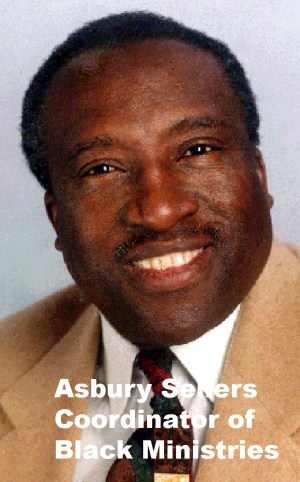
In my early years of working for the Church of God, I got to know the Executive Director of Church of God Black Ministries, Asbury Sellers (photo at right.) When I tell people I grew up in Palm Beach, most let it pass. Not Bishop Sellers. He quizzed me down extensively on where exactly in Palm Beach I had lived. I ended up giving him driving directions to the place, at which point he was satisfied I wasn’t a poser. How could he do this? He had been a pastor at one of our churches across the lake, and doubtless some of his church members worked on the island.
Many of our churches in South Florida are black churches, be they African-American, Haitian, West Indian, or what not. We also have a rapidly growing (approx. 20% of our local churches) group of Hispanic churches. We serve these people through conferences (my superior was in North Miami last weekend to speak at a men’s conference at a West Indian church,) support for their men’s and evangelistic ministries, and product sales. They are our brothers and sisters, and they’re great people (take a look at this posting from a recent leader’s conference in Orlando to see the composition of a Church of God delegation.)
When you are put in a position where you deal with such a diverse group of people as equals, your whole perspective changes. It’s put me in a position of dealing with people whom I would have never rubbed shoulders with had I stuck with the social circle I was raised in. But I’m certainly the better for it, and have had a lot of fun in the process.
I’m adding Joyce Reingold’s blog–PB Upd8–to my blogroll. It will give you a unique perspective of what’s going on in a place like Palm Beach.
-
There’s a Reason Obama Didn’t Pledge the Flag

The following photo has been making the rounds on the Internet:
Now Spengler offers a plausible explanation why this is so:
Barack Obama is a clever fellow who imbibed hatred of America with his mother’s milk, but worked his way up the elite ladder of education and career. He shares the resentment of Muslims against the encroachment of American culture, although not their religion. He has the empathetic skill set of an anthropologist who lives with his subjects, learns their language, and elicits their hopes and fears while remaining at emotional distance. That is, he is the political equivalent of a sociopath. The difference is that he is practicing not on a primitive tribe but on the population of the United States.
To which I’d like to add one thing more.
One of the lessons of growing up in Palm Beach is that American elites look at our country in an entirely different way from the rest of the population. Their idea of patriotism is based on what the country can do for them. Public schools talk about training leaders; elite ones merge the concept of “public service” with serving the interests of the elites. Elites despise America’s populism because it energises the population, which in turn forces the elites to share power. This explains Obama’s appeal to the upper reaches of our society and of his own party.
Hillary Clinton is little better in her attitude but she is a true product of this system, so her message resonates with more “traditional” constituencies (read: older ones.)
I’ve never cared for the choices the Democrats put forth, but this time they’ve outdone themselves.
-
A Relevant Feast: St. Matthias
Although the main celebration today is the Third Sunday in Lent, it’s also the Feast of St. Matthias, the apostle chosen to replace Judas. The Collect for the feast is especially relevant in view of the current state of the Anglican Communion:
Almighty God, who into the place of the traitor Judas didst choose thy faithful servant Matthias to be of the number of the twelve Apostles; Grant that thy Church, being alway preserved from false Apostles, may be ordered and guided by faithful and true pastors; through Jesus Christ our Lord. Amen.
The story of Matthias’ election is as follows:
About this time, at a meeting of the Brethren, when there were about a hundred and twenty present, Peter rose to speak. "Brothers," he said, "it was necessary that the prediction of Scripture should be fulfilled, which the Holy Spirit made by the lips of David about Judas, who acted as guide to the men that arrested Jesus, For he was one of our number and had his part allotted him in this work of ours." (This man had bought a piece of land with the price of his treachery; and, falling heavily, his body had burst open, and all his bowels protruded. This became known to every one living in Jerusalem, so that the field came to be called, in their language, ‘Akeldama,’ which means the ‘Field of Blood.’) "For in the Book of Psalms," Peter continued, "it is said– ‘Let his dwelling become desolate, and let no one live in it’; and also–‘His office let another take.’ Therefore, from among the men who have been with us all the time that Jesus, our Master, went in and out among us– From his baptism by John down to that day on which he was taken from us–some one must be found to join us as a witness of his resurrection." So they put forward two men, Joseph called Barsabas, whose other name was Justus, and Matthias; And they offered this prayer–"O Lord, who reads all hearts, show which of these two men you have chosen To take the place in this apostolic work, which Judas has abandoned, to go to his proper place." Then they drew lots between them; and, the lot having fallen on Matthias, he was added to the number of the eleven Apostles. (Acts 1:15-26)
Sailing the Last Voyage with Newton and Pascal
 Positive Infinity