-
The Fathers of the Church Come to a Pentecostal University
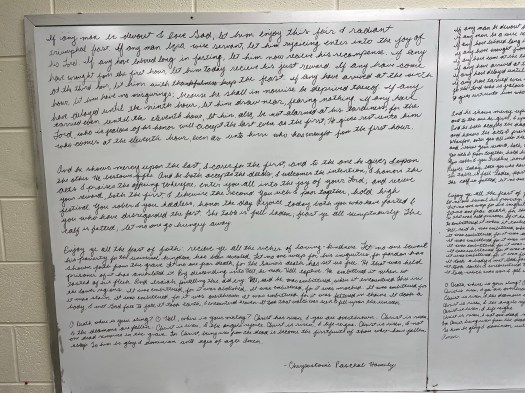
As some of you know, I teach at Lee University in their new Engineering program. Recently I reserved a computer lab to administer a test, and was regaled with the above, from St. John Chrystostom’s Pascal Homily. It was written on the white board (the students were amazed it was in cursive, I guess I should have been, too.) This, mind you, was in the Science and Math Complex.
It’s not every day that a Pentecostal university such as Lee gets to look at one of the Fathers of the Church, but here we are. It’s not a singular event either: Lee gives out student awards, and one of the nominees last year had in her cv the fact that she had translated a work of Lucifer of Cagliari, a name I hadn’t heard in years (yes, I had heard of him through my studies of Jerome, the patron saint of social media.)
Long time readers of this blog know that I am a supporter of Patristic studies and even of the Patristic hermeneutic of the Scriptures. Even without that, it’s becoming evident to more Evangelicals and Evangelical-adjacents that the Patristic witness is crucial to demonstrating the continuity of the faith from New Testament times through the Roman Empire and beyond. The Patristic period, being the closest in time to the New Testament, is a) crucial to understanding what came immediately before and b) does not neatly fit into the various paradigms of Christianity that are competing today.
That last point is the “trout in the milk” for broader acceptance of Patristic studies.
Roman Catholicism, armed as it is with its own concept of being an infallible church lead by an infallible pope, is mostly content these days with relying on these and its own institutional continuity to proclaim its own authority. Its best retort to “we’re trying to get back to a more authentic form of Christianity by going back to the Fathers” is that of Bossuet: where do we draw the line? But as I have observed, “A Roman Catholicism which is more like Bossuet envisions it–conscious of Scripture, independent of the state, Augustinian in theology–would be a better entity to adhere to than the one that he had then and we have now.” That is a way back to a more Patristic view of things.
Reformed types, having turned Augustinianism on its head, have closed the door to the way back and are, as King James’ men would put it, led “…by self-conceited Brethren, who run their own ways, and give liking unto nothing, but what is framed by themselves, and hammered on their anvil…”
The Anglican world has a golden opportunity to step into this void, but is too lost in stuff like this to really take advantage of it.
I’m not sure where the real forward-moving initiative is going to come for this, but I’m grateful to see signs of it at Lee.
-
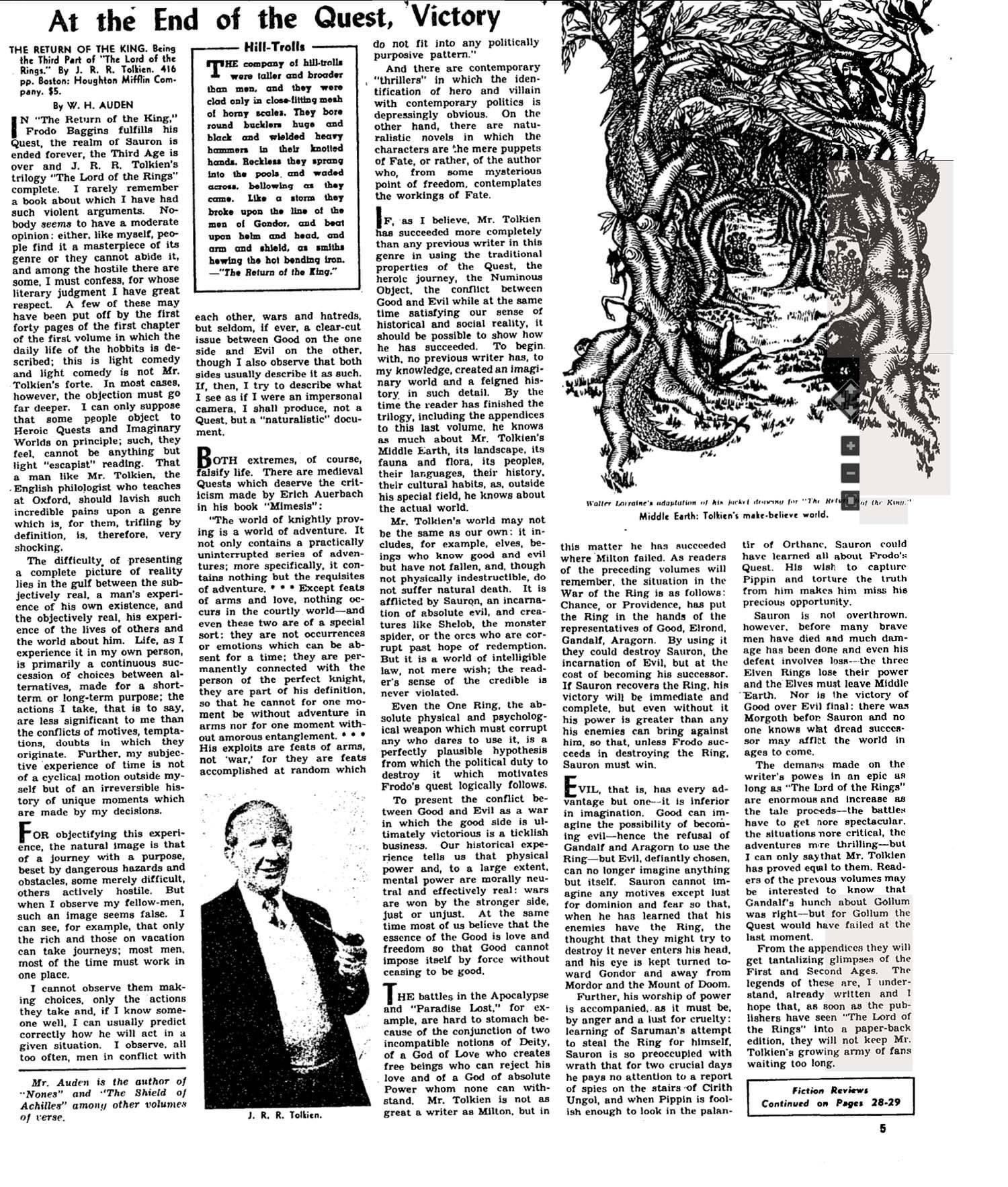
The Africans Take the Communion: At the End of the Quest, Victory
In the absence of such repentance, we have been prayerfully advancing towards a future for faithful Anglicans, where the Bible is restored to the heart of the Communion.
Today, that future has arrived.
Our Gafcon Primates gathered this hour to fulfil our mandate to reform the Anglican Communion, as expressed in the Jerusalem Statement of 2008.
Ever since this site became involved in the “Anglican Revolt” one of the objectives has been to dethrone Canterbury and recentre the Communion where it belongs, primarily with the Africans but also with others. In a sense it’s a fulfilment of posts such as Message of the Africans: It’s Our Communion Now and Forget About the Guilt March. Just Give Them the Communion. Now the old Communion, at once revisionist and colonialist, is done.
With this event those in the ACNA who have, secretly or openly, pined for reunion with Canterbury need to take that off their bucket list and turn to bringing to resolution many of the dissonances that have been resident in the organisation (such as it is) from its inception and even before. May they humbly seek God’s help in making that a reality.
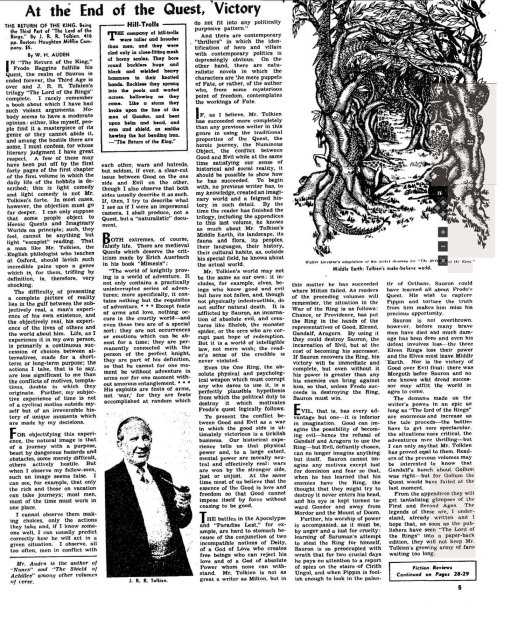
P.S. As far as the title is concerned, see below. I used that phrase when, after five years of tumult, I received my PhD.
-
The Stephen Wood Chaplaincy Case Just Gets Stranger and Stranger
It’s getting downright nasty and legal. ACNA bishops led by Bishop Phil Ashey contend that the charges of misconduct (but not of a sexual nature) laid at the feet of Bishop Derek Jones of the Special Jurisdiction of the Armed Forces and Chaplaincy (SJAFC) are grounds for an inhibition.
The complaints include allegations of ecclesiastical power abuse, wrongful use of disciplinary processes, backdating or fabrication of church documents, interference with external employment opportunities, wrongful release of a priest from orders, and infliction of financial, emotional, and psychological stress upon persons in Jones’ care.
As someone who has worked for a denominational chaplains’ accrediting agency (the Church of God Chaplain’s Commission) in a denomination which, like the ACNA (supposedly,) has a centralised episcopal government, this whole thing is bizzare. (I also am on a board which oversees the COGCC.)
The purpose of accrediting agencies like the SJAFC and the COGCC is to give denominational accreditation to chaplains who then serve in institutions. The principal institution for our Commission is the military, but it also applies to prisons, hospitals and other institutions as well. These institutions need to know that the person being recommended by the denomination has valid ministerial credentials, the requisite education and is of good quality (and in our case that means men and women, because most institutions these days will accept either.) The key here is “denominational:” these chaplains represent their denomination to the institution, not a rogue agency that one day had affiliation but the next didn’t.
If the Executive Director of the COGCC would, by some process, try to do the same thing as Derek Jones is, I have no doubt that either the Divisional Director (our church departments are in divisions,) the Executive Committee or both would fire him and find another to take his place. I am happy to report that both of the Executive Directors I have known (both military men) loved their church more and had more respect for those over them in the Lord than to try something like that.
Additionally, full-time chaplains are required to regularly report to the Commission on their activity and to contribute a “fair share” contribution to the Commission, which includes ongoing education and training activities. The Church of God is very strong that the tithe goes to the local church.
Unfortunately this situation has arisen because of two things, one which antedates the ACNA and the other a by-product of the ACNA’s own “loosey-goosey” structure.
The first is the Egos Inflatable to Any Size phenomenon which seems to ooze out of the purple shirts and mitres which Anglican bishops wear. This has been a plague on the “Anglican Revolt” since the days of AMiA Bishop Chuck Murphy’s Moment of Truth and TAC Archbishop John Hepworth’s Tough Trip to the Bottom and before that in the Continuing movement.
The second is the ACNA’s aforementioned “loosey-goosey” structure, which like Sun Yat-Sen’s characterisation of post-Ching dynasty China is a “sheet of loose sand.” Sheets of loose sand, as pointed out in my book Soils in Construction, have no strength. Most of the energy around this problem is focused on WO (which is misplaced,) but this fiasco exposes the weakness of the ACNA’s basic structure. The accrediting agency for the denomination should have been under the control of the Archbishop, but like every other diocese it is not. Jones claims that the SJAFC has a special status based on its initial formation; if he is right, that was a mistake.
I am worried about the future course of the ACNA, an institution that I lauded when it was launched (although I was aware of the “unresolved problems segment” as Bill O’Reilly would say.) Caught between its loose structure and the rise of Gothardian “little Caesars,” it’s turning into a rough ride that will eventually manifest itself down the line.
-
Just a Reminder: The Men Kicked Off Apostasy
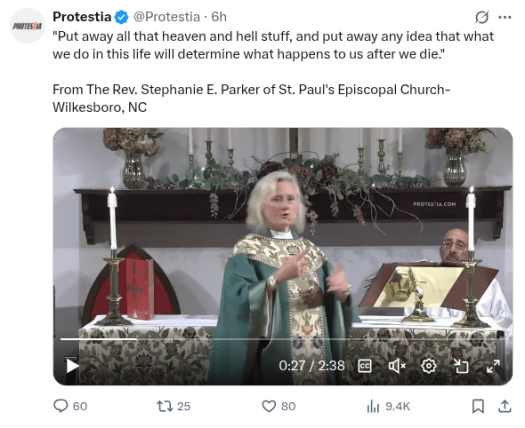
There’s been quite a lot of pushback to the election (?) of Sarah Mullally as Archbishop of Canterbury, much of which concentrates of the fact that she’s a woman (at least that’s defined, no mean feat these days) and this breaks with the rest of the Anglican Communion, with Rome, with Constantinople, Moscow, and many other sees.
With this I saw the above on X, complete with heretical statements by one Stephanie Parker, Rector of St. Paul’s Episcopal Church in Wilkesboro, NC. As can be expected, there are those who attribute this sorry denial of eternal life to the fact that she’s a woman.
One point I’d like to make before I go passing on is that the apostasy that has overwhelmed much of the Anglican/Episcopal world started long before the Episcopalians, followed by the Church of England and other provinces, started ordaining women to the priesthood (such as it is) and episcopacy. Exhibit A of this is John Shelby Spong, that pseudosophisticate who denied just about everything basic in Christianity. It was for that reason that very early in the history of this site I posted When Church Becomes Pointless, and later with other posts which I link to in John Shelby Spong Goes to Meet God.
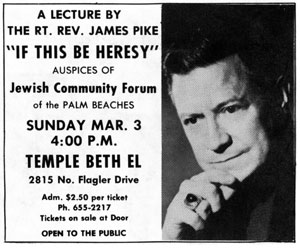
There are others of his ilk (like James Pike and Paul Moore) who propagated much the same kind of thing. (One thing about all of these men is that the Episcopal church awarded them for their unbelief by making them bishops.) Many of these, however, came before there were women in the Episcopal pulpits and cathedral thrones.
That leads to an observation I made before and hope to live long enough to make again: the Anglican/Episcopal world spends too much time fighting over secondary issues rather than tackling the primary ones. The classic example of this was the fight over the 1928 Book of Common Prayer; everyone was up in arms over the changes in the wording and not the doctrinal shifts (such as The Baptismal Covenant: The Contract on the Episcopalians) that ended up being embodied in the dreadful 1979 book. It took the ordination of V. Gene Robinson to finally drive the point home that something was really, badly wrong with the whole Episcopal paradigm (the loss of a large chunk of the membership in the 1960’s and 1970’s didn’t accomplish that either.) Ultimately a church is defined by two very important things:
- What it, to paraphrase Origen, “believes and is convinced” is true.
- How it sees itself relative to God and its laity, or to use the fancy term its ecclesiology.
Everything else stems from both of these. The Prayer Book is an important witness to these but before Cranmer put to pen the words that are still fought over those two things were behind those words.
The problem with so many divines (or anti-divines) in the Anglican/Episcopal world is that the way they look at things is so secular that they import that mentality into their ministry, such as it is. In the case of the women that means feminism, which is not univocal. That last adds confusion to non-Christian thinking. This doesn’t have to be the case, but again many of the men that came before them had the same problem (and many of those still with us carry on the tradition.)
A great driver of all of this I dealt with in Squaring the Circle of Anglican/Episcopal Ministry: the elevated demographics of the parishioners. Now lowering the average AGI of the congregations won’t solve this problem, but it makes it much easier to deal with. The situation the Anglican/Episcopal world in general and the ACNA in particular is unenviable, but until the problems are recognised the solutions will be elusive.
-
The Missing Lesson in “The Drama of Confession”
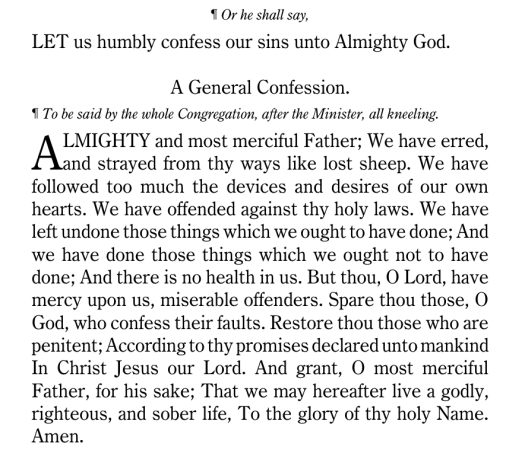
In a recent post by the North American Anglican entitled “The Drama of Confession,” the author goes into a long Anglican description of the importance and benefits of confession, with emphasis (justified) on the Anglican “general confessions” that we see in traditional Anglican prayer books. For all of the detail he goes into, he misses an important point: that the existence of these confessions undermine the whole idea of unconditional perseverance, be it Reformed or Baptistic.
I am in a Bible study class lead by Dr. R. Lamar Vest, former President of the American Bible Society in addition to being former Presiding Bishop of the Church of God and former President of (then) Lee College (now University.) Last night’s session was about the importance of confession, this in a church which, being in the Wesleyan tradition, generally denies unconditional eternal security.
Unfortunately the adoption of basic Baptistic worship structure (if not rigid adherence to same) doesn’t include a mandatory time of confession and repentance of sin. Being a product of Bethesda-by-the-Sea Episcopal Church and remembering What I Learned About Approaching God From the 1928 Book of Common Prayer, I had to say something. So I started by pointing out that, for our Morning Prayer service (Evening Prayer and the Holy Communion are the same in this regard) we had a penitential rite; the one I had in mind and outlined is of course the following:
I pointed out (as is my custom) that, back in old Palm Beach, it was fitting that members of our paid youth choir (and I should have included the acolytes in the bargain) characterise themselves as “miserable offenders.”
Years later My Mother the Exvangelical confessed that she really hoped that I would adopt “once saved always saved,” but, to adapt a good hillbilly expression, that was like closing the barn door after the cattle had made their exit.
I think there are two lessons from this adventure in life, worship and doctrine.
The first is that I don’t see how a TULIP Calvinist (and that is the “reference standard” for Calvinism these days, like it or not) can be an Anglican. I don’t see how one can be Pentecostal either but for a different reason: the whole “saved/sanctified/baptised in the Holy Spirit” progression is just that: a progression. So why is progress needed when you get everything at the start? Jettisoning predestination in election doesn’t help (no, Baptists, it doesn’t) and has uninspiring consequences, as I outline in The Baptists, Their Doctrine and Their Nasty Politics.
The second is that, if we confess and receive forgiveness for our sins on an ongoing basis, we won’t need dramatic events to restore our relationship with God either individually or corporately. That doesn’t mean that such Joel-like events aren’t necessary but that necessity is a product of our neglectfulness.
-
It’s Time to “Think Before You Convert” to Catholicism Once Again
It’s been a while since I’ve been actively posting to this site, and in looking at my stats an old favourite page has been active again: Think Before You Convert. It’s an overview of why you should (or shouldn’t) convert to Roman Catholicism or, if you’re there why you might want to take your leave. As someone who has done both in his lifetime, I’ve always thought this was an important topic; evidently others think so now.
There’s been a lot of speculation as to whether Charlie Kirk was moving towards a Tiber swim, but let’s start with a more relevant example: JD Vance, our current Vice President. I’d like to make a challenge to our ministers in the Church of God, whose core ethnic group is Scots-Irish and which has deep roots in the hills (and mountains) of Virginia, West Virginia, Kentucky and Ohio, where Vance is from. Would one of you like to explain why Vance, a natural for our church and with all of the gifts and anointing that it claims, abandoned that path for Rome?
I can’t answer that for Vance, but I can answer that for myself. My last year in prep school I drove past an Assemblies of God church in Delray Beach every day going to school. At the time I never gave a thought to any Pentecostal or Evangelical church; I had started visiting St. Edward’s (where Jack Kennedy went to Mass when he was in Palm Beach) and continued that when moving to Boynton Beach, a saga I detail in Called Out of the Pews: An Experiential Reflection on the Role of the Laity.
To cut to the chase, Roman Catholicism was better at answering one question that Evangelical and Pentecostal (and really the Episcopal Church) churches were loathe to answer: why?
Most people go through life focused on their own needs and situations, many of which bounce up and down from one week to the next. They don’t see themselves as part of a greater whole, which is one reason why they don’t make an impact on the greater whole. Evangelical and Pentecostal churches have made a career–and a successful one at that–appealing to people of this idea. They’ve been criticised for only furnishing “fire insurance” in eternity, but given the eternal consequences of crossing over without it, it’s a valuable thing to have. In some ways these churches have gotten off track with things like prosperity teaching and its cousin the obsessive search for respectability, but that’s another post.
For others whose interests take them beyond themselves, sooner or later that kind of focus doesn’t cut it. So I swam the Tiber my senior year in prep school. Starting with Dante’s Divine Comedy (Inferno, Purgatorio and Paradiso) many of the “why” questions were answered in a way that made sense and had rooting in history. Many criticised me (especially Episcopalians) at the time because they said that I wasn’t “allowed to think” as a Catholic, but that didn’t make sense with the fire hose of St. Augustine’s City of God and later Aquinas’ Disputed Questions on Truth and the Summa. Besides, authoritarian institutions had been a familiar part of my landscape; I knew how to deal with them.
The big difference between what I see today and what I experienced a half century ago is that today the emphasis is more heavily on authority now than it was then. That’s not just a Catholic thing, that’s across the board in Christianity. It seems that everyone is obsessed in one way or another with human authority–even the Baptists, who upended the whole concept of institutional authority in the church. That’s the leitmotif of the Trads, who are caught between their idea of what is really Catholic and the Church’s insistence on papal infallibility (as opposed to that of the Church at large) when we have Occupants like Francis. I think this is unfortunate because Catholicism does have definite (if sometimes hard to figure out) answers but also has a rationale behind them.
Ultimately however Catholicism’s biggest problem isn’t their theology but their ecclesiology. Their idea is that they are an active intermediary between man and God, and that leads both to their willingness to exercise authority when it suits them and complacency the rest of the time. That became evident in the early years of John Paul II, when we saw things like David Peterman and the Hard Choices of the Catholic Charismatic Renewal and what I went through in an area where the Catholic churches were more concerned with their image than to help fulfil the spiritual needs of their flock. At that point I took my leave and passed into a world with problems of its own but also with the freedom to interact with God in a way that my years as a Catholic had presented to me.
Today we hear of a renewed interest in Roman Catholicism. Unless they solve the core problem of their lackluster pastoral system (a product of the aforementioned ecclesiology) they’re going to continue to experience what we call a “back door” problem, i.e., people leaving the Church in substantial numbers. But their strength in attracting people who are more interested in “fire insurance” or simply prosperity in this life will continue.
And as for the rest of us? Unfortunately our ministers are content with the big crowds (and the revenue stream that comes with them) and are blind to the limitations they have set upon themselves. Some of them think that they can take society through a populist, revivalistic method, but they will never attract and keep the people who can meaningfully interact with the top of society. And they cannot replicate one of Catholicism’s biggest advantages in this country–the ability to put together a church with a broad socio-economic spectrum–or even consider that some groups need a different methodology.
The one group which could actually change things are the Anglicans. They, however, from left to right are too bogged down in their own stuff to make a reasonable shot at it, and they are plagued with the opposite problem of the Evangelicals–they cannot figure out how to attract the lower end of the socio-economic scale, with the perils of top-heaviness that come with that.
So here we are. One of the lessons of the Vietnam War was that the American soldier, no matter how valiant he was, could only control the ground he stood on. That’s true of all of us really, which means that the choice of church is personal first and broader after that. It means that, before all else, you need to Think Before You Convert.

Sailing the Last Voyage with Newton and Pascal
 Positive Infinity