-
So Why, Gene Robinsion, Are You a Bishop?
“Let’s be honest, most of the discrimination … has come at the hands of religious people, and the greatest single hindrance to the achievement of full civil rights for gay, lesbian, bisexual, and transgendered people can be laid at the doorstep of the three Abrahamic faiths: Christianity, Judaism and Islam,” Robinson said in Atlanta at Emory University’s Center for the Study of Law and Religion.
But he has no solution. Or, more precisely, he isn’t a part of the solution.
If he really believes this, he should be a pagan, or an atheist or something–anything, but a bishop in a church that represents itself as Christian.
That’s what’s always bothered me about people like Gene Robinson. He rejects many basic tenets of Christianity–and in some ways the remark quoted above is an acknowledgement of that rejection–but he still wants to be a part of a church. This has never made sense to me, except perhaps that the pay is good, the work isn’t too hard and, for someone who was raised in this tradition, the surroundings are familiar.
If things keep going in the West the way they are, it won’t be too long before we will be able to say that the greatest hindrance for members of the three Abrahamic faiths to practice their religion in freedom is the LGBT community, but such is the way of revolutions.
-
Cross of Shame
 Today’s Holy Week podcast exploration looks forward to Good Friday. It’s the Kairosingers’ Cross of Shame, from their album Of One Accord.
 -
Lending to the Lord, and Getting Back
In preparation for his “Palm Sunday entry” into Jerusalem, Our Lord did the following:
“When they had almost reached Jerusalem, as far as Bethphage and Bethany, near the Mount of Olives, Jesus sent on two of his disciples. “Go to the village facing you,” he said; “and, as soon as you get there, you will find a foal tethered, which no one has ever ridden; untie it, and bring it. And, if any one says to you ‘Why are you doing that?’, say ‘The Master wants it, and will be sure to send it back here at once.’”” Mark 11:1-3, TCNT.
In addition to obtaining the foal, God promised to send it back.
God had already heard a demand for return:
“And when she (Hannah) had weaned him, she took him up with her, with three bullocks, and one ephah of flour, and a bottle of wine, and brought him unto the house of the LORD in Shiloh: and the child was young. And they slew a bullock, and brought the child to Eli. And she said, Oh my lord, as thy soul liveth, my lord, I am the woman that stood by thee here, praying unto the LORD. For this child I prayed; and the LORD hath given me my petition which I asked of him: Therefore also I have lent him to the LORD; as long as he liveth he shall be lent to the LORD. And he worshipped the LORD there.” 1 Samuel 1:24-28, KJV.
Hannah had promised that, should she bear a son, same son would be dedicated to God’s service. She came through with her promise with one stipulation: that, once he had fulfilled God’s purpose, that she would get him back. It didn’t matter that it would be in Sheol, she wanted him back.
It’s amusing in a way to think that God, who owns it all, would either make a promise to return something or someone or honour such a request. But he does.
-
Imitation Europeans and Foreign Devils, and From Dreaming About his Father to Repeating his Mistakes
The Elitist Snob discovers that the Europeans aren’t on the same wavelength as he is:
While President Nicolas Sarkozy of France did not repeat an earlier threat to walk out of the conference – “I just got here,” he joked – he made it clear he would reject an agreement that puts off stringent new regulations on banks, tax havens, and hedge funds.
“The decisions need to be taken now, today and tomorrow,” he said. “This has nothing to do with ego. This has nothing to do with temper tantrums. When it comes to historic moments, you can’t circumvent them.”
Mr. Sarkozy added that tougher regulation – he has called for a “global regulator” that would be able to reach inside the borders of the United States and other large nations to deal with international financial firms – is “nonnegotiable.”
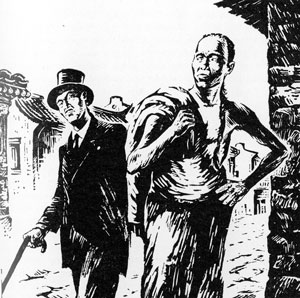 The Chinese author Lu Xun’s greatest work was the short story The True Story of Ah Q (I also got to see the movie when in Hong Kong on my last trip to China.) One of the more memorable characters was the Imitation Foreign Devil, shown at right affecting the Western top hat, coat and cane. He was obviously not to be confused with the real article.
Obama is, along with many other elitist snobs in this society, an Imitation European. He wants to impose a European socialist model on this country, and has the legislative initiatives to prove it. He is prepared not to waste this crisis to make to make that a reality.
Well, the Real Europeans aren’t prepared to waste it either. They want to further their own agenda, which includes a) striking a blow at the tax cheats which are part and parcel with European business and b) getting at the Americans who, in their opinion, have snookered them with what Alan Greenspan famously referred to as “irrational exuberance.”
Unfortunately their agenda is unacceptable to Obama for two reasons. The first is that many of those irrationally exuberant were his major supporters and contributors. They may be having second thoughts about their exuberance for him but he can’t afford to expose them to the tender mercies of the Europeans, just yet. The second is that Americans–even such as Obama–only recognise one form of extraterritoriality: their own. (That will make Obama’s response to Spain’s attempt to arrest Bush officials really interesting.)
Beyond that, Obama is in the process of repeating his father’s mistakes, or at least those of his father’s generation of African leaders. Coming straight out of the chute of colonialism, these leaders (of which Robert Mugabe is the last of the breed) saw a European model of socialism and bureaucratism (I’m not sure that’s a word, but it’s the best I can do) as the model for Africa. Needless to say, it degenerated rapidly, and Africa is only now coming out of that. Barack Obama’s attempt to be an Imitation European will have similar consequences if he pursues it on these shores.

Sailing the Last Voyage with Newton and Pascal
 Positive Infinity