-
A Fistful of Yuan Takes a Step Closer to Reality for Everyone
 In putting together my series on doing business in China in the early 1980’s, I adopted the title A Fistful of Yuan, turning a business tale into a spaghetti Western (or, more properly, an Eastern.)
Well, it looks like the Chinese are working up towards making the yuan a real hard currency, as this indicates:
The Chinese government’s decision this month to let exporters in a small number of cities settle their overseas trade in yuan rather than in US dollars has far-reaching implications, according to economists, even though the immediate impact is minimal.
The trading hubs of Shanghai at the mouth of the Yangtze River and Guangzhou, Shenzhen, Zhuhai and Dongguan in the Pearl River Delta further south can use the yuan in overseas trade settlement, a State Council, or cabinet, meeting chaired by Premier Wen Jiabao said. The two deltas are the base for most of China’s export-oriented industry.
The settlement scheme is voluntary and of benefit to relatively small groups, said Pauline Loong, senior vice president in charge of China policy and risk research at CIMB-GK Securities (HK) Ltd, but “the implication is far-reaching. The scheme extends the use of the Chinese currency outside of the mainland. We see this as the first step on the road to full liberalization of China’s capital account and full convertibility for the renminbi,” one term for the Chinese currency, also known as the yuan.
And so we, in the not too distant future, may need a “fistful of yuan” (or perhaps a few yuan more) to get along.
-
Civil Marriage: Let’s Take This to the Next Level, Gene
Bishop of New Hampshire V. Gene Robinson is at it again:
The first openly gay Episcopal bishop told a Los Angeles gathering yesterday that the church should begin mending divisions over the issue of same-sex marriage by getting out of the civil marriage business altogether.
During a visit to St. Michael and All Angels Church, the Rev. Gene Robinson said he favored the system used in France and other parts of Europe in which civil marriage – performed by government officials – is completely separate from religious vows. In the United States, the civil and religious ceremonies often are combined by the cleric signing the government marriage license.
“In this country, it has become very confusing about where the civil action begins and ends and where the religious action begins and ends, because we have asked clergy to be agents of the state,” said Robinson, bishop of New Hampshire.
I just dealt with this again last week, and my response was and is as follows:
The way out of this is to get ministers away from being agents of the state. Recently a Hispanic colleague in the ministry “serenaded” his wife on Facebook for their 25th anniversary. He’s from Uruguay. They met at summer camp meeting in February (an interesting concept,) and then were married twice: once by the state and once by the church. That’s the way it’s done in much of the world (things get complicated when it’s not done in that order, as Prince Alexander of Belgium found out.)
There are some in the LGBT community who want to do just that in this country, which–following an example that goes back to Calvin’s Geneva–has heretofore preferred to empower ministers to solemnise marriages. But the simpler solution is to get rid of civil marriage altogether.
Let’s take this to the next level, Gene, and stop wasting people’s time in the quest for same sex–or any other–civil marriage.
-
David Martin’s Preface to the New Testament
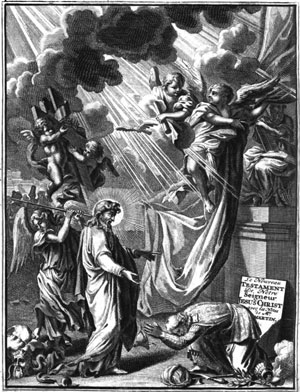 One cannot be happy without knowing God, and one can only know him well by the divine Scriptures.
The world is, in truth, like a great open book where one can see the brilliant handiwork of an infinite power and a wisdom worthy of worship. The heavens declare, said the Prophet King, the glory of God; and the firmament sheweth his handywork. (Psalm 19:1) And St. Paul said to the Romans, For the invisible things of him from the creation of the world are clearly seen, being understood by the things that are made, even his eternal power and Godhead (Romans 1:20). But sinners and criminals that we are, we especially need to know God by means of his mercy; now it is only from himself that we can know him, and to learn with certitude that he, in view of the expiation which was done by his Son Jesus Christ, wants to pardon our sins. The Books of the Old Testament had predicted this happy expiation, and it had long been prefigured in the blood of the victims which were sacrificed by the order of God; but the Books of the New speak to us of an expiation which is a fait-accompli. Isn’t it a consolation to a soul, deeply afflicted by sins, to learn from these divine Scriptures that there is no condemnation to fear when, with a sincere repentance and a faith enlivened by love, that soul has recourse to Jesus Christ and, supported by the intercession and based on the merit of this divine Redeemer, can go with assurance to the throne of grace, to find mercy, and obtain salvation, life and immortality? This great and consoling truth presents itself to us in virtually every page of the Books of the New Testament, but it is never detached from the obligation to love God, and to keep his commandments. Truly one of the most dangerous illusions of self love is to pretend to find salvation in faith in Jesus Christ, and then to proceed as if there is nothing else left to achieve.
From this comes the loosening of morals and a nearly universal negligence of the most essential duties of Christianity, even among the most Orthodox of Christians. One reads the Scriptures to make oneself wise more than to make oneself holy, without realising that only knowledge of Religion is nothing but an amusement of one’s spirit, or a light which is only good for dazzling, and which in dazzling deceives, and leads to going over the cliff of damnation. The person who wants to profit from the reading of this Holy Book reads it to learn how to sanctify oneself by the practice of good works. He takes Jesus Christ as his model as well as Saviour, because he cannot be our Saviour if he is not our model. This is the constant teaching of the Holy Apostles, and Jesus Christ himself often expressed this in the strongest of terms, that it was necessary to renounce the Gospel, and to read it only for one’s own condemnation, unless one was to follow its holy principles, and practice all of its duties. And as many as walk according to this rule, peace be on them, and mercy (Galatians 6:16) of God, Amen.
The preface by the Huguenot pastor David Martin of his translation of the New Testament into French, 1731
-
First the Celebration of Life. Then the Cocktail Party.
 One of the oldest pieces on this site (around ten years, I think) is A State of Being, which concerns the prominent and gracious Palm Beach socialite Helene Tuchbreiter (right.) She and my mother were friends, and they worked together to found Palm Beach’s first (I think) resale shop: the Church Mouse. Helene’s charitable work extended far beyond that: in the four decades she lived in Palm Beach, she raised money for no fewer than eighteen causes.
Shortly after her death in April 1996, my mother received an engraved invitation to her “Celebration of Life” at Bethesda-by-the-Sea Episcopal Church, R.S.V.P. and all. After the service at Bethesda, the following was included:
Cocktail Dansant Reception
five until seven o’clock
The Pavilion at The ColonyThe Colony, one of Palm Beach’s most prominent hotels, was the place where my parents had entertained Prince Alexander of Belgium thirty-one years prior.
It was only fitting.
-
Special to Jethro Tull Fans: When Prayers for Souls in Kentish Town Get Answered
Tull fans may remember this line from A Passion Play:
We pray for souls in Kentish Town.
Evidently someone’s prayers along these lines got answered, as the former well-known sceptic A.N. Wilson attests:
A week ago, there were Palm Sunday processions all over the world. Near my house in North London is a parish with two churches. About 70 or 80 of us gathered at one of these buildings to collect our palms.
We were told by the priest: ‘Where we are standing in Kentish Town does not look much like a Judaean hillside, and the other church to which we are walking does not look much like Jerusalem. But as we go, holding our palms, let us try to imagine the first Palm Sunday.’
And there’s more to this too:
When I took part in the procession last Sunday and heard the Gospel being chanted, I assented to it with complete simplicity.
My own return to faith has surprised no one more than myself. Why did I return to it? Partially, perhaps it is no more than the confidence I have gained with age.
Rather than being cowed by them, I relish the notion that, by asserting a belief in the risen Christ, I am defying all the liberal clever-clogs on the block: cutting-edge novelists such as Martin Amis; foul-mouthed, self-satisfied TV presenters such as Jonathan Ross and Jo Brand; and the smug, tieless architects of so much television output.
But there is more to it than that. My belief has come about in large measure because of the lives and examples of people I have known – not the famous, not saints, but friends and relations who have lived, and faced death, in the light of the Resurrection story, or in the quiet acceptance that they have a future after they die.
From the dark, into ever-day…
-
Institution of the Eucharist
This is Maundy Thursday; our podcast is the institution of the Eucharist (along with the acclamation,) from Roger Smith’s album Who Shall Spread the Good News.

Sailing the Last Voyage with Newton and Pascal
 Positive Infinity