-
Government Policy: Giving Way to Bicycles and Pedestrians, and a Photo of the Future
That’s what our Transportation Secretary said:
Transportation Secretary Ray LaHood has announced a “major policy revision” that aims to give bicycling and walking the same policy and economic consideration as driving.
“Today I want to announce a sea change,” he wrote on his blog last week. “This is the end of favoring motorized transportation at the expense of nonmotorized.”
The new policy, which was introduced a few days after Mr. LaHood gave a well-received speech from atop a table at the National Bike Summit, is said to reflect the Transportation Department’s support for the development of fully integrated transportation networks.
I guess he means this:
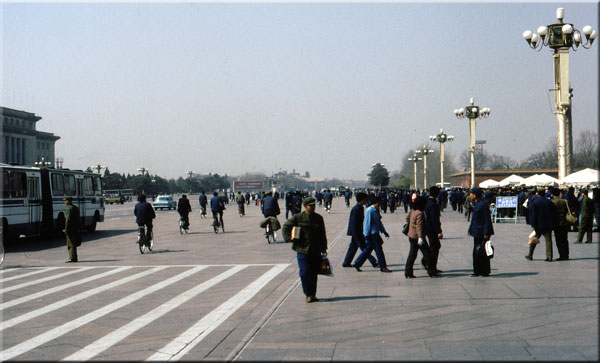
A view looking west on the Changan Avenue with the corner of the Great Hall of the People on the left. Beijing, China, 1981. Taken during the negotiations documented in A Fistful of Yuan.
I’ll also guess that those who oppose it will be labelled “counter-revolutionary double-dealing capitalist roaders,” but the Chinese received us well in those days.
-
The Importance of Causality
In his book Introduction to the Differential Equations of Physics, German physicist Ludwig Hopf opens with the following statement:
Any differential equation expresses a relation between derivatives or between derivatives and given functions of the variables. It thus establishes a relation between the increments of certain quantities and these quantities themselves. This property of a differential equation makes it the natural expression of the principle of causality which is the foundation of exact natural science. the ancient Greeks established laws of nature in which certain relation between numbers (harmony of spheres) or certain shapes of bodies played a privileged role. The law was supposed to state something about a process as a whole, or about the complete shape of a body. In more recent times (Galileo, Newton, etc.) a different concept has been adopted. We do not try to establish a relation between all phases of a process immediately, but only between one phase and the next. A law of this type may express, for example, how a certain state will develop in the immediate future, or it may describe the influence of the state of a certain particle on the particles in the immediate neighbourhood. Thus we have a procedure for the description of a law of nature in terms of small (mathematically speaking, infinitesimal) differences of time and space. The increments with which the law is concerned appear as derivatives, i.e., as the limits of the quotient of the increments of the variables which describe the process over the increment of space or time in wihch this development takes place. A law of nature of this form is the expression of the relation between one state and the neighbouring (in time or space) states and therefore represents a special form of the principle of causality.
The whole issue of causality is an important one for both scientifc and theological reasons, and I want to touch on one of each.
Every event that takes place in the universe is a result of an event before it. Those events in turn are the results of those which have gone before. All of these events form a chain which leads back to the first cause. The need for the first cause is one of St. Thomas Aquinas’ proofs of God’s existence:
The second way is from the nature of the efficient cause. In the world of sense we find there is an order of efficient causes. There is no case known (neither is it, indeed, possible) in which a thing is found to be the efficient cause of itself; for so it would be prior to itself, which is impossible. Now in efficient causes it is not possible to go on to infinity, because in all efficient causes following in order, the first is the cause of the intermediate cause, and the intermediate is the cause of the ultimate cause, whether the intermediate cause be several, or only one. Now to take away the cause is to take away the effect. Therefore, if there be no first cause among efficient causes, there will be no ultimate, nor any intermediate cause. But if in efficient causes it is possible to go on to infinity, there will be no first efficient cause, neither will there be an ultimate effect, nor any intermediate efficient causes; all of which is plainly false. Therefore it is necessary to admit a first efficient cause, to which everyone gives the name of God.
Although, as Hopf points out, our understanding of how that causality actually works in the physical universe is different from the Greeks (and Thomas Aquinas worked in a Greek concept of natural philosophy) the truth of the importance of causality is undiminished.
To determine what comes after is a major reason for differential equations, which contain three elements: the equation itself, the initial conditions and the boundary conditions. Once we have these, we can predict the behaviour of a system. In some cases we can do so with a “simple” equation, others require discretisation and numerical modelling. And that leads to our second point.
It’s interesting that Hopf speaks of “exact natural science.” Today much of science and engineering is driven by probabalistic considerations, which in turn lead to statistical analysis. Probability and statistics is a very useful tool, but not a substitute for the understanding of the actual mechanisms by which things work. The actual mechanisms (physical laws, etc.) are what cause the phenomena which we record as statistics, not the other way around. The fact that there are variations in these should not blind us to the core reality.
The advent of computers with broad-based number crunching abilities has only inflated our overconfidence in such methods. It is essential, however, that we understand the why of phenomena as well as the what. We must both be able to quantify the results and the correct causes of what is going on around us. Two recent debacles illustrate this.
The first is the climate change fiasco we’ve been treated to of late. Removing the dissimulation (as opposed to simulation) of some involved in the science, the core problem is that we do not as of yet have a model of global climate sufficiently comprehensive so that we can dispense with reliance on the statistics and project what will happen with a reasonable degree of confidence. Part of the problem is the core problem in chaos theory: minor variations in initial conditions lead to major variations in the results. But without such a model we are bereft with a definitive “why” as much as “what.”
The second is our financial collapse. The models developed of the elaborate credit structure were fine as far as they went. But ultimately they were divorced from sustainable reality because they did not take in to consideration all of the factors, many of which were obvious to those with raw experience.
The issue of causality is one that is central to our understanding of the universe.
-
Does Education Kill Creativity?
Sir Ken Robinson thinks so, from this TED talk.
This hilarious discourse is all too painfully true, as I have found out in my brief educational career. But the humour he uses kills a lot of the pain.
-
Shaneen Clarke: The Gospel for the Rich and Famous
An extraordinary ministry by someone I had the chance to meet last weekend:
http://downloads.cbn.com/cbnplayer/cbnPlayer.swf?s=/vod/SUS124_ShaneenClarke_060209_WSShaneen attends Holy Trinity Brompton (of Nicky Gumbel and “Alpha” fame) with her husband Martin. She was also influenced by my superior at Laity Ministries, Leonard Albert.
Hopefully, Palm Beach is next…
-
John Shelby Spong, Surrender Monkey
That’s the opinion of Bayard Taylor in The Late Great Ape Debate:
John Shelby Spong, retired Episcopal Bishop of Newark, is a surrender monkey. His “Call for a New Reformation” is really a call to wave the white flag, throw in the towel, and give up on the God revealed in both Jewish and Christian history. We need, he says, a new language for God because “most theological God-talk is meaningless.”
Obviously, the good bishop is excluding his own God-talk from the meaningless category. He apparently wants us to take his God-talk as a beacon shining in the wilderness of Christian darkness.
I’m constantly amazed that a bishop, who took vows to uphold the peace and purity of the church and to proclaim the gospel, could spread such blasphemy and contempt for Christian faith’s core beliefs and not receive some kind of censure or discipline. But there he is today, an ex-bishop in good standing, drawing his pension from a church he tried his best to destroy.
I’d go easier on Spong if he’d had a faith crisis, realised he could no longer affirm the basic biblical worldview and teaching, and then had the honesty and integrity to step down from his position of leadership. But that’s not what he did. Instead, he went on the warpath against anything that smells like traditional Christian faith, and he’s tried to take his whole church down his revisionist road. Christians who disagree with him he attacks as “fundamentalists,” and in his worldview, that’s about the worst insult you can utter. Spong ironically exhibits many of the worst attitudes he decries in others: narrow-mindedness, bigotry, and belligerence. He’s a first-rate fundamentalist for his own worldview. (pp. 109-10)
An analysis that’s hard to beat. And the author keeps going from here re Spong in the book. My own review of Taylor’s book is here.
-
Offshore Wind Energy Makes a Splash
An interesting site called Offshore Wind shows the advances in wind technology and its application to power generation in the North Sea. It is a German effort, and it illustrates some major differences between Europe and the US in energy policy (or lack thereof.)
Locating wind turbines offshore is a logical type of effort, especially in areas where high ocean winds are the rule rather than the exception (and the North Sea certainly qualifies in that respect, although there are many such places on the earth.) In some ways, it’s a progression from the oil platforms that have dotted the North Sea since the 1960’s; in fact, the “German sector” for wind turbines is identical to the sector they had for oil exploration (see map at right.) The technology for doing this is very similar; lessons learned from petroleum production can and have been applied here.
One can see from the map that the German effort is extensive. As I noted just before the 2008 election, European countries have a more purposeful effort towards meeting their energy requirements. Unfortunately, we in the US do not, noises towards nuclear energy notwithstanding. If early opposition in Massachusetts is any indication, offshore wind won’t get any further in this country than offshore oil has: the Gulf of Mexico, and that’s not the windiest ocean we border. Trapped in our “…luddite, romantic vision of a country, once depopulated, being returned to its pristine state,” we can’t move forward so easily.
Then again, same Massachusetts elected Scott Brown to the Senate. Maybe we can. Maybe…
Sailing the Last Voyage with Newton and Pascal
 Positive Infinity