-
Cars That Drive Themselves: The Next Step
It’s the logical “next step” from the smart highways, cars that drive themselves:
It may sound like science fiction, but the research arm of the Transportation Department is at work on this future right now. With many modes of transportation already using automation as standard operating procedure, cars guiding themselves and avoiding crashes might not be too far off.
The key, Dr. Robert Bertini, the acting director of the Intelligent Transportation Systems program at DOT, says is not just knowing what is possible technologically, but how the technology works together, and how to make it widespread in the market.
“We envision a world with connected vehicles, that we think we can dramatically improve safety, mobility, and sustainability,” Bertini said.
The program, called IntelliDrive, has the DOT working with states, auto manufacturers, and after-market devices manufacturers. DOT has three aims: improving safety across the transportation system, improving mobility, and also improving environmental sustainability.
For those of us who have witnessed really stupid driving–and who hasn’t–the advantages of this are obvious.
The downside: what happens when the car (or whoever is really controlling it) doesn’t want you to go where you want to?
-
Stephen Hawking and the Arrogance of Insignificance
At the end of his piece Why God Did Not Create the Universe, Stephen Hawking makes the following statement:
Although we are puny and insignificant on the scale of the cosmos, this makes us in a sense the lords of creation.
This statement is part of a long train of inconsistent thinking on this subject.
Let’s go back to the days when the Ptolomaic universe ruled the roost. Readers of Dante remember that earth-centred business. Since man lived on earth, man was at the centre of the universe, which made him feel good about himself.
Then Copernicus came along and demonstrated that the solar system orbited around the sun. Earth–and thus man–was no longer at the centre of things. The church was upset at the idea, but that’s because it tore up its Aristotelian playhouse. The church got over it, but Renaissance humanism didn’t grasp that man wasn’t the yardstick they thought he was.
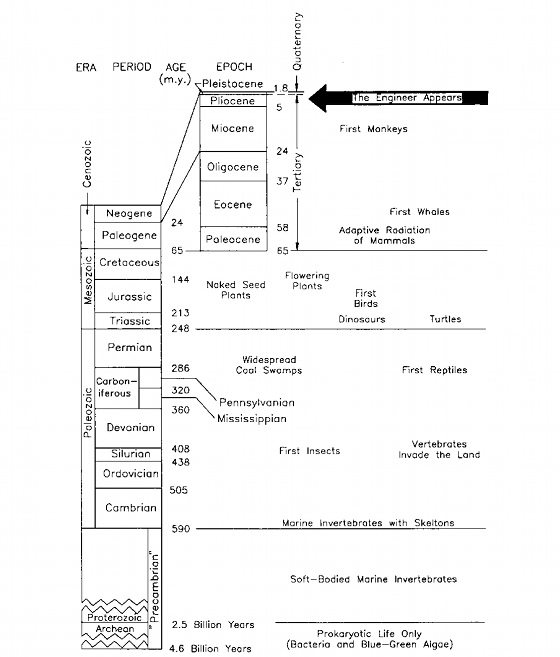
We move on to the nineteenth century, when both geology and later Darwin showed that the earth–to say nothing of the universe–were far older than Usher’s 6,000 year chronology, which man occupied the entirety of. Man was the “johnny come lately” par excellence. A few people picked up on that necessary implication. This led to charts such as below, which appeared in our government’s publication Coastal Geology:
But many did not. The nineteenth century saw the development of ideologies such as Marxism which reduced man’s worth further. But that didn’t stop the followers of Karl and Fred from trying to conquer nature in the following century, the result of which was turning places such as Russia and Ukraine into environmental basket cases.
Now we have Hawking, while waxing melodically on how we live in a cosmos of multiple universes of which we are but one and that there is no need for a creator to explain how they arrived, informing us that our race are “lords of creation.” Creation!
It never occurs to these secular worthies that, the more they show how diminutive our race is by comparing it with their expanding view of the universe, the more they attempt to swell themselves up with the importance of our race. It never occurs to them that the sensible response to this kind of thing is humility, but that’s the key problem with secularism these days: for all of their obsession with reason, the conclusions they come to don’t follow the premises they set down.
Christians are aware that finite humans cannot compare to an infinite God. There are many places in the Scriptures that set this forth; probably the most sustained discourse on the subject is found in Job 38-41. Part of the idea behind that is to inspire humility, a decidedly Christian virtue. But modern and post-modern people cannot bear humility, and that in turn is the cause of much of the sour blowback from our advances. They would sooner see our planet vaporised than be humble about anything, especially themselves.
And then we’d really be insignificant.
-
Touch not God's Anointed
This is the fifth in a sporadic series on the Catechetical Lectures of St. Cyril of Jerusalem. The previous post was Confirmation or Chrismation?
In the previous piece we discussed the chrism, or anointing immediately after baptism. Discussing this to the newly baptised and chrismated, Cyril makes a very bold statement:
Having therefore become partakers of Christ (Hebrews 3:14), ye are properly called Christs, and of you God said, Touch not my Christs (Psalm 105:15), or anointed. Now ye have been made Christs, by receiving the antitype of the Holy Ghost; and all things have been wrought in you by imitation (lit. imaging), because ye are the images of Christ. (XXI, 1)
In addition to repeating Cyril’s concept of baptism as the antitype of Jesus’ baptism in the Jordan—and the descent of the Holy Spirit having chrismation as its antitype—this passage throws out a concept that flies in the face of a lot of what passes as “Holy Ghost led ministry”: the idea that everyone who bears the label of Christian and the name of Jesus Christ is anointed.
In setting this forth Cyril invokes a verse for his pupils that has to rate one of the most misused verses in the Old Testament:
He suffered no man to do them wrong: yea, he reproved kings for their sakes; Saying, Touch not mine anointed, and do my prophets no harm. (Psalms 105:14, 15)
Anyone who has watched Christian television for any length of time knows what I’m talking about. We have the very well known preacher, usually under attack for financial dealings or moral failure, who invokes this verse to stop any kind of criticism or action against him or her. Since their ministry is successful, they are “anointed,” with the implication that we aren’t and thus have no right to question or criticise what they are doing.
There are two ways of coming against this kind of thing.
The first is to consider the nature of leadership: how do we know that this or that minister is a leader, and thus deserves “special treatment”? This goes to the whole problem of authority in evangelical churches, but it also brings up this:
Not every one who says to me ‘Master! Master!’ will enter the Kingdom of Heaven, but only he who does the will of my Father who is in Heaven. On ‘That Day’ many will say to me ‘Master, Master, was not it in your name that we taught, and in your name that we drove out demons, and in your name that we did many miracles?’ And then I shall say to them plainly ‘I never knew you. Go from my presence, you who live in sin.’ (Matthew 7:21-23)
There’s no New Testament support to the idea that anointed people are beyond reproof on either side of eternity.
Opposed to this Cyril—and I’ve seen this point made elsewhere—sets forth what was more obvious to him than it is to us. With Greek as his primary language, Cyril proclaimed that the Christos was the “anointed one,” and that the Christians were likewise anointed. The whole act of the chrism underscored this simple fact.
And why not: if Jesus Christ dwells in us and what we do and have in this life that is of value is from and of God, then we too are partakers in his anointing, to repeat a verse that Cyril himself uses:
For we now all share in the Christ, if indeed we retain, unshaken to the end, the confidence that we had at the first. (Hebrews 3:14)
It’s worthy of note that Cyril does this in a era when the priesthood of a certain group of people was the accepted norm!
The sooner we get back to the Biblical concept that the anointing is the common property of all those called by the name of Christ the happier we will all be and the more fruitful the ministry of the church will become.
-
If I Told You Where My Palm Beach House Is, I'd Have to Kill You
Bernadette Casey Smith, daughter of the late former CIA director William Casey, has sold Estrella del Mar, her family’s North End oceanfront house at 1240 N. Ocean Blvd. for $6.8 million, according to a warranty deed filed Thursday afternoon.
Most recently listed for $8.5 million, the 10,000-square-foot Spanish-style main house is situated on nearly one acre across from the ocean. A beach cabana is included on an additional direct oceanfront parcel. The eight-bedroom compound included a guest house and a two-bedroom staff suite.
Elizabeth Cleckner and John Pangborn, associates with Corcoran Palm Beach, represented the seller; Crissy Poorman, an agent with Sotheby’s International Realty, and Mary Ann Cleckner, a broker with Real Property Palm Beach, represented the buyer.
The house is about halfway between where I grew up and the Inlet. I went to Palm Beach Day School with John Pangborn.
-
Confirmation or Chrismation?
This is the fourth in a sporadic series on the Catechetical Lectures of St. Cyril of Jerusalem. The previous post in the series is here.
One of the significant differences between the “Western” Churches (Roman Catholic, Anglican) and their “Eastern” counterparts (Orthodox, Chalcedonian and otherwise) is the varying practice of what is done to Christians after baptism. In the East, chrismation, or the anointing with oil, is performed immediately after baptism, while in the West confirmation, or the laying on of hands, is done some time afterwards. So what, or why, is there a difference?
Needless to say, Cyril, as an Eastern prelate, performs chrismation, and describes it to his now baptised and chrismated pupils as follows:
And to you in like manner, after you had come up from the pool of the sacred streams, there was given an Unction , the anti-type of that wherewith Christ was anointed; and this is the Holy Ghost; of whom also the blessed Esaias, in his prophecy respecting Him, said in the person of the Lord, The Spirit of the Lord is upon Me, because He has anointed Me: He has sent Me to preach glad tidings to the poor. (Isaiah 61:1). (XXI, 1)
That “unction” was anointing with oil, and in fact Cyril describes a first unction before baptism as well. And anointing after baptism wasn’t a strictly Eastern practice either: Tertullian describes it as well:
After this, when we have issued from the font, we are thoroughly anointed with a blessed unction,— (a practice derived) from the old discipline, wherein on entering the priesthood, men were wont to be anointed with oil from a horn, ever since Aaron was anointed by Moses. Whence Aaron is called “Christ,” from the “chrism,” which is “the unction;” which, when made spiritual, furnished an appropriate name to the Lord, because He was “anointed” with the Spirit by God the Father; as written in the Acts: For truly they were gathered together in this city against Your Holy Son whom You have anointed. (Acts 4:27) Thus, too, in our case, the unction runs carnally, (i.e. on the body,) but profits spiritually; in the same way as the act of baptism itself too is carnal, in that we are plunged in water, but the effect spiritual, in that we are freed from sins. (On Baptism, 7)
So how did the divergence in practice of chrismation and confirmation come about? And what does this mean for those of us who are spectators to the dispute?
The first thing necessary in this debate is to discard the Roman Catholic practice of referring to Eastern chrismation as “confirmation.” The fact is that the two practices, although they have common origins, have divergent theologies, and understanding the difference is crucial in analysing their significance.
The simplest way to explain this is to look at the different Biblical typology of each. Eastern baptism in general has as its Biblical type Jesus’ baptism in the Jordan. Cyril is very emphatic about the importance of this event and the baptiser:
Baptism is the end of the Old Testament, and beginning of the New. For its author was John, than whom was none greater among them that are born of women. The end he was of the Prophets: for all the Prophets and the law were until John (Matthew 11:13): but of the Gospel history he was the first-fruit. For it says, The beginning of the Gospel of Jesus Christ, etc.: John came baptising in the wilderness. You may mention Elias the Tishbite who was taken up into heaven, yet he is not greater than John: Enoch was translated, but he is not greater than John: Moses was a very great lawgiver, and all the Prophets were admirable, but not greater than John. It is not I that dare to compare Prophets with Prophets: but their Master and ours, the Lord Jesus, declared it: Among them that are born of women there has not risen a greater than John (Matthew 11:11): He says not “among them that are born of virgins,” but of women. (III, 6)
Chrismation, thus, has as its type the descent of the Holy Spirit in the form of a dove after Jesus’ baptism, as we saw earlier, with the oil anointings from the Old Testament thrown in for good measure. It’s worthy of note that Cyril is very solicitous to avoid an adoptionistic interpretation of Jesus’ baptism, which is more than one can say about many contemporary preachers.
Having been decoupled (in time at least) from baptism, confirmation has more complex origins, and is still a topic of perplexity today, as this discussion evidences. If we look for Biblical origins of a rite such as this, however, we’re pretty much forced to consider the receptions of the Holy Spirit as described in the Book of Acts. The 1928 Book of Common Prayer did this in including Acts 8:14-15 as an epistle. But this idea is not upheld by many advocates of confirmation, which begs an important question: just what, to these people, is the significance of this rite?
Noting this difference, however, brings up another topic that has generated an enormous amount of controversy over the years: when do Christians receive the Holy Spirit? If we look at the two rites on their face, chrismation tells us that Christians receive the Holy Spirit at baptism and that’s it. On the face of it, that puts the Orthodox in league with the Baptists, who have argued against a subsequent reception of the Spirit for many years.
On the other hand, confirmation speaks of a subsequent reception of the Spirit, and a sacramental one at that. Those who believe that God’s grace are channeled primarily through the sacraments, however, are forced to argue that confirmation is the sacramental encapsulation of the subsequent receptions of the Holy Spirit documented in Acts. This turns the rite into an ersatz baptism of the Holy Spirit.
A more reasonable analysis of both of these rites would be facilitated by observing that the question, “When do Christians receive the Holy Spirit?” is really the wrong question to ask. Such a question assumes that the Christian life is a static business whose course and outcome are assured by absolute assurance. That assumption is one of the cornerstones of Reformed theology, an assumption that has snuck into other parts of Protestant Christianity while no one was looking. Under that scenario, one is saved, and that’s it.
However the New Testament doesn’t support that kind of concept of the Christian life:
For whereas, considering the time that has elapsed, you ought to be teaching others, you still need some one to teach you the very alphabet of the Divine Revelation, and need again to be fed with ‘milk’ instead of with ‘solid food.’ For every one who still has to take ‘milk’ knows nothing of the Teaching of Righteousness; he is a mere infant. But ‘solid food’ is for Christians of mature faith–those whose faculties have been trained by practice to distinguish right from wrong. Therefore, let us leave behind the elementary teaching about the Christ and press on to perfection, not always laying over again a foundation of repentance for a lifeless formality, of faith in God– teaching concerning baptisms and the laying on of hands, the resurrection of the dead and a final judgement. Yes and, with God’s help, we will. (Hebrews 5:12-6:3)
Christian life is all about growth. I doubt there are many Christians out there who would seriously argue that the believer is totally bereft of the Holy Spirit before either their sanctification (if they follow a true Wesleyan concept) or the baptism in the Holy Spirit. The Holy Spirit has been there even before they were reborn. After that the unified Godhead has come in, but his work is active and progressive in the life of the believer. That’s the whole message of the baptism in the Holy Spirit, and that in turn is not an end to growth either. But the whole concept of growth is why John Wesley had to untether Christian thought from its tight Reformed mooring in order to set the stage for what has happened during the last century.
And, of course, the true purpose of the baptism in the Holy Spirit should be noted here as well, which puts many things in a new light:
But you shall receive power, when the Holy Spirit shall have descended upon you, and shall be witnesses for me not only in Jerusalem, but throughout Judea and Samaria, and to the ends of the earth. (Acts 1:8)
So where does that leave us with chrismation vs. confirmation? Some will argue otherwise, but I think that the greater weight of the evidence is towards chrismation immediately after baptism. Why? Because confirmation attempts to sacramentalise something that cannot (or more precisely should not) be restricted to a certain ceremony, but is a part of the believer’s daily walk with God. There is little argument that the Holy Spirit comes in at the time of a person’s coming to Christ, and baptism is certainly a part of that.
And besides, anointing someone immediately after baptism is way cool.
-
What do you expect us to do with it, give it to the poor?
This priceless anecdote, from a recent conversation re confirmation on StandFirm:
Another move, no LCMS (Lutheran Church Missouri Synod), no CRC (Christian Reformed Church), but an invitation to teach Adult Bible Class at the Episcopal Church (dismal failure; Episcopalians generally have little interest in reading, mush less studying, the Bible). This was before the 1979 revisions were in place in that parish so the liturgy was almost word for word what I grew up with in the LCMS The hymns were for the most part unsingable, but you can’t have everything. I took the adult confirmation class…twice. I backed away from confirmation the first time because of a crass remark about how much money the parish was sitting on; I expressed surprise that the parish had that much money in the bank and the priest said, “What do you expect us to do with it, give it to the poor?” I was a full time volunteer with Habitat for Humanity working as Director of Family and Children’s Services (no pay, but a title that allowed the schools and welfare department to treat me as an equal). I knew considerably more about the plight of the “poor” in the community than the priest could comprehend. I needed a church home, took the class again, the bishop came and I was officially confirmed in the Episcopal Church. I worked Alter Guild, sang in the choir, served as a Reader, coached a friend through his required Bible study to become a Deacon, filled the pulpit on one occasion, and moved out of state when they tried to draft me for the Vestry.
I guess it’s stuff like the Rector blurted out about the bank account that gave me such a jaundiced view of the Episcopal Church (or any other Main Line church for that matter) being a suitable instrument of social justice.
Her comments about Episcopalians’ studied disinterest in the Bible rings true as well. As far as the difficulty in singing traditional Anglican hymns is concerned, I managed to master the 1940 Hymnal in our paid youth choir, so I never understood my mother’s gripes about it.
But I will have to admit one thing: I never knew of anyone who fled the state to avoid serving on a Vestry.
-
National Service Committee of the Catholic Charismatic Renewal: Newsletter, June-August 1981
In digging through some archives, I’ve put together three issues of the newsletter of the National Service Committee of the Catholic Charismatic Renewal for June-August 1981.
There was nothing special in the selection, just what I had available.
There is one noteworthy event covered in the June issue: the meeting of Ralph Martin and other leaders with Pope John Paul II in Rome. I remember seeing a video of the event where Martin knelt before the Pope before embracing him. The newsletter doesn’t show the kneeling. Charismatic leaders at the time made a big deal out of this, although in view of subsequent events I don’t think their optimism was well placed.

Sailing the Last Voyage with Newton and Pascal
 Positive Infinity