-
The Keyhole/The Way In (Church of the Redeemer)
 It’s hard to think of a group that defines 1970’s Christian folk/coffee-house music as much as this one, which morphed into The Fisherfolk. The group had its start in 1969 as the resident singing group of The Way In, a Christian coffee-house in the Allen Landing area of Houston, Texas. The Way In was, in turn, a ministry of the Church of the Redeemer, a Charismatic Episcopal church near the Gulf Freeway.
Their style was heavy on acoustical guitar and light on percussion, which quickly became de rigueur for Christian coffee-house groups. The style was certainly replicated in churches and coffee-houses in the region, as I found out while living there in the mid-1970’s. It can even be seen across the pond in the UK in groups such as Achor and The Alethians.
Eventually the Fisherfolk took their leave from the Lone Star State, and are still active, but alas they don’t use these albums for bait any more. Unfortunately the Church of the Redeemer, unable to maintain the building (with its famous “Christ of the Workingman” mural above the altar,) was forced to close in 2011.
The Way In (GIA M/S 129) 1968
Their first album, and their style pretty much defines what coffee-house/youth group music in the late 1960’s and 1970’s was like. The style is a little flat, but they keep things moving. It’s very similar to the style that characterised the Catholic covenant charismatic communities such as the Word of God, People of Praise, Community of God’s Delight, etc., and given the date on this album, it’s not hard to understand who figured it out first.
 The songs:
- Like The Wind
- To Be Redeemed
- What A Great Thing Is This
- To Everyone That Thirsteth
- If I Had All The World’s Money
- The Spirit Is A-Movin’
- I Am The Resurrection And The Life
- They’ll Know We Are Christians By Our Love
- My Lover And My Master
- I Will Arise
- Ye Were Sometimes Darkness
- Bless Thou The Lord O My Soul
- My Beloved
- My Soul Doth Magnify The Lord
Hallelujah Jesus is Lord (GIA M/S 130) 1969
The album is similar to the first, but moves in a decidedly “spiritual” direction, with songs they probably picked up from visiting Pentecostal churches, both black and white.
 The songs:
- Hallelujah! Jesus Is Lord
- By Their Fruits Ye Shall Know Them
- Go Down Moses
- The Song Of Moses
- Joshua Fit De Battle Of Jericho
- Come Go With Me To That Land
- I’m Gonna Sing
- Come Follow Me
- Jesus Is Soon Coming
- Planted Wheat
- The Canticle Of The Gift
- Foot Washing Song
- Let Us Break Bread Together On Our Knees
Glory (GIA M/S 140, 1973)
This is, AFAIK, the last in a series of albums they did for GIA in Chicago. It was during this year that they took their ministry on the road, touring with the renewal outreach of the Fishermen, Inc.
The album contains several coffee-house and liturgical renewal classics (the performances were definitive also) but some striking original pieces such as “Living Words.” The tempo tends to drag in spots but, if you want to know what it felt like to sit in a Christian coffee-house in the 1970’s and take in the music, this is a great place to start.
 Personnel:
- Gwen Arnold
- Mimi Armstrong
- Ed Baggett
- Ann Caldwallader
- Nancy Carr
- Diane Davis
- David Farra
- Mike Kennedy
- Gary Miles
- Jodi Page
- Ricky Roberts
- Albert Rountree
- Jon Wilkes
- Max Dyer, Cello
- Arabella Miner, Tambourine
- Cover Design: Cathleen Gillis
- Photography: Paul Pedrazas
- Sound Production: ACA Recording Studios, Inc., Bill Holford, Engineers
 The Songs:
- Sing to God a Brand New Canticle
- The Lord is a Great and Mighty King
- Psalm 42: As a Doe
- Peace
- I Am the Resurrection
- Living Words
- Sing, Sing Alleluia
- Glorious in Majesty
- Glory
- Praise My God With a Tambourine
Sweet Jesus (Praise Records FF 1008, 1974)
The Keyhole continues their ministry on a new label with this one. The group is starting to show signs of “running out of gas” (the first oil crisis took place the previous fall) but there are still some very good performances on this album, especially the haunting “Hey Soul” (which found its way into our retreats and Masses.)
 The Performers:
- Gwyneth Arnold
- Ed Baggett (Guitars)
- Francine Baggett
- Holly Carnahan
- Jeff Cothran (Piano)
- David Farra (Saxophone)
- Ruth Gordon
- Jan Gundelfinger
- Grace Krag (Flute)
- Brian Howard (Guitars, Electric Bass)
- Marty Pearsall
- Ricky Roberts (Guitars)
- Oressa Wise (Guitars, Electric Bass, Xylophone)
The songs:
- Let Us Give Thanks
- What Could Be Better
- Come Unto Me
- I Heard The Voice of Jesus
- Capernaum Comes Alive
- Jesus Is A-Drivin’ Out Satan
- Christ Is Risen
- Sweet Jesus
- Hey Soul
- I Will Sing, I Will Sing
- Song Of Repentance
- O How Amiable
- Allelujah Today
- Album Music Coordinator: Nancy Newman
- Cover Design: Kevin O’Neill, Roger Gumbinner (also photography)
- Produced by N.E.T. Records, Houston, Texas
- Recorded by ACA Recording Studios, Houston, Texas, Bill Holford, Sound Engineer
For more music click here
-
Month of Sundays: Compassion
And Jesus went forth and saw much people, and his heart did melt upon them and he healed of them those that were sick. (Matthew 14:14, Tyndale)
Published in 1526, William Tyndale’s New Testament was the first New Testament to be translated directly into English from the original Greek. Originally from England, he was forced to flee to the Continent because his translation, not authorized by the new Church of England, was illegal. Ultimately he gave his life for his activity.
But his work was not in vain. His translation became the basis for every English translation for the next century, including the Church of England’s “Authorized” Version (better known as the “King James Version.”)
In many ways Tyndale’s translation, although eighty-five years older than the KJV, is more readable. The passage above is a good example of that: when Jesus saw the people and their difficult condition, his heart melted, and he healed their diseases.
That should give us an idea of how God feels about our condition: his heart still melts for the miserable state we are in. But we’re told that we’re now God’s servants. Does our heart melt when we lift our eyes and look around at the condition of those around us? Are we moved to act on God’s behalf to meet their need? Or do we, like those who passed by the man the Samaritan picked up, look the other way?
It’s true that every day we’re put on many “guilt trips” about doing good things for others. And it’s true that our desire to help others can be manipulated to a wrong purpose. But the fact remains that Jesus’ heart melted at the condition of those around him. If we claim to be his followers, ours should too.
When he was executed in 1536, Tyndale’s last words were, “Lord, open the King of England’s eyes.” That opening took place, for his translation at least. May God open our eyes too to the needs—spiritual and physical—of those around us, and make us swift to act!
-
Non-Compete Clauses for Churches
Just when you think you’ve seen everything in the Anglican Revolt, we have this:
There is a new twist in property settlements that forces fleeing orthodox parishes that wish to disaffiliate from the Episcopal Church over faith and morals. They can keep their properties in a lease back arrangement, but the church cannot affiliate with an orthodox diocese or Anglican jurisdiction like the ACNA, AMIA or CANA.
The Diocese of Virginia and The Episcopal Church announced the legal settlement with Church of Our Saviour, Oatlands (six miles south of Leesburg), following a congregational vote this past weekend. Our Saviour is one of nine congregations that sought to keep its church property after leaving the Episcopal Church in 2006.
Under the deal Our Saviour will lease the Oatlands church from the Diocese for up to five years and retain the parish funds it has on hand. Our Saviour will use a significant portion of those funds for maintenance and much-needed repairs of the Oatlands church. At Our Saviour’s request, the congregation will also retain several memorial items.
The real kicker, however, is that Our Saviour will also voluntarily disaffiliate from any connection to the Convocation of Anglican Churches in North America (CANA), the Anglican District of Virginia (ADV), and the Anglican Church in North America (ACNA). The parish also agreed that no bishop will visit the congregation without the permission of the Bishop of Virginia. (This means he will never approve of CANA Bishop Martyn Minns)
This tells me two things.
First, it’s a tacit admission that TEC is running out of money to sue seceding congregations to get their property back, and that Presiding Bishop Katharine Jefferts-Schori knows it. In that respect it’s a step forward from the “kill-kill-kill” mentality we’ve seen in the recent past.
Second, it’s a sign that a corporate mentality has taken over “815” (TEC’s headquarters). Non-competes are common with departing employees, why not churches, you ask?
I suppose it is, in one sense, appropriate for a church with TEC’s traditional socio-economic make-up to adopt such a strategy. But one would think that the whole concept of a left-wing, socially conscious church is to get away from corporate types and corporate tactics, to say nothing of the whole concept of church property as a centrepiece of one’s religion. But there are many things that disappoint in TEC’s post-1960’s history, and this is just one more.
-
Month of Sundays: Asking
“Thy Kingdom come, thy will be done–on earth, as in Heaven.” (Matthew 6:10.)
My mother wasn’t in the best of moods that evening. As I prepared to leave her and my wife in the car and run in the grocery store, she gave me her orders:
“I want the greenest bananas in the place!”
That was easy: there were plenty of green bananas to choose from. The tricky part came after they got home. She wanted them to last on the counter for a while and they did…they never ripened! She eventually threw them out.
We come to God with a list. We’ve been told that, if we ask, we’ll receive. But we never ask the first question: “I wonder what God thinks of this…” We just make our demands and expect results.
But God is sovereign. He can say yes. He can say wait. He can say no. However, to really teach us a lesson, he can allow what we want to come to pass, and then we can suffer the consequences.
Our first task is to discover what God wants for us to do and be. That was Solomon’s secret: he first sought wisdom, and God rewarded him with great wealth and fame. Had Solomon reversed the order, he might have gotten…the green bananas. But he asked for God’s best first and was rewarded accordingly.
May we always first ask God for his best for our life, and then really listen for the response! He already knows what that is.
When praying, do not repeat the same words over and over again, as is done by the Gentiles, who think that by using many words they will obtain a hearing. Do not imitate them; for God, your Father, knows what you need before you ask him. (Matthew 6: 7, 8 )
-
Month of Sundays: Introduction and Dedication
This coming Sunday I will begin featuring my devotional book, Month of Sundays. I’ve already posted the first devotional on happiness; the rest will follow in sequence. This post is a dedication and the introduction to the book.
Dedication
This work is associated with several “lasts” and yet another one is the object of this dedication.
Month of Sundays was my last book to be published by the Department of Laity Ministries of the Church of God, where I worked for 13 1/2 years. The department was abolished with the 2010 General Assembly. One of my colleagues there was Philip E. Day, who managed our bookstore and did many things to help get this book out. Phil was a dedicated Christian who put shoe leather to his walk with Christ in a number of ways, as a faithful husband and father, working while living in Italy and later in Cleveland, TN, with the Church of God Ministry to the Military, and finally in his years at Laity Ministries. Phil was a hard working, diligent person who was reliable in the extreme.
Phil passed away today from complications following surgery. Although I’ve been planning serialising Month of Sundays for some time, I am dedicating this to his memory, not only as someone who helped get this into circulation, but also for exemplifying the virtues I feature in the work.
Introduction
If there’s one thing missing in the lives of Christian men these days, it’s a challenge. They’re expected to go to work, make a living, be a suitable husband to their wife and a father to their children, and on top of that support the church generously with their finances.
While such a life agenda is challenging enough, over time it becomes a routine. And any routine has two dangers. The first is that the routine becomes a formality and, inside, a man yearns for other things. The second is that a man allows that yearning to turn into a family-destroying quest from which there is no return.
A devotional book may seem like an unlikely vehicle for breaking this routine. But ultimately the spark for renewal must come from a man seeking deeper things. Where do I come from? Why am I here? How do I enter into a deeper relationship with God? All men, sooner or later, will take a journey, a voyage. But the voyage will only have a happy ending—for the man and those around him—if God is his helmsman.
These devotionals are designed to start the escape from the routine and set our course with God. Some are life lessons. Others are taken from the Bible and the world around it. Many first saw the light of day on my blog, Positive Infinity. But they are all designed to provoke thought, to provoke prayer, and ultimately to provoke action to further God’s kingdom on this earth.
There are thirty-one of these. My mother used to describe something that took a long time as taking a “month of Sundays.” Hopefully each of these will make reading them a little of the “Lord’s day” each day, preparing you for the long journey to eternal life.
May God richly bless you!
Don C. Warrington
-
School Sisters of Notre Dame: Choose Life
School Sisters of Notre Dame
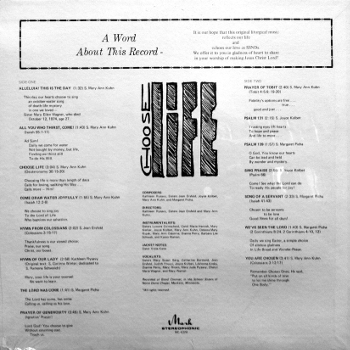
Choose Life (Mark MC 4 329) 1976?
If you’re looking for an album that epitomises the guitar strumming, non-percussional style of music that dominated Catholic Masses during the 1970’s, it’s hard to beat this album. On top of that, the School Sisters (from Mankato, MN) perform in the cavernous, reverberant acoustics of so many older Catholic churches.
However uninspiring the description of the style and venue may be, this album comes off better than one might expect. It’s reminiscent of some of the albums the Word of God in Ann Arbor put out, but the multi-part harmony of the vocals is definitely a step above most of their counterparts elsewhere. In fact, those vocals do more to carry the album than just about anything else; they add “ear candy” and lift this album up very nicely. Since I first posted this it has become one of my favourites.
 The songs:
- Alleluia! This Is The Day
- All You Who Thirst, Come!
- Choose Life
- Come Draw Water Joyfully
- Hymn From Colossians
- Hymn of Our Lady
- The Lord Has Come
- Prayer of Generosity
- Prayer of Tobit
- Psalm 131
- Psalm 139
- Sing Praise
- Song of A Servant
- We’ve Seen The Lord
- You Are Chosen
The School Sisters have achieved more recent fame as the subjects of an extended study on Alzheimer’s Disease. The research found that the sisters were mentally acute and active into their nineties, even though a post-mortem revealed physical signs of the disease. Their life of prayer and activity–a life evidenced by this album–contributed to their long-term mental health.
For more music click here
-
The Ten Weeks: Week Ten (14-20 February): When God Touches Your Life, You Are Never the Same
The setting of the novel The Ten Weeks was exactly forty years ago. This is the last of a series of excerpts from the novel, one for each week (except for Weeks Two and Three, which were combined).
Click here for more information on the book, including the new e-book version.
“There are many unpleasant thoughts here,” James replied. “So let’s talk about the miracles.”
“You don’t believe in them,” Madeleine replied, defensively. “Carla’s church has already told her that they don’t. Is yours the same?”
“Absolutely not. We believe in miracles. I have seen them myself, prayed for them as well. We believe that you have done these things. What we don’t understand is how you did them.”
“You have not heard. . .I invoke the Trinity, pray in the name of Jesus Christ, usually put my aloe vera on them to anoint them when I can touch them. Don’t you?”
“Yes, but beyond that it is entirely different. Listen, we believe that the Holy Ghost is working the same way he did in the Book of Acts. It includes healings, casting out demons, all kinds of miracles. But we pray, we fast, we have altar services. Then we have many rules for our people for holiness: we do not drink, smoke, our women don’t wear jewellery or make-up of any kind, and we generally don’t go to the beach. You, you drink your wine, you go to Mass, your father smokes his pipe, you wear rings for your ears and fingers plus the bracelets, and you come to the beach in your shorts, like you did the day you came to Beran to watch tennis.”
“This was obviously important to you.”
“Important? It was the talk of my church and the Beran church for weeks. But that’s the problem: why is it that you, living as you do, can do the things that many of our saints do not?”
“Perhaps the problem is that your God and the God of your ‘saints’ is too small,” Madeleine came back, desperate enough to quote an Anglican.
“Perhaps the real problem here is that your idea of what God can do in your life is what is far too small here,” James replied deliberately and slowly.
Madeleine stared into James’ black eyes in shock. She and Carla had been in a state of retreat since this whole adventure began, and even before that. Now she was staring in the face of someone who was putting in front of her the proposition that forward movement was possible, and that robbed her of a comeback, something she was almost never without.
“God has picked you out for something special,” James resumed, realising he had the floor to himself. “It is obvious. And there is no limit to what he can do in your life. You could become a great healing evangelist, travelling to all parts of the world seeing more blind eyes opened and more people rise from their sick bed than you can imagine. God has given you an anointing that many people in my church only dream of. Or, you could pass on this great heritage to your children.” He stopped and saw that she winced at the thought. “Children. Of course! Nobody around here talks about them. They smoke their pot, they shoot their drugs, they make love, they take love, they talk about the university they will attend, but no one talks about the children they could have. No one! Perhaps it is better, as mean as they are. But what Pentecostal kid wouldn’t give their eye teeth to say, ‘My mother healed the blind when she was in secondary school and stood up to the government in the process.’ Or you could do both of these things, or more. And of course there is no telling who you might marry. He might be black like me, in which case those beautiful children would be the colour of your coffee.” She looked down at her cup to catch the meaning of his illustration.
“Do you have a special someone in your life, James?” she asked, breathless from the discourse.
“I am happy you asked,” he said, grinning. With that he took out his wallet and handed her the picture of someone she recognised immediately. She gasped.
“It’s Elisabeth Cassidy!” she said. She looked at James wide-eyed, unable to say anything.
“We know what you did that day,” James replied. “We know you prayed for Terry Marlowe to win and Elisabeth to lose. It was very hard on us. Elisabeth was the first person in our church to be so prominent in girls’ sports in Aloxa. She was the national champion last year and will probably do it again this year. If Denise keeps getting herself in trouble, she just might win the Collina Invitational. All of our church—all Aloxan Pentecostals, really—are very proud of her, although some in our church don’t like the clothes she has to wear to play. Before the match, some of us actually went on a fast so she could win. So we were shocked when she lost to Terry. We thought God had abandoned us. We had seen you and Terry’s grandmother praying for her. But she was the first to understand that it was God’s plan to undermine Denise. Then we knew what it meant. Besides, it wasn’t so bad because she was beaten by someone who is, I hate to say this, who is not. . .”
“Really white,” Madeleine said.
“Exactly. Her father is well liked in Aloxa. I think that it is terrible the way people here treat her about her race. Do you realise that you are the first girl from PC I have sat down with for dinner? I always get some kind of lame brain excuse every time I ask one. If I had known, I would have asked earlier! But it was God’s will that I court Elisabeth, we have a lot in common and she is very sweet.”
“How long have you been seeing each other?”
“We have grown up together. But it has been difficult since Leslie became King. He is not a Christian, and his wife Arlene—Elisabeth’s sister—is, shall we say, on the fence. Many people in her family are Christians, but we must be careful because of Arlene. We would have been engaged by now but we have decided to wait until we get to the U.S., where we can marry away from everyone. We are going to college together—at a Pentecostal school, on Royal scholarships.
“Look, I know you are going to Europe to university. I don’t know what kind of church you need to be in to fulfil God’s plan for your life. But he has a great one for you. And, as far as this place is concerned, someday God will punish this place. When he does, you and Carla and everyone else who has been persecuted for Jesus’ sake will rise up and speak judgement against this country. When you do, I want to be there to cheer you on.”
“So what happens if I become a specialist in education?” Madeleine asked him.
“Then you can come back and be our Minister of Education, and I will bow to you and refer to you as ‘Your Excellency.’ We have never had a Christian Minister of Education.”
Madeleine giggled at the idea. “You are simply too charming. What will happen when Elisabeth finds out you saw me like this?”
“She already knows,” James replied, “and she wants me to be an encouragement to you. Besides, she wants to issue a challenge to you: she wants you and Carla to come to Beran again and play doubles with Elisabeth and Alice Fitzwilliam. Since you have been ejected from the teams, you two can only represent God. We will have a large crowd there. And, we will all pray before the match starts, not like here.”
Madeleine thought for a minute. “She is very brave, playing people who only represent God.”
“Like Jacob,” James replied. “But, you know, like Jacob, when God touches your life, you are never the same.”
Sailing the Last Voyage with Newton and Pascal
 Positive Infinity