-
High Church is One Thing, but Trashing the Nautilus is a Mistake
It would make sense that a Reformed person such as Steven Wedgeworth would pan an article on the revival of “high church”. After all, who else to trash “high church” but the people who pitched the liturgy to start with?
It would move the debate forward if a definition of “high church” would be agreed on by everyone. Conscientious sticking with a liturgical form of worship is one thing; the Anglo-Catholic ideal of “smells and bells” in expensive Gothic facilities like this one is another. And yet both could be called “high church” especially when compared what passes for “low church” (in more ways than one) these days.
Wedgeworth invokes Roman Catholic Walker Percy (a sure sign of desperation for any Reformed writer) to the effect that Roman Catholics can celebrate their liturgy in more informal ways because of the substance of the sacrament. He’s right about that; it’s something I picked up on during my Tiber swimming four decades ago:
Bethesda wasn’t quite an Anglo-Catholic church then, but the undertow was there: very formal liturgy (and trained acolytes to help with it,) paid youth and adult choirs to make sure they got it right, and very long (~1 hr 30 min) Holy Communions with all of Cramner’s antique prose topped off by the 1928 Prayer Book’s prayer for the dead. And everyone dressed up for the occasion.
St. Edward’s was a whole different story: modern liturgy (the Novus Ordo Missae had only been official for two years,) no music at many Masses, no intonations of “Gawd” from the altar like the Episcopalians did. Without music and with the right celebrant, thirty-five minutes and the sacred mysteries were done, at which point all of the men stampeded out in their golf shirts, presumably having made a tee time at the Everglades Club or the Breakers. (Catholics’ way of dressing down for Mass was way ahead of its time.)
Anglo-Catholicism always liked a “frillier” form of Christianity, presumably because it looked and felt good and because it helped to drive home the sacredness of what they were doing. Roman Catholicism can certainly do the ceremonial when the occasion calls for it, but the efficacy of the sacraments is driven by the nature of the church, not because of how elaborately the sacred mysteries are celebrated.
 Then Percy informs us of this:
The Catholic is content to practice his faith in a dumpy church in York, while the tourists gape at the great nacreous pile of the York minster, an artifact of a former Catholic culture, as beautiful as the shell of a chambered nautilus and as empty.
Having featured the York Minister on my 1662 Book of Common Prayer cover, this is hard to take. And trashing the poor nautilus not only makes matters worse, but ultimately does Percy no credit. The nautilus, more than York Minster, is a testament to the genius of its Creator and his long-term governance of the creation.
 The nautilus (right) is a living creature, not very pretty when living, but having changed little in the half billion years or so it has been swimming in the seas. It’s biological configuration isn’t very complicated but it has survived tumultuous swings in the earth’s environment. This is because its design is simple and durable, having outlasted many more “sophisticated” counterparts both on land, in the seas and in the air.
 But like all creatures it dies, and when it does the chambers Percy refers to can be seen. The nautilus’ shell geometry is what is called a logarithmic spiral, and that appears in nature over and over again. We see it in the shape of galaxies, the arms from tropical disturbances such as hurricanes, and the failure surface of shallow foundations. Without going into the math, the basic “shape” of the spiral is unaltered as it progresses away from the centre.
What Christianity–and just about everything else–needs is neither gratuitous simplicity or complexity, but like the nautilus simplicity that embodies the ability to survive in its complex and changing environment. My guess is that our Creator is more pleased with the way the nautilus is doing its job than the Church.
Look at the wild birds–they neither sow, nor reap, nor gather into barns; and yet your heavenly Father feeds them! And are not you more precious than they? But which of you, by being anxious, can prolong his life a single moment? And why be anxious about clothing? Study the wild lilies, and how they grow. They neither toil nor spin; Yet I tell you that even Solomon in all his splendor was not robed like one of these. If God so clothes even the grass of the field, which is living to-day and to-morrow will be thrown into the oven, will not he much more clothe you, O men of little faith? Do not then ask anxiously ‘What can we get to eat?’ or ‘What can we get to drink?’ or ‘What can we get to wear?’ All these are the things for which the nations are seeking, and your heavenly Father knows that you need them all. But first seek his Kingdom and the righteousness that he requires, and then all these things shall be added for you. (Matthew 6:26-33)
-
The Southern Joy Quartet: The Lighthouse
Mark Five SJ-4272
Although I am not positive, I think this is their first album as Southern Joy, having been known before as the Cavaliers Quartet. From Greenville, SC, this album (probably from the early 1970’s) is a solid Southern Gospel album, probably no worse (and in some cases better) than more widely known groups of the era.
We also feature their other albums In the Valley and Over the Next Hill.
 The musicians:
- Vocalists:
- Don Forrester, lead vocalist
- Don Pilgrim
- Frank Hopkins, Bass
- Dovie Foister Hopkins, Alto
- Instrumentalists:
- Sybil Stafford, Piano and Organ
- Jess Stafford, Jr., Bass
- Don Hopkins, Drums
- Adger Hardrick, Guitar
 The songs:
- Living in Canaan
- The Lighthouse
- Sweeter Gets the Journey
- Redemption Draweth Nigh
- Eastern Gate
- My Lord I Want to See
- I’m Longing for Home
- Then I Met Jesus
- He Will Not Fail Me Now
- Oh What a Happy Day
- I’ll Have a New Live (Medley)
- I’ll Be in the Rapture
More Music
- Vocalists:
-
For Once, Jimmy Carter is Right
Former president Jimmy Carter condemned the effect U.S. intelligence
 programs had on U.S. moral authority in the wake of NSA revelations brought to light by leaker Edward Snowden, Der Spiegel reports.
“America has no functioning democracy,” Carter said at a meeting of The Atlantic Bridge in Atlanta, Georgia on Tuesday.
I’ve never been a fan of this man, from the time he was inaugurated (when I was actually working for a defence contractor) forward. Neither were some of my co-workers; one put a plastic peanut with grinning teeth in his cubicle, but was forced to take it down. Many evangelicals were thrilled when he, a Southern Baptist, was elected, but unlike Chris Mathews the thrill up the leg quickly dissipated as they realised what he was about.
Since he left office, he’s promoted Habitat for Humanity (a good thing, although it usually builds single family dwellings instead of the 50 square metre apartments leftists long for) and made many stupid statements. But this time he’s right, we don’t have a functioning democracy. We have an élite driven system where those at the top of the system spend billions in candidate donations, PAC’s, lobbying efforts and what not to insure that the rest of us have no substantive voice, but we think that, just because we have an occasional election, we have popular rule and can be pompously moralistic to everyone else whose system doesn’t meet our fancy.
But even Carter knows this is a lie, and the Snowden affair has made this obvious both here and elsewhere.
Like any other problem, the first step to a solution is to admit the problem exists in the first place. (Like the sin problem…) The oldest former president has done so; hopefully those who have come after him, along with the rest of us, will do likewise.
-
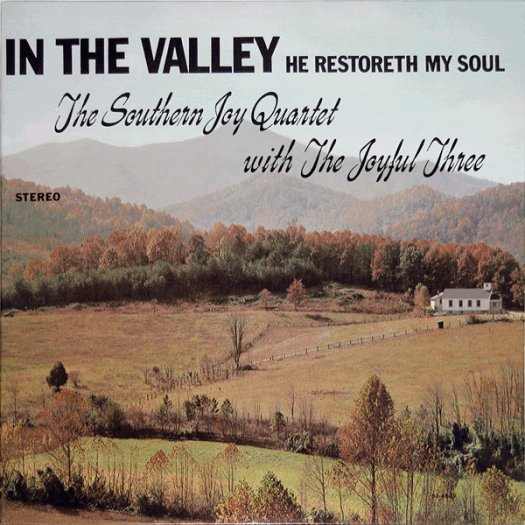
Southern Joy Quartet with the Joyful Three: In the Valley
Mark Five SJ-4809
A very traditional Southern Gospel album. Although undated, I think it’s from the early 1970’s. One thing you immediately pick up on is the change in content of the songs; it’s hard to imagine even a classic like the title track making much of a dent these days with our obsessive ego-pumping. Vocals are excellent, instrumentation is plain. Southern Joy will have to wait until Over the Next Hill to really pull the emotional heart-strings that the genre is very going at doing.
The Musicians:
- Southern Joy:
- Don Forrester, lead singer
- Frank Hopkins, Bass
- Don Pilgrim, baritone
- Dovie Foister Hopkins, alto
- The Joyful Three:
- Sybil Stafford, Piano
- Jess Stafford, Jr., Bass
- Don Hopkins, Drums
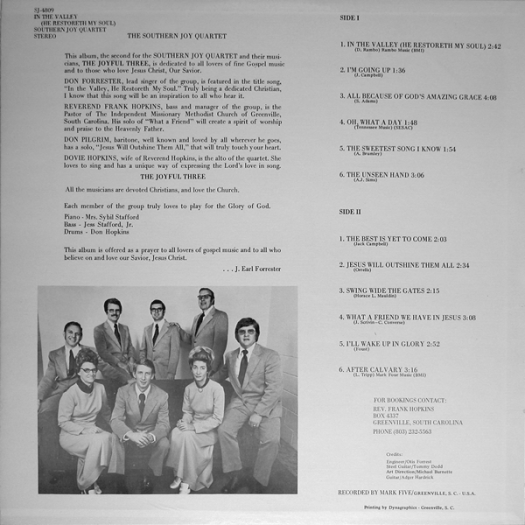
The Songs:
- In the Valley (He Restoreth My Soul)
- I’m Going Up
- All Because of God’s Amazing Grace
- Oh, What a Day
- The Sweetest Song I Know
- The Unseen Hand
- The Best is Yet to Come
- Jesus Will Outshine Them All
- Swing Wide the Gates
- What a Friend We Have in Jesus
- I’ll Wake Up in Glory
- After Calvary
More Music
- Southern Joy:
-
The Chickens Come Home to Roost for the Church of England
There’s a lot going on these days; the problem for me is that most of it either doesn’t deserve comment or I’ve already done it before. The topic at hand falls into the latter category, but it probably deserves a little recap.
Liberals like Mark Harris like to remind us from time to time that “We are part of the Anglican Communion because we are in communion with Canterbury.” That’s true, although that’s not all there is to the AC. Ever since the Anglican Revolt started in North America the impossible dream has been for a non-Episcopal Anglican structure to be recognised by the See of Canterbury, TEC and ACoC get the boot, and everyone lives happily ever after. The affiliation with the African provinces and others represented trying to obtain that on an indirect basis, but the goal (for many at least) has not changed.
The dream was impossible from the start. Beyond TEC’s money favouring and Anglican fudge, the core problem has always been the Church of England itself. To start with, there’s probably little stomach in Albion to take sides in a substantive way in a Colonial dispute. Beyond that, however, the Church of England is the state church. Its existence stems from an Act of Parliament and the monarch’s “broad seal”. The state exercises authority over the church, although in general that overlording has been rather light.
But it doesn’t have to be. As I reiterated in this 2011 post, incorporating material going back to 2006:
Obvious? It was to this blogger at least. From last year:
The CoE’s position as an established church has always made it vulnerable to state interference and control of the kind that Cameron is implicitly threatening (over same sex marriage). That’s why North American Anglicans’ endless desire to find validation by the CoE (along with getting into an Anglican Covenant, with the CoE as the natural centre) is misguided and will end in disaster.
And earlier, in 2006, re women becoming bishops:
It just gets crazier and crazier out there…
In our Island Chronicles fiction series, we document the successive edicts of an autocratic Island monarchy which by decree imposes first women ministers and then women bishops on its reluctant Anglican state church. They do this because the first woman to hold each is a favourite of the kingdom’s strong-willed queen and crown princess.
Now we see that certain members of Parliament in London are considering doing basically the same thing to the Church of England to force it to have women bishops. While some have described it as a “constitutional crisis,” the blunt fact is that, as long as the Church of England is basically a creature of the state, the state can pretty much tell it what to do when push comes to shove.
On this side of the Atlantic, we’ve forgotten what it means to have a state church. Some worry about the consequences of religious influences on the state. The rest of us worry about the reverse. This is a reminder of that simple fact.
The only amazing thing is that it’s taken so long.
What it took was a government willing to put the LGBT’s agenda at the top of its own, and David Cameron’s certainly has done so, to the benefit of the UKIP. But that’s little consolation to those who were hoping that recognition from Canterbury would settle things on this side of the Atlantic. The Church of England, long the beneficiary of state support and approval, is on the verge of reaping a whirlwind from this association.
The new Archbishop of Canterbury, Justin Welby, has seen which way the wind is blowing, both in Westminster and elsewhere, and is trying to come up with an accommodation, much to the displeasure of his African counterparts. Some, noting his pre-clergy experience in the oil industry, have sneered at his attempt to cut a deal. Now, having spent some time in the oil patch, I would be the first to admit that some of the people one does business with are interesting and some equally interesting agreements come out of it.
But Welby is about to find out that his attempts to “cut a deal” on the matters at hand won’t work for two reasons.
The first is that the people he’s dealing with, especially in the LGBT community, can’t be negotiated with. As I’ve noted before, they’re looking for unconditional surrender, not accommodation.
The second is that neither surrender nor accommodation will reverse the CoE’s decline. There are just too many secular ways of doing what liberal churches offer, as I pointed out to Susan Russell in 2007. If Welby’s goal is to run a system of wedding chapels and museums, he will do that. But I don’t see that this is what Our Lord had in mind.
As painful to those with roots in Britain as it is, we need to stop our earthly tribalism and understand our place as a heavenly people. To repeat David “Spengler” Goldman’s advice to Donald Rumsfeld:
The blood of the pagan was his life; to achieve a life outside of the blood of his tribe, the pagan had to acquire a new blood. It is meaningless to promise men life in the Kingdom of Heaven without a corresponding life in this world; Christianity represents a new people of God, with an existence in this life. That is why Christianity requires that the individual undergo a new birth. To become a Christian, every child who comes into the world must undergo a second birth, to become by blood a new member of the Tribe of Abraham. Protestants who practice baptism through total immersion in water simply reproduce the ancient Jewish ritual of conversion, which requires that the convert pass through water, just as he did in leaving his mother’s womb, to undergo a new birth that makes him a physical descendant of Abraham. Through baptism, Christians believe that they become Abraham’s progeny.
If that means moving the earthly centre of our faith away from the West, so be it. And that, friends, is not only true for those in what is presently the Anglican Communion.
-
The Strange Case of Bose Speakers
The death of audio pioneer Amar Bose brings back the memory of something that was a passion of mine during the 1970’s–audio equipment. (The legacy of that passion may be seen in my digitisation technique for some of the albums on my music pages). It may seem strange now but the quest for analogue perfection was a serious business for many of us.
 “High fidelity”, the catchphrase for the 1950’s and 1960’s, was a relative term, and most of the equipment produced during the era didn’t quite make it. A good example is the BSR turntable to the right. They were cheap and appeared in millions of “stereo systems”, all the while helping the UK’s economy, struggling under post-World War II socialism and trade unions. (Garrard, from the same shores, were better). But the ceramic cartridges (the thing that actually faced the vinyl record) were not only poor transducers of the groove modulations to electrical signals, they pushed back against the grooves and wore them out, which is a major reason some of the albums on this site sound so bad. (The photo shows a moving magnet magnetic one, a major improvement in all respects.)
Once the signal was out of the turntable, amplifying it was probably the best part of the process, although some circuit configurations were better than others. When we hit the other end of the process, the speakers, we ran into another electromechanical component, and things got dicey again.
Speaker design in the era was something of an art; the designers worked without the benefit of either computer simulation or digital processing at the speaker. Since the frequency range of any speaker component is limited by its size and physical configuration, it’s usually necessary to build a crossover network of some kind to feed different portions of the frequency spectrum to different components. Between the limitations of passive crossover networks and the various configurations of the speaker “box” (a part of the sound generation process), speakers of the era ranged from good to hopeless.
Most were dreadfully inefficient too; in parallel with the “muscle cars” of the era, there was a power race in amplification to get the sound levels Boomer rockers and others wanted out of the things, and to avoid “clipping” which was yet another source of distortion. This was especially true of the “bookshelf” speakers of the era, most of which were stuffed with Scott’s acoustical foam to kill as much of the effect of the box as possible. Others attempted to redirect the backward waves forward. This improved efficiency but, if not done properly (and generally it wasn’t) the result was a muddy sound due to phase shifting. The most successful speakers of the “reflex” kind were the Arkansas produced Klipsch speakers, although these corner-standing behemoths were not practical for most people to have.
Others decided the best way to get to audio victory was to pitch the conical coil speakers and go to a “flat panel” configuration. This involved putting a membrane between two biasing plates, the biasing being either electrostatic or electromagnetic. The UK made Quad ESL’s were for many years “the deal”, and they, backed up by Quad’s amplification system (first tube then transistor), could match their company’s slogan of “the closest approach to the original sound”. On a smaller scale the Wharfedale Isodynamic headphones did the electromagnetic thing; the biggest advantage of these was that one could dispense with the externally powered plates by using permanent magnets. Today flat panel speakers are common, a testament to the vision of Quad’s Peter Walker.
And that brings us to Bose…although 1970’s audiophiles fought speaker wars with emotion, and many swore by them, Bose speakers of the era never struck me as particularly accurate reproducers of sound. Like many speaker manufacturers of the era, they produced a full line of them, and I always felt that the small, (relatively) cheap bookshelf speakers were the best of the bunch! The less you paid Bose, the better a product you got!
What I suspect is that Dr. Bose was attempting to produce something that was beyond the design capabilities of the era, which may explain the broader success of his later products. (He was also a vociferous defender of what he produced, which intimidated critics).
Personally I moved on to computers as a “hobby” interest, although I suspect that many reading this blog wished I has stuck with the audio equipment.
-
Newbury Park
Newbury Park (Cream CR-9003)
Most Christian albums in the 1970’s eschewed secular labels and concert venues, nurturing the developing Christian sub-culture and being evangelistic in the process. This album and group were an exception, although their later work was more distinctively Christian.
But if you like the 1960’s with its “Sunshine music” (like the Mamas and the Papas,) social commentary and strange love songs, this is the album for you. It is an unabashedly “period piece,” and sounds good in the process. In spite of pieces like “I Wanna Come Home”, it’s a fun album. (Personally, after putting this together, I smile at “My Own 1889”.) Newbury Park could have been a much bigger group had others not beaten them to their genre, but the passage of time makes this album an enjoyable–and sometimes spiritual–voyage through an era that haunts us to this day.
 The Songs:
- My God And I
- I Will Take You There
- I Wanna Come Home
- Green Tambourine
- Hey Little One
- Zip A Dee Doo Dah
- My Own 1889
- When I Am Young
- You Only Know Me
- Afternoon Sky
- Love Now
- Zig Zag People
-
The Government Agent Who Promoted Cohabitation
We’re up on another 4 July, and frankly this one looks to be depressing. Many of us find ourselves in a country that doesn’t want us any more; we’ve even gotten to the point where we find a person like Edward Snowden a hero for exposing the NSA, even when he fled to places our government, for all practical purposes, considers enemies.
Thinking about this takes me back to something I’ve considered sharing for a long time. But I guess it’s now or never. It comes from the 1980’s, when Ronald Reagan was President and it was “morning in America”, a morning that has turned into a stormy afternoon and evening since.
I’ve always believed that the Christian sexual ethic is simple: the only licit conjugal relations are between a man and a woman in Holy Matrimony. I’ve also believed that it is unrealistic to expect non-Christian people to live up to this, although many do. I’ve always felt that the best way to state this truth is to live it in whatever state I found myself. That hasn’t always been easy or popular, especially growing up on the “leading edge” of our culture in 1960’s and 1970’s South Florida.
When I came into my family business on a full-time basis in 1978, it was never my desire to turn the business into its employees’ moral police. Concerning cohabitation and the children that resulted therefrom, we had a tradition of an even-handed approach which eschewed the moralistic punishment of the past and the sappy affirmation that was coming into vogue. So when one of my employees had a child out-of-wedlock with marriage following, it never occurred to me to make anything of it. His good performance continued and I never said anything to anyone else about it.
Unfortunately the company’s performance was another matter. The oil crash of the early 1980’s took many a good company in the oil patch into oblivion and our business suffered as well. He saw which way the wind was blowing and took a position with another organisation which required that he hold a security clearance. Security clearances were something I knew something about; I had one with my first employer. When the government examines a person who applies for one, they want to know everything about your whereabouts and everything else in your life.
Our government dispatched an agent to interview me as his supervisor. Armed with the knowledge and wanting to make the full disclosure I felt they were looking for, I mentioned his inauspicious start to married life. I figured that, if it meant anything to the government, they would take it into consideration and, if it did not, they would ignore it and move on.
Silly me: the agent started to push me about my own attitudes on the subject, with the unmistakable implication that I was being “judgemental” in my attitude. He was quite persistent in the matter and wasted a good deal of the time the taxpayers were paying for making an issue out of it. It never occurred to him that, had I been the judgemental ogre he was making me out to be, I would have fired the employee and been done with it. Finally he got the hint that he wasn’t going to change my convictions on the subject, finished the interview and left.
It was bad enough that the government was upset with me on the subject; a few years later, my family got into the same mode when we experienced some cohabitation of our own. Again I was cast as “judgemental” not because I took action against anyone but because of my beliefs. (In spite of this, no one would challenge my mother’s standing refusal to have any one of us stay in her house if they brought a companion they weren’t married to). My family was out of sorts with many of my Christian convictions, but their “Plan B” didn’t work out as advertised, and my poor brother took most of the blowback.
So when same-sex civil marriage floated to the top of the national debate, my first reaction was, “huh?” After all these years of trashing people who objected to cohabitation, how could these people turn around and insist that certain people needed to get married? Do they really expect all same-sex couples to get married? And doesn’t expanding marriage shame cohabiters? Yes, I know that we have a “try before you buy” attitude these days, but, if we remove the Christian sexual ethic from the discussion (which removes the “try” in any case) why the buy after the try?
My experience on a personal level with the cohabitation issue, and the stunning volte-face on same-sex civil marriage, have convinced me that those who lead this society are either insane or duplicitous or both. They remind me of Count Czernin’s description of the Bolsheviks. But to some extent we as Christians have painted ourselves into a corner on this issue. We’ve bawled for the last forty years that the reason for the breakdown of the family stems from lack of long-term commitment, but instead of focusing on Christian marriages we’ve obsessed with upgrading society. So our culture leaders have taken our obsession with long-term commitment and shoved it back into our face with same-sex civil marriage, even though we all know that there are some commitments in life that don’t need to be long-term or any term.
At this point the best we can hope for is that the relationship between state and church be a cat and mouse game, with the cat being hopelessly overweight. That’s not what our Founding Fathers fought our Revolution for, nor is it what the many men and women have fought for to defend our freedoms. But until we have yet another “new birth of freedom” on this continent, the dreams that many of our ancestors had when they came here will become just that.
-
When It's Easier to Demolish Your House Than to Make the Code Police Happy
Two new residences will be going up while five old residences will be coming down, as approved Wednesday by the Architectural Commission…264 Bahama Lane: Owner Karl Wattenhofer is demolishing his house to cure a code-enforcement violation for unapproved window changes. He currently has fines that total more than $74,000.
For me personally, this is poignant: the house is down the street from where I grew up.
Mr. Wattenhofer’s house’s back yard faces the Palm Beach Country Club, the place where Bernie Madoff made off with both the funds of a large part of the membership and the club itself. Under U.S. law, those who choose to live next to a golf course take an assumed risk for the damage to person and property that errant golf balls inflict, so they can’t sue the club or the golfers for the damage.
Faced with this reality of American law, the Swiss Wattenhofer did a logical, defensive act: he installed bullet-proof glass in his windows. That, sad to say, fell afoul of Palm Beach’s dreaded Architectural Commission (“ARCOM”). The police discovered this installation–then ten years old–in May 2012 when they were making a routine security check nearby, and turned him into ARCOM, which cited him and started a $250/day fine.
Wattenhofer, faced with a $50,000 retrofit and unable to see his way clear to recoup the loss in selling the house, decided to take his leave from the land of the free and the home of the brave and petitioned ARCOM to demolish the house. ARCOM has now agreed to the demolition; his attorney can now move to have the fines reduced, destroy the house, and sell the land to someone else who can jump through ARCOM’s hoops and build anew. (That’s expensive, but keep in mind that, in Palm Beach, generally the value of the land far exceeds what’s sitting on it).
Bahama Lane is part of the old “Dodge Estate”, which I think was the last “major” estate to be broken up on the island. (I went to school with the son of same Dodge). The houses aren’t that old. The whole concept of demolishing a house to satisfy the prissy sensibilities of ARCOM, especially in view of the reality Wattenhoffer was facing, is absurd.
Although I’d be the first to admit that Palm Beach is an exceptional place on the edge of these United States, the sad truth is that all of our country, in varying degrees, has saddled itself with a morass of property regulations. Every day we hear of people fighting municipalities and associations regarding flags, political signs, basketball goals, mailboxes, Bible studies and the like. And that’s just the start; you get into environmental disputes such as wetland designations, and things really get rough.
Mr. Wattenhofer, for his part, has had enough. Perhaps when he’s back in Switzerland he can commiserate with Tina Turner, who gave up her U.S. citizenship to live in the land of Alps and muesli. In the meanwhile those of us who are left behind, as we celebrate our independence with swelling patriotic rhetoric,need to cut the platitudes and conventional wisdom and ask a simple question: independence from what?

Sailing the Last Voyage with Newton and Pascal




 Positive Infinity