-
The Never-Ending Interest in Donald Trump's Mar-a-Lago Club
My piece last year on Donald Trump and Mar-a-Lago has been a hit on this site. There’s a great deal of interest in the subject, either by his supporters (who think he’s a SJW hero for the club) or his detractors (who are trying to find out some dirt about the place.) Neither of these quite hit the spot, although his supporters have the better argument. My last piece was a little brief, so some background is in order.
It’s easy to get sidetracked in an issue like this, because Palm Beach’s social system is different (or sui generis to use the fancy term) than what most Americans are used to, either in the past or now. Donald Trump’s concept of a club for everyone in the place–black, Jew, gentile–was revolutionary, but that has to be seen in the context of Palm Beach, not some egalitarian utopia.
First: Mar-a-Lago wasn’t a club until Trump bought it. It was the estate of Marjorie Meriwether Post, the cereal heiress, and it was the largest private home on the island.
Second: until around the First World War, Jews and Gentiles mixed pretty well in Palm Beach. That changed with the growing perception among the Gentile community that the Jews, God-chosen achievers that they are, were a threat. Probably the most shameful manifestation of this was the change in the admission process of the Ivy League schools, who de-emphasised academic excellence and went for this “well-rounded” (usually Gentile) student. We’re seeing a repeat of this with the Asians.
Jews in Palm Beach, not wanting to be at the bottom of the place’s social system (and that’s a bad place to be, as I found out the hard way) started their own clubs, most prominently the Palm Beach Country Club. The segregation of Jew and Gentile was a prominent feature of Palm Beach society for many years. The one place that wasn’t extended to was the schools, where I had Jewish friends whom I remember fondly.
Turning to the issue of black people, South Florida is in many ways an extension of the Northeast. However, looking back the Southern influence was a lot stronger in Palm Beach than I used to realise. Gentile Southerners brought their racial attitudes to the place just as their Northern counterparts brought their religious ones. The first time I heard anyone I knew called the N-word was a schoolmate at Palm Beach Day School, something that still blows me away. Having said that, when some enlightenment started to sink into the place the big issue, IMHO, was economic. Living on the island is a dreadfully expensive proposition, joining the clubs isn’t any easier. The Jews had that problem in hand; most black people have not.
Into this segregated/stratified situation enters Donald Trump. As I noted in my review of Lawrence Leamer’s book:
The inrush of that kind of money has changed the landscape of Palm Beach more than anything else, both physically (to the extent that those who want to build can get past the preservationists) and socially. At the vanguard of that change is Donald Trump, whose transformation of the Mar-a-Lago estate into a private club, with the concomitant opportunity of the clubless arrivistes to have their own place in the sun free from the constraints of places like the Everglades Club, the Bath and Tennis (B&T) Club, or even the Palm Beach Country Club.
From my viewpoint as someone who grew up in Palm Beach, Trump’s opening of the club scene to nouveaux riches was the biggest innovation that he made. Putting together a club where Jew and Gentile could mix freely was and is an achievement for which he needs to be given credit. Iconoclastic as that was, Trump saw that an “old money” town like Palm Beach was changing with the billions generated by the newly wealthy, and he put Mar-a-Lago at the centre of that change. And there’s political significance to that.
As distasteful as nouveaux riches are, they are a necessity for a vibrant economic system. They show that people can and are moving up. Unfortunately there are many “gatekeepers” in our society who don’t want others to move up as it would involve them to move out. Some of them are the recently successful people in the tech industry, who know better than anyone that glory is very fleeting. Others are in academia, who have convinced everyone that the credentials people pay them dearly to hand out are the key to a unruined life. Still others are in government, the usual laggard, which finds it easier to block change than to adapt to it.
Most of the discontent is coming from the American people’s decision that they’re getting the shaft from all of these “gatekeepers.” That’s true of both Trump and Bernie Sanders supporters; they share the basic perception of the problem but not the solution. As long as our haughty masters attempt to lord over us the way they have, they will have blowback.
The fear of Trump is that, if he can take on a social system like Palm Beach’s and win, he could do the same with them.
Yes, he can.
-
Lessons from the Cotter Bridge
 The Ruthven Bridge, as it has been officially called since 1976, is a familiar landmark to visitors and residents of north central Arkansas. It has an interesting history, not only for its design and construction, but also in how it was authorised and its subsequent history.
Arkansas did not establish a State Highway Department until 1927. Before that time the counties were responsible for building and maintaining the roads. One of the Department’s first tasks was to identify places where major bridges needed to be built. One of those sites was the White River at Cotter, west of Mountain Home. (It’s the same White River, and not far from the site, of the real estate development that the Clintons made famous in the Whitewater scandal.)

Unfortunately the State Highway Commission had put the bridge at Cotter at the bottom of the list. This was remedied by Judge R.M. Ruthven, who pocketed the report before the Commission met. Unaware of the priorities of the report, the Commission approved the bridge and construction began.

The bridge was designed by James Barney Marsh, who used a patented design for this reinforced arch bridge. The rainbow concrete arch bridge was meant to be an economical substitute for the steel arched bridges at the time, and had the added advantage of being more corrosion resistant. In addition to the novel design, the bridge was built by first putting in place the steel arch reinforcement and then using that to hang the forms and pour the concrete for the rest of the bridge. This eliminated the use of formwork built from the river bed; the White River’s wild swings in level made that a risky proposition. (Today bridges across rivers and wetlands are generally built from the top down for environmental reasons.)
The bridge was completed in 1930. It eliminated significant detours during flooding; the next bridge crossing was upriver at Branson, 100 miles away. One would think that such an improvement would have been welcome, but traffic was low because the locals preferred to use the ferries, which were paid ferries and slower. The State Highway Department found this frustrating; one highway engineer stated that “If Baxter County people want to new improvements on their highways, they will have to patronise those already made…” The Department was not at a loss for a fix: they paid off the ferry operators to get out of business, the last one for USD250.00. With that traffic picked up, and it remained the main crossing between Baxter and Marion counties until the 1980’s.

It’s strange that, in these days of “free stuff” most systems, religious and secular, need a payment. Beyond the usual griping about taxation, we pay a great deal of “rent” for many things: housing, Internet and data service, utilities, and the like. Most religious systems are this way. They require that we do certain things to get a temporal or eternal reward. Ever wonder, for example, why Muslims radicalise and then kill others so quickly? Part of that is that both killing and dying for Allah in jihad is the one sure “straight shot” to Paradise for Muslims. It’s a steep price for them and for us, although I suspect they won’t find what they’re expecting when they’re ferried across the river into eternity.
Christianity has never been like this because Jesus Christ paid the price for our sin on the Cross. “The Divine Righteousness which is bestowed, through faith in Jesus Christ, upon all, without distinction, who believe in him. For all have sinned, and all fall short of God’s glorious ideal, But, in his loving-kindness, are being freely pronounced righteous through the deliverance found in Christ Jesus.” (Romans 3:22-24, TCNT.) That work is complete. We don’t have to pay the ferry operator anything to get from this side of eternity to the other. In fact, like the residents of north central Arkansas, we don’t have to take the ferry; the bridge was built and paid for. “But, when Christ came, he appeared as High Priest of that Better System which was established; and he entered through that nobler and more perfect ‘Tabernacle,’ not made by human hands–that is to say, not a part of this present creation. Nor was it with the blood of goats and calves, but with his own blood, that he entered, once and for all, into the Sanctuary, and obtained our eternal deliverance.” (Hebrews 9:11, 12, TCNT.)
Many of you—and I know this was an issue in my own family—have been trying to get to where you want to go by paying something, whether money, time (think about all that “volunteer” work you’ve done to pad your resumé) or whatever. But the most important destination can be had for free; the choice is yours.
If You’re Tired of Paying the Ferry, Click Here

Most of the material for this piece came from Witcher, T.R. (2016) “Arkansas’ R.M. Ruthven Bridge.” Civil Engineering, July/August, 42-45. The photos are mine.
-
Texas A&M Newman Association 1975-6
I’ve alluded to my years in the Catholic Students Association in pieces like this. Now you can get a little more flavour of what that was like in the following video.
Thanks so much to Jeanne Geidel-Neal for the music for this video.
As noted elsewhere, the “straight outta Irondale” folks won’t like this, but that’s true of a great deal on this blog.
-
My Response to "Think Younger" and the Church of God General Assembly
With our Independence Day celebration out of the way, it’s time for those of us in the Church of God to head to Nashville (if not physically, virtually) for the Church of God General Assembly. It should be an interesting one; three of the five members of the executive committee will be going off of that august body; the elections are always the highlight for many.
But there are some interesting things on the agenda too. Without going into a great deal of detail, what’s on the table is to a) allow ordained ministers to join the ordained bishops in the General Council (which would give some of our women ministers a vote for the first time) and lower the minimum age of those in the General Council and running for office. It’s the latter that I want to concentrate on.
That’s made simple by the fact that one Dr. Marty Baker has put together a site called Think Younger. His idea is not only to promote the idea of lowering the voting age, but also to promote those ministers who in his opinion “think younger.” Because of the way American Christianity is bleeding believers (especially among the Millenials) there’s an idea out there that, unless we turn the church over to our younger ministers, we’ll be left in the “ash heap of history,” to use Leon Trotsky’s term. This goes with the idea of “engaging our culture.” This has created a great deal of consternation among our older (and in many cases successful) ministers who are seeing the same possibilities of defection from the faith that we’ve seen in the Main Line churches. (And my Anglican readers know all too well what that means.)
As someone who just completed a PhD in a program with people half my age, this is yet another surreal situation. Coming off of those experiences, my mind goes back to my years at the International Offices, because for all the bravado these people exude, they’re still not addressing what I think is the core issue in the dynamic of the Church of God: the issue of race.
Last year I wrote a piece entitled What Working for the Church of God Taught Me About Race. After a long survey of the history of that subject in the church, I made the following observation:
A large reason Pentecostal churches grow and others don’t is because Pentecostal churches expand among non-white groups in a way that others don’t. Many want to turn this in to another “moral crusade” but the simple truth is that hindering multi-cultural growth is just plain stupid if we’re serious about expanding our church and fulfilling our mission.
Evidently our brethren at the Assemblies of God have figured this out:
Much of the numerical growth in the Assemblies of God in recent decades has been among ethnic minorities. From 2001 to 2015, the number of AG adherents increased by 21.5%. During this period, the number of white adherents decreased by 1.6% and the number of non-white adherents increased by 76.8%. From 2014 to 2015, the percentage of white adherents dropped from 57.6% to 57.2%. It should be noted that the number of white adherents in the U.S. includes quickly-growing constituencies of immigrants from places such as the former Soviet Union and Romania. Without these new white immigrants, the white constituency in the Assemblies of God would be falling even more quickly.
If you look at the worthies endorsed on Think Younger, most are white. If, for example, we want our Executive Committee to reflect our ethnic composition, we would elect two (2) non-white people to the open positions, assuming the other two men with time remaining went back on. I don’t think that Dr. Baker and his allies are ready to do that, based on the make-up of his preferred candidates. (Four out of thirteen are non-white; with three positions up and the other two going back on the Committee, nine should be.)
And I’ll throw out another idea: I think our older ministers would be more receptive to this idea. That’s because our non-white churches tend to be more traditional in belief and worship than our larger white churches. (In many cases they’re more urban too, which is an interesting juxtaposition.) It would also put the cause of our women ministers further down the road because the core of the opposition to women ministers in the Church of God has come from our Scots-Irish ministers, who are well represented in Dr. Baker’s preferred list.
It should be an interesting show from the “cheap seats,” where not only are the exhorters and ordained ministers excluded from the proceedings of the Council, but the laity too. That was certainly the case in 2008 during the “Missional Revolt,” when our younger ministers showed that they didn’t need to change the voting age to change the church.
In the meanwhile, I’ll continue to go to the denomination’s mother church, which is in many transitions these days. One of those is that we now have an Hispanic Pastor (which is a shock to many.) Next Sunday our state Administrative Bishop will visit us to begin the process of bringing in a new Pastor. If the Hispanic Pastor really succeeds, we’ll be in a different state with a different overseer.
And that, people, would be a jolt to young and old alike.
-
An American Children's Book in the Name of Allah
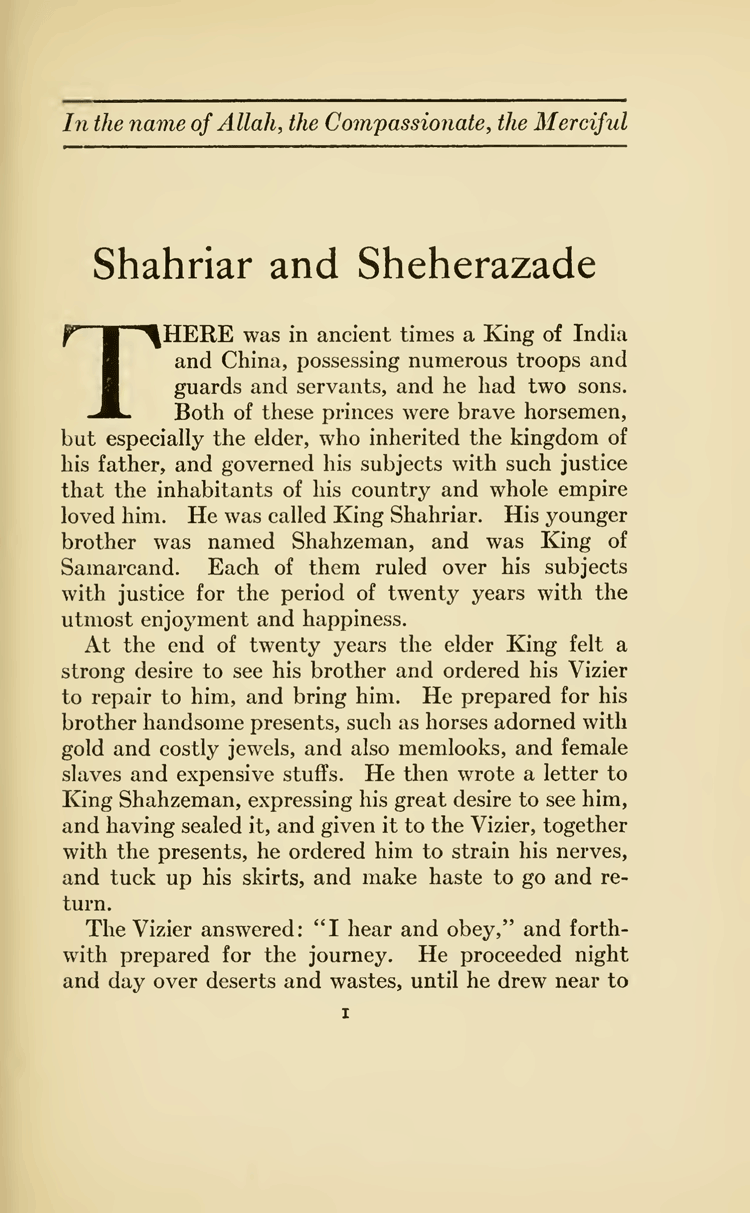 No, this is not CAIR’s newest idea of subversion. Look to the right at a page from the 1913 edition of the Arabian Nights by Frances Jenkins Olcott, an American librarian. There at the top is the traditional Islāmic invocation “In the name of Allah, the Compassionate, the Merciful,” which I have seen (with variations) in places like scientific and technical monographs.
I think it’s safe to say that Americans in the years before World War I were better informed about the tenets of Islam than they are today. One example of this was the coverage given in Godey’s Lady’s Book about the Banner Named Barack. There was also significant missionary activity in the Middle East in the waning years of the Ottoman Empire, and of course many of the Bible commentaries and reference books of the era contained information about the then-contemporary Middle East.
So, given what was known then and is known now, how could Olcott get away with putting this at the front of these stories? The simple explanation is that, then, the main face of Islam in the West was that of the Turk, and the Turk was having his difficulties, to say the least. Islam in this country wasn’t perceived as much of a threat, and the Ottoman Empire’s loss of World War I only buttressed that perception. (Europe was another story; the spectre of Islāmic conquest was always in the back of people’s minds, as Benito Mussolini knew all too well.)
Today we have two sources of misleading about Islam and the Middle East. One from the right really doesn’t grasp anything different from what it has had, which explains George W. Bush’s quest for democracy in the Middle East. One from the left discounts people’s beliefs in favour of their own artificial construct, which is why we careen from one failure to another these days. Entertaining either or both of these fantasies will keep our world in turmoil.
-
Banning Sobriety in Palm Beach
It’s unlikely residents will see sober homes popping up in their Palm Beach neighborhoods any time soon.
Earlier this month, the Town Council declared “zoning in progress,” a measure that essentially halts permits for alcohol and drug-free living environments in town while officials consider how best to regulate them. Council members also directed the Planning and Zoning Commission to discuss an ordinance change at a future meeting.
If there’s one thing the Town of Palm Beach is good at, it’s restricting residential development. They’ve even frustrated people who had the good sense to put bullet-proof glass next to a golf course to the point of razing their house. If they want to keep sober houses off the island, they can turn the task over to the Architectural Commission (ARCOM,) who can bankrupt just about anyone with the “improvements” they require.
I’m not sure why anyone who wants to run a sober house would try to put one on the island. In addition to ARCOM, the real estate prices are dreadfully high. By the time they would have the house set up, they would be out of money to actually help someone with their substance abuse problem.
What will be fun, however, is when the Feds try to put Section 8 housing in Palm Beach…
-
The "Arabs" of Thomas Aquinas Weren't Arabs At All
Returning to the site Ite ad Thomam, I saw an advertisement for the “Annual Fall Workshop on Aquinas and the ‘Arabs’” at Marquette University (not, these days, an ideal venue for such a traditional Catholic conference.) For someone like myself who started the Summa as an undergraduate and finished it as a PhD candidate, it looks to be interesting.
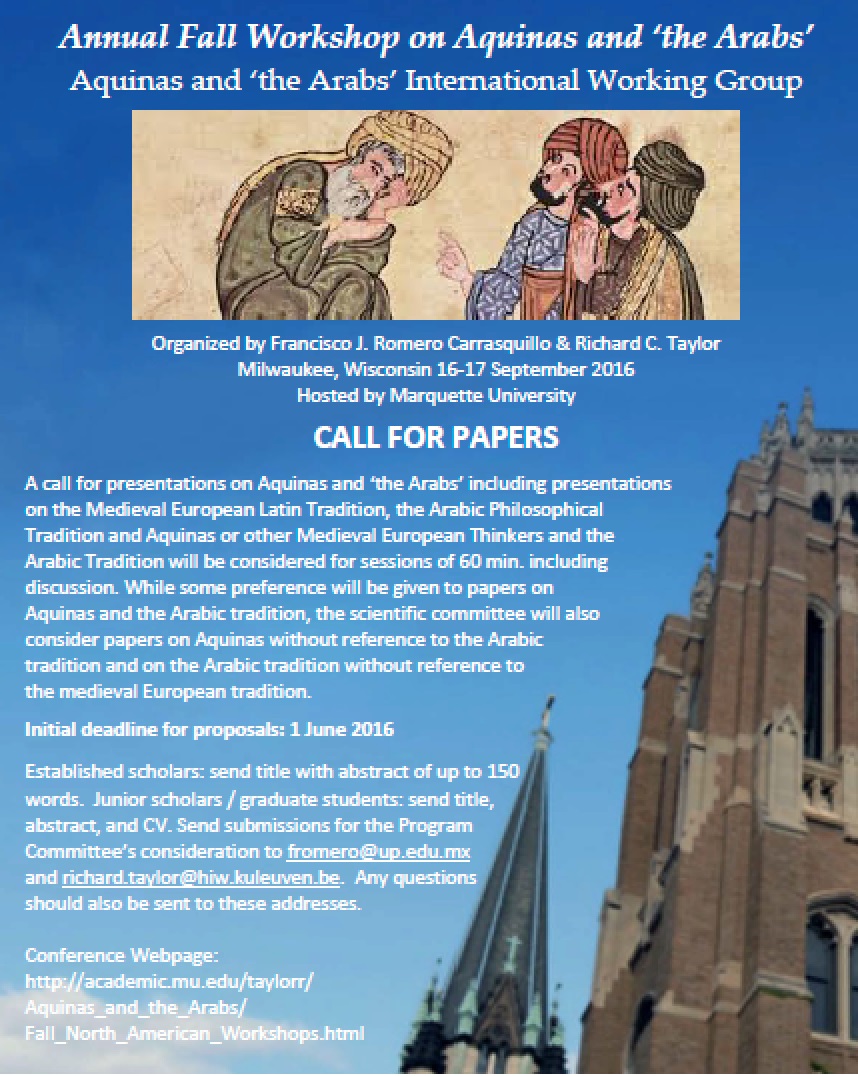
The two main scholars from the Islamic world that Aquinas cites are Avicenna and Averroes. The first thing the conference needs to establish is that neither of these two worthies are Arab, although they certainly wrote in Arabic.
Avicenna (Abū ʿAlī al-Ḥusayn ibn ʿAbd Allāh ibn Al-Hasan ibn Ali ibn Sīnā) was Persian. Having spent five years with Persian scholars, I can tell you that they’re a world apart from their Arab counterparts. I’ll go a step further: if there is an “Islamic Civilisation,” it’s Persian, not Arab.
Averroes (ʾAbū l-Walīd Muḥammad Ibn ʾAḥmad Ibn Rušd) lived in Moorish Spain. His family was prominent under the Almoravids, a Muslim dynasty of Berber origin, from North Africa. Some Berbers at least are very defensive about being called “Arabs.”
As an aside, Averroes’ chief opponent, Al-Ghazali, was also Persian. About ten years ago I dealt with the difference between Al-Ghazali and Aquinas; it remains an often visited piece on this site.
So perhaps this will be the first order of business of the conference. Such differences may seem trivial, but if they and others were better understood–especially by those making the decisions these days–our world would be a better place.
-
When One Steals From A Church, One Sins Twice
Never gave this much thought, but from the “Ite ad Thomam” site:
So stealing from a church is actually two sins, theft and sacrilege? Or is it still one – sacrilegious theft?
Two sins. And both have to be confessed. In other words, it’s not enough to say merely “I stole something from a building,” or “I committed sacrilege at the church”; one has to confess having stolen from the church, both theft and sacrilege. And so with other acts that involve multiple species of sin, as when one does one bad thing for the sake of another.
Something to think about…
Sailing the Last Voyage with Newton and Pascal
 Positive Infinity