-
The Creation of Men and Angels: The creation of the angels
This is the first in a series from Bossuet’s Elevations on the Mysteries. More information on the Bossuet Project is here.
God, who is a pure spirit, wanted to create pure spirits like him, who like him live in intelligence and love, who know and love him as he knows and loves himself, who like him are happy in knowing and loving that first being, as he is happy by knowing and loving himself. By this they are steeped in their root by a divine nature, by which they are made in his image and likeness.
Such perfect creatures are drawn from nothing as the others, and from there, perfect that they are, they are by their nature prone to sin. He only by its nature is not prone to sin, which is itself perfect by its essence. But as it is the only perfect one, everything is defective except him, “and he found the same depravity in his angels.” (Job 4:18)
However is not he who made them depraved: it is not pleasing to God. Only the very good comes from a hand so good and so powerful: all minds are pure in their origin, all intelligent natures were holy in their creation, and God had formed their nature and filled them with grace all together.
He lifted from his treasures minds of countless kinds. From these infinite treasures came the angels, from these same infinite treasures came reasonable souls. There was a difference, that the angels are not united to a body, which is why they are called pure spirits. Instead, reasonable souls are created to animate a body; and though in themselves they are pure and incorporeal spirits, they make up a whole which is mixed with body and spirit, and this is all man.
O God, be praised forever in the wonderful diversity of your works. You who are spirit, you have created the spirits; and doing what is most perfect, you have not denied the being from what is most imperfect. So you also made minds and bodies, and since you have made spirits separated from the body, and bodies that have no spirit, you also wanted spirits who had bodies; and this is what led to the creation of the human race.
Who doubts that you can not separate and unite and all that pleases you? Who doubts that you cannot make spirits without bodies? Does one need for a body to hear, and to love, and to be happy? You who are a spirit so pure, are you not immaterial and intangible? Are intelligence and love not spiritual and immaterial operations, which can be exercised without being united to a body? Who would doubt that you can not create this kind of intelligence? And you told us that you have created such.
You have told us that these pure creatures “are innumerable.” (Heb. 1:12) One of your prophets, enlightened by your light and transported in spirit as among your angels, saw “a thousand thousands who executed your orders; and ten thousand times a hundred thousand who remained in your presence,” (Daniel 7:10) without doing anything else than adoring you and admiring your greatness. We must not believe that by speaking in this way he has tried to count. This prodigious multiplication, done by the largest numbers, tells us that they are innumerable and that the human mind is lost in this huge multitude. Count, if you can, the sand of the sea, or the stars of heaven, both seen and unseen, and believe that you have not reached the number of angels. It costs nothing to God to multiply most excellent things: and it is most beautiful; we can say that is what he excels in.
“O my God, I adore you in front of your holy angels; I will sing your wonders in their presence;” and I will unite in faith and truth to the immense multitude of the inhabitants of your holy temple; of your perpetual worshippers, in the sanctuary of your glory.
O God, who hast deigned to reveal that you have made them in such numbers, you have wanted to teach us that you distributed them in nine choirs; and your Scripture never lies and says nothing unnecessary, named “angels, archangels, virtues, dominions, principalities, powers, thrones, cherubim and seraphim.” Who will attempt to explain those august names, or describe the properties and the excellence of these beautiful creatures? Too content to dare name them with your always true Scripture, I dare not cast myself in high contemplation of their perfections; and all I see is that among the happy spirits, the Seraphim, which are the most sublime and whom you put at the head of all celestial squadrons nearest you, dare not yet look up to your face. Your prophet who gave them six wings, to signify the height of their thoughts, “two to put them before your face two to put them in front of your feet.” Everything is great in your nature and what is called the face and the feet, there is nothing in you that is incomprehensible. The most refined minds cannot support the splendor of your face: if there is some place in you where you seemed closer to them, and which we can call for that reason your feet, they cover with their wings and do not dare look at him. Six wings, they use four to hide from themselves both your impenetrable and inaccessible light and the love and the incomprehensibility of your being. There are left “two wings to flutter,” if one dares say it, around you, without the power to either enter your depths, or fathom the immense abyss of perfection, before whom they beat barely trembling wings, and they can hardly be sustained in front of you.
O God, I worship you with them! I do not dare to mix my unclean lips with their immortal mouths which resound your praises across the sky. I wait for one of these celestial spirits to come touch me with the fire of coals burning before your altar. What grandeur do you show in these purifying minds! And now you show me that the spirits that purify me are so small in front of you!
-
How Did We Get From Scanlan to #straightouttairondale?
The death of Fr. Michael Scanlan, the University of Steubenville’s long-time leader, has saddened many in the conservative Catholic world, if not refugees from covenant communities. It’s an event that may not resonate with the majority of the Christian world, but for those of us with any involvement with the University of Steubenville, it’s worth noting.
I’m going to leave to those more directly affected by his actions vis-à-vis covenant communities how to explain that situation. Suffice it to say that, after lecturing us on visitations from God, the covenant community that absorbed Steubenville’s Emmanuel group came to an end after the visitation of another higher power, namely the bishop.
As someone who chaperoned three youth group trips to the National Catholic Charismatic Conference on Young People and Youth Ministers (1981-3) and attended one leadership conference (1983,) I have an entirely different question: how did we get from the breezy, folk mass and folk youth service format of those days to the stiff, Latinate style (which I refer to by the Twitter hashtag of #straightouttairondale, because its most prominent proponent is EWTN) that is all the rage in conservative Catholicism now? Why are the same people who thought we were really in touch with God then now promoting something different?
Let me start by giving you a couple of examples of what things looked like in those days. The first is a little photo montage I put together from my years in the Texas A&M Newman Association, just a few short years before:
The second comes from Steubenville itself: it’s the opening of the 1983 Student conference:
When we look at either of these, and then compare them with what is presented as “normative” conservative Catholicism these days, the difference is, well, striking. And what isn’t shown is also worth noting: devotions to Our Lady were few and far between (although I confess I saw a rosary so large it took two people to carry it) and not a word of Latin in or out of the liturgy. The old folk Mass reigned supreme in those days; it’s just about considered blasphemy now.
What’s really amazing is that many of the same people who thought this was from the throne room have joined the #straightouttairondale bandwagon: Bert Ghezzi, Ann-Marie Shields, Ralph Martin, etc. Scanlan himself “swam the Tennessee” (which is what you would do going to Irondale or Cullman) during his tenure as President of the University. The University’s summary of his years there is as follows:
Over the next 26 years, he transformed the College into Franciscan University of Steubenville and gained for it a worldwide reputation for both excellence in academics and its passionate Catholic faith environment…His success helped spark a restoration of authentic Catholic education in the United States and beyond, with many colleges and universities renewing their Catholic identity and new schools imitating his emphasis on Catholic Church teaching.
But reality isn’t this seamless. When you throw in the business about the covenant communities (which have been accused of Protestantising tendencies, although the situation is complex) you get the impression that you’re looking at a group of people who started out at one point, ended up at another, and either have no idea they went on a journey or who don’t want to admit it.
I think there are several reasons for this spectacular volte-face:
- A change in pontificate. John Paul II was solicitous about putting the RCC’s “house in order.” A large part of that was to emphasise particularly Catholic practices such as devotions to Our Lady. That split many an ecumenical prayer group or covenant community, including this one.
- A belief that traditional Catholic doctrine had to be accompanied by traditional Catholic worship style and practice and traditional Catholic devotions. This is a mistake we see in many threads of Christianity; we cannot seem to separate what we believe with the style of our worship. I am aware of the connection (especially in liturgical churches) between what we believe and what we pray, but that has been pretty much set since 1970, except for the English translation changes.
- The tendency of people in authoritarian institutions to switch sides and party lines as a means of survival. This isn’t restricted to the RCC; we saw this in the early years of the Church of England, and during the Cultural Revolution in China. It’s not pretty but it can be explained.
Some people think that the current Pontiff is trying to pull the Church back the other way. I think that the current Bishop of Rome is a reverend père Jésuite whose goal is to bring back the morale accomodante of the likes of Escobar, Bauny, Sánchez, etc., and that’s always a disaster.
But we must return to Scanlan’s journey, which has now ended. If I had to pick a song for his funeral, it would be Erich Sylvester’s “Stay With Me,” whose third verse goes like this:
I went to school for a long time
Expecting to stay in a straight line
Until I discovered that great minds
Don’t move in a straight line at allThe sooner that everyone can face the reality that his life and those of many who walked with him were and are not straight lines, the sooner Roman Catholicism will be able to decrease its efforts to bring its departed sheep back home, because not so many will leave.
-
If I Started the way @BartCampolo Did, I Wouldn't Believe in God Either
One of the more baleful pieces that has recently appeared in the “Old Grey Lady” (and there are many) is their article on Bart Campolo and his decamping from Christianity to atheism. I am sure that some secular progressives have toasted each other (probably multiple times, with the predictable result for them) on this catch. And I am sure that many evangelicals have lamented his departure; one of those reflections is here.
For me, something of a perennial outlier in Evangelical terms, the thing that struck me about his “deconversion” (strange term in and of itself) was this:
His faith had already begun to falter by the next summer, while he was working at a camp for poor children in Camden, N.J. Some of his campers had been sexually abused, yet his religion told him that a benevolent God controlled every last thing that happens on earth. He had a hard time squaring these two thoughts.
His own bicycle accident iced his Faustian moment:
Now, after his near-death experience, his wife told him — more bluntly than she ever had — what she thought was going on. “You know,” Marty said, “I think you ought to stop being a professional Christian, since you don’t believe in God, and you don’t believe in heaven, and you don’t believe Jesus rose from the dead three days after dying — and neither do I.” He knew that she was right, and he began telling friends that he was a “post-Christian.”
It strikes me that his entire journey in and out of faith centres around the theodicy issue. For someone who came out of an Evangelical background, the concepts he was taught are normative, especially if the church you’re in is Reformed to some degree.
For me personally, it’s an entirely different ball game. If I had ever asked the question at home (and I can’t recall I ever did) “Why do bad things happen to good people,” the answer I probably would have gotten was, “So what? You just have to tough it out, and if you can’t, it’s too bad.” And, as I’ve mentioned numerous times on this blog, the home I grew up in was anything but an “ideal” Christian home. The difference between the two is significant. While Campolo’s concept on the existence of evil focused on God, the one I was presented with focused on me.
And why not? Christians were routinely portrayed by their opponents as weaklings in need of a “crutch,” never mind that same opponents spent much of their time high or drunk. There were always those whose secular success, especially in business, went forward without any clear help from “the man upstairs.” We lived in a world where the state-sponsored atheists, when they beat us into space, didn’t find God, and had nuclear weapons to boot. That was a high bar for someone not in the cocoon of the Evangelical system to hurdle.
But hurdle I did, first because God came to me, and second because I never saw in the Scriptures the idea that this world was going to be perfect, and that eternity was the most important goal and would overshadow the pains of this life. Eternal life was one the one thing that God could give me that the world could not. But perhaps that all was because I looked at the Scriptures informed by the secular framework I was raised in. The theodicy issue, such an obsession with so many, was never a big deal for me. If these humanists were such great people, why didn’t they solve the problem of evil in the world?
Unfortunately I find myself as always an outlier in this culture. We live in a consumerist mentality where those who mean anything to us are those who do for us, and only those who do for us, even if we have to pay for the service. Three score ago Jack Kennedy could challenge Americans to “Ask not what your country can do for you, ask what you can do for your country.” Today such a challenge would be met with derision, either by the country or by anyone else. And that applies to God and his church too.
As is their custom, Evangelicals are always chasing the culture’s trends, and moulding their message accordingly. But the price to pay in this case, easily predictable, is that when things don’t go according to our plan–and sooner or later they won’t–the first impulse is to bail.
I think it’s fair to say that Bart Campolo is ultimately both a victim of that Faustian bargain and a perpetrator of one of his own. But here’s where things turn unexpectedly: if a consumerist mentality is corrosive to Christianity, it’s also corrosive to the secular left. Gone are the days when the likes of a Nikolai Ostrovsky gave everything (and he suffered tremendously in his lifetime) to make the world a better place as he saw it. Today we have a deeply rooted entitlement mentality, where the arc of history will always bend our way no matter how slovenly or inept our effort is. (Or how good we think it is.) This past election cycle is a good example of how that kicked back hard.
That, in a sense, is the silver lining in the cloud of Bart Campolo. Those who carry the banner of atheism aren’t like their predecessors; they’re in a different part of the food chain, and for people who believe in evolution and natural selection, that should be the ultimate insult. That fact that it isn’t should tell us something, and be good news for us, if it isn’t–in more ways than one–for Bart Campolo.
-
What College Used to Look Like, and a History of Tau Beta Pi
What a “college man” used to look like, in this case my grandfather, C.H. Warrington, who is at the right. He started out at the University of Illinois but ended up at Lehigh, where he graduated with a Civil Engineering degree in 1912. (It was another eighty-five years before a member of the family would obtain another civil engineering degree.)

Lehigh is best remembered in engineering academia as the birthplace of Tau Beta Pi, the premier engineering honour fraternity, and gave the fraternity its seal brown and white colours. However, my grandfather wasn’t the Tau Beta Pi type, let alone a member; he was more comfortable with what was referred to as the “Gentlemen’s C.” My experience teaching has informed me that the Gentlemen’s C is very much alive and well in engineering!
Tau Beta Pi
Speaking of engineering’s premier honour fraternity, below is an account of the founding of Tau Beta Pi, from the 1912 Epitome, Lehigh’s yearbook (pp. 199-200):
THERE exist in the college world three well-known societies, membership in which signifies college honor, in the manifestation of high scholarship. They are Phi Beta Kappa, Sigma Xi and Tau Beta Pi. The first of these finds its membership in the men pursuing literature and the arts. The second selects its men from those who have shown distinction in the sciences and who have performed some research work. The last, Tau Beta Pi, of which we write, enrolls the honor men in engineering courses. Of the three Phi Beta Kappa is the oldest, having been founded in 1776, while the dates of founding of the other two were separated by only one year-Tau Beta Pi, 1885, and Sigma Xi, 1886. The existence of Tau Beta Pi is owed to Prof. Edward H. Williams, Jr., an alumnus of Yale and of Lehigh where he became Professor of Mining Engineering and Geology. The motives leading to and the circumstances attending the formation of this society are interesting and worthy of record in a book of this nature.
As valedictorian of the class of 1875 at Lehigh, Prof. Williams had been elected an honorary member of the Sigma (New York) chapter of Phi Beta Kappa, and was anxious for the establishment of a chapter of that society here. There were, however, two obstacles standing in the way, first, the fact that the council, in whose hands the granting of charters lay, met only once in six years, and, second, the strong objection in Phi Beta Kappa against the admission of technical men into its membership. Owing to the highly technical character of Lehigh’s courses the likelihood of an establishment of a chapter here was very slight and even with a charter granted the membership would be confined to a very small number.
Prof. Williams was aware of the necessity for the recognition of a man’s ability other than the diploma which he received, and further that the recognition should be given while the man was still at college, and not as he was just passing out through her portals. The attitude which some men had towards a diploma can best be shown by the following incident: As the valedictorian of one of the ’80 classes came from the stage after graduation Prof. Williams congratulated him, to which he received the reply” …… ‘s got one too.” The fellow in question had flunked every examination in his four years of college. There was no limit to re-examinations in those days and he had taken enough until he had passed.
These were the motives leading to the formation of the society. The details of organization are briefly given as follows: Prof. Williams’ conception of the society was that its membership should be taken from those men whose grades showed them to be in the first quarter of the class. Their rating must be above 75% and they must have no conditions. In practice this was to work as follows: At the end of their Junior year the men standing in the first eighth of their class became eligible for election and at the beginning of the Senior year the first quarter of the class became eligible. The election of these men, however, was not to be on the basis of scholarship alone but in addition the men must possess high morals, qualities of good fellowship, and manifest a healthy interest and rational participation in college activities.
To start such a society so that election into it would be sought and so that its .establishment would be firm and give promise of vigorous growth was a matter requiring much careful work. How this was accomplished is best told in Prof. Williams’ own words, and we quote from a letter from him on the subject, giving the Editor of the EPITOME this information on request.
” …… Now, too many cooks spoil the broth of society building; so I decided to take nobody into my confidence. I knew what I wanted and I went to work alone.
“I first drew up a constitution and provided for granting new chapters, for an executive council, and for alumni advisers to act as a balance wheel to keep things going in line, and I made it hard to amend this instrument. I then drew up By-laws for Lehigh.
“Next, there must be a body of alumni behind the affair before the first undergraduate was let in. I delivered the valedictory for ’75 and so was eligible to the society. I took the old faculty records and calculated the standing of every man who graduated, during his four years; drew up a list of the men in the order of their stand. They must be in the first fourth of the class and also have a general average of 75. Having the eligible men of the past, I had Edwin G. Klose, of the Moravian Book Concern, buy a series of special fonts of type, which are now in the possession of the society, a lot of electrotypes of the society key, and some other matter and print a lot of diplomas. . ….. I signed them as secretary, to which office I elected myself. The answers I received from the boys were refreshing. One valedictorian said he would value it more than his diploma.
“Then I had my friend Newman, of John St., New York, file out a society key, to see how the thing looked. Then I was ready for the undergraduates. I went slowly, however, and it was May, 1885, before I told Irving A. Heikes, the best man in ’85, to stop after recitation, one morning, and asked him if he would like to be the first undergraduate to join a society. He wanted to think it over, and finally said ‘Yes,’ so I initiated him. He took post-graduate work, I think, and in the fall he and Professor Meaker, who helped me initiate the classes for several years, and Duncan, ’80, initiated the men from ’86 and the Wilbur man from ’87.
“For several years I was elected president of the society and directed the body till it began to have a good number of alumni and many representatives in the Faculty. It took like hot cakes and soon its elections were looked for. “I wanted to have Tau Beta Pi in full blast before Phi Beta Kappa came, as it would not then be looked upon as an imitation by a lot of men who could not get into the latter. In deference to the general tradition I limited the membership in Phi Beta Kappa to students in the liberal courses, and I had the charter given to a council of a few graduate members, Mr. Kitchel, Albert G. Rau, myself and a few others.
“This is the way Tau Beta Pi came to Lehigh. It was the culmination of a lot of work covering four years. I could not give as much time to it as I wanted, owing to the growth of my department. Breckenridge was elected an honorary member. Heck became president and a ‘member of the advisory board, and then it began to form chapters outside. While the founding is wholly my own unassisted work, the spread is due to others …….. “
In June, 1910, the society had a membership of 3680 divided among 24 flourishing chapters, located at institutions of acknowledged leadership in the instruction of engineering. The twenty-fifth anniversary was celebrated here at Lehigh last June and the attendance and enthusiasm in connection with the convention gave every evidence of the solidity and prestige of Tau Beta Pi. J. L. B.
-
Anger in God
Something to consider, from Philo Judaeus, On the Unchangeableness of God XI:
And this is what follows: “I will destroy,” says God, ” the man whom I have made from off the face of the earth, from man to beast, from creeping things to the fowls of the air, because I have considered and repent that I have made them.” (Genesis 6:7) Now, some persons, when they hear the expressions which I have just cited, imagine that the living God is here giving away to anger and passion; but God is utterly inaccessible to any passion whatever. For it is the peculiar property of human weakness to be disquieted by any such feelings, but God has neither the irrational passions of the soul, nor are the parts and limits of the body in the least belonging to him. But, nevertheless, such things are spoken of with reference to God by the great lawgiver in an introductory sort of way, for the sake of admonishing those persons who could not be corrected otherwise. For of all the laws which are couched in the form of injunction or prohibition, and such alone are properly speaking laws; there are two principal positions laid down with respect to the great cause of all things: one, that God is not as a man; the other, that God is as a man. But the first of these assertions is confirmed by the most certain truth, while the latter is introduced for the instruction of the many. In reference to which, it is said about them, “as a man would instruct his son.” (Deuteronomy 1:31) And this is said for the sake of instruction and admonition, and not because he is really such by nature. For of men some are attached to the service of the soul, and others to that of the body; now the companions of the soul, being able to associate with incorporeal natures, appreciable only by the intellect, do not compare the living God to any species of created beings; but, dissociating it with any idea of distinctive qualities (for this is what most especially contributes to his happiness and to his consummate felicity, to comprehend his naked existence without any connection with figure or character), they, I say, are content with the bare conception of his existence, and do not attempt to invest him with any form.
There are two concepts here, both of which are, unfortunately, out of fashion right at the moment.
The first, to cut to the chase, is Philo’s idea that anger in God is an anthropomorphism, i.e., a human attribute spoken of in God to aid our understanding but which is not literally there. We use this referring to such things as God’s hand, foot, etc., although God is incorporeal. (The Mormons are not able to get that far, as they posit that God has a body, which cans his omnipresence, among other things.) In the Greek view that Philo expresses, the passions of the soul (anger, lust, etc.) are connected with the body, while the rational soul, whose task it is to control these passions, is above this. To attribute to God literal anger is to lower God, and there’s enough of that going on.
The second is that much of the Scriptures, and especially the Old Testament (which is all Philo had,) were written in an instructional way. As anyone who has taught knows, it is necessary to sometimes simplify the material to get the students to initially grasp it. Given the first proposition, saying that God is angry is likewise a teaching tool. Saying that things in the Old Testament are such isn’t restricted to Philo or God’s anger: “Thus the Law has proved a guide to lead us to Christ, in order that we may be pronounced righteous as the result of faith.” (Galatians 3:24 TCNT)
To come back and say that this only exists in liberal Christianity is simply not so: this line of thinking pervades the Fathers of the Church and the medievals, including St. Thomas Aquinas. And it is really different from liberal Christianity in that liberals do not think that God is angry for sentimental reasons. The ancients and medievals accepted the fact that bad things happen and that bad things come when we transgress God’s way. The question is whether we think that God, like the referee in a football game, simply calls the penalty and moves the ball back, or whether the angels duck to avoid the stuff that gets thrown from the throne room.
Today, of course, we’re supposed to be perpetually passionate and worked up, and we have the crazy society to prove it.
-
Happy New Year, Comrades, and Thinking About the Class Struggle
 To the right is a Soviet New Year card; I’ve featured these before. If they look suspiciously like Christmas cards, well, that’s just the genre…
As it happens, this New Year isn’t one our counterparts on the left have looked forward to ever since That Man With the Big Hair won a couple of months ago. There have been many recriminations about this. For some of us the question is this: how could you people, who have showered trillions on the population while taking complete credit for it, miss running the table at election time? (Same question in 2000, and 2004…) I think the answer to that question comes in part from the country that produced that New Year’s card.
The left has traditionally had three wedges to drive into Euro-Christian civilisation: sex, race and class. A fourth one, the environment, is used to underpin the other three. This combination is a metastable one; it can work for a while, but can be only maintained with a great deal of propaganda while relying on their opponents to help keep the rickety chandelier together.
One way to simplify things is to de-emphasise one or more of them and concentrate on the others. American conservatives like to characterise their opponents as Marxists. This is not entirely true: there are very few real Marxists on the American political scene, even in academia. That’s because, while Marx focused on one of those wedges–class–American liberals concentrate on sex and race. That was certainly in evidence this last election cycle. Had the American left struck a better balance among the three, Donald Trump–or any other Republican for that matter–would have never stood a chance of winning the White House, and that defeat would have probably taken the Senate with it.
But they didn’t. Instead they took their stand with the pro-choice and identity politics–the latter of which is, in a sense, trying to revive pre-Enlightenment ways of governing society–and ignored the fact that income inequality only worsened under Barack Obama. Bernie Sanders attempted to shift this back to a more class-based dialectic, but his attempt wasn’t entirely successful. And, as we all know, the Democrat party leadership was in no mood to nominate him anyway…
Marx’ obsession with class–and that of his disciples–has its shortcomings. The racism embedded in Russian society never changed during Soviet times. The move to women’s rights didn’t go very far either, even though they had very liberal abortion and divorce legislation. Their environmental policies were a disaster they are still suffering from. But they built a nation to be reckoned with and a great industrial power.
The American left, however, is still pursuing its (or its parents’) hippie dreams of a land with free love and no need to achieve.
I still think that the American left could finish the job (close the deal, perhaps?) To do that, however, will need a lot better leadership then has surfaced up to now. I used to say they needed to find their inner Lenin; I’m not sure they’ve got anyone at this point up to Otto von Bismarck or even Léon Blum.
Which, I suppose, is the best insurance for happiness for the rest of us…Happy New Year, comrades.
-
A Merry Christmas/Joyeux Noël from Positive Infinity
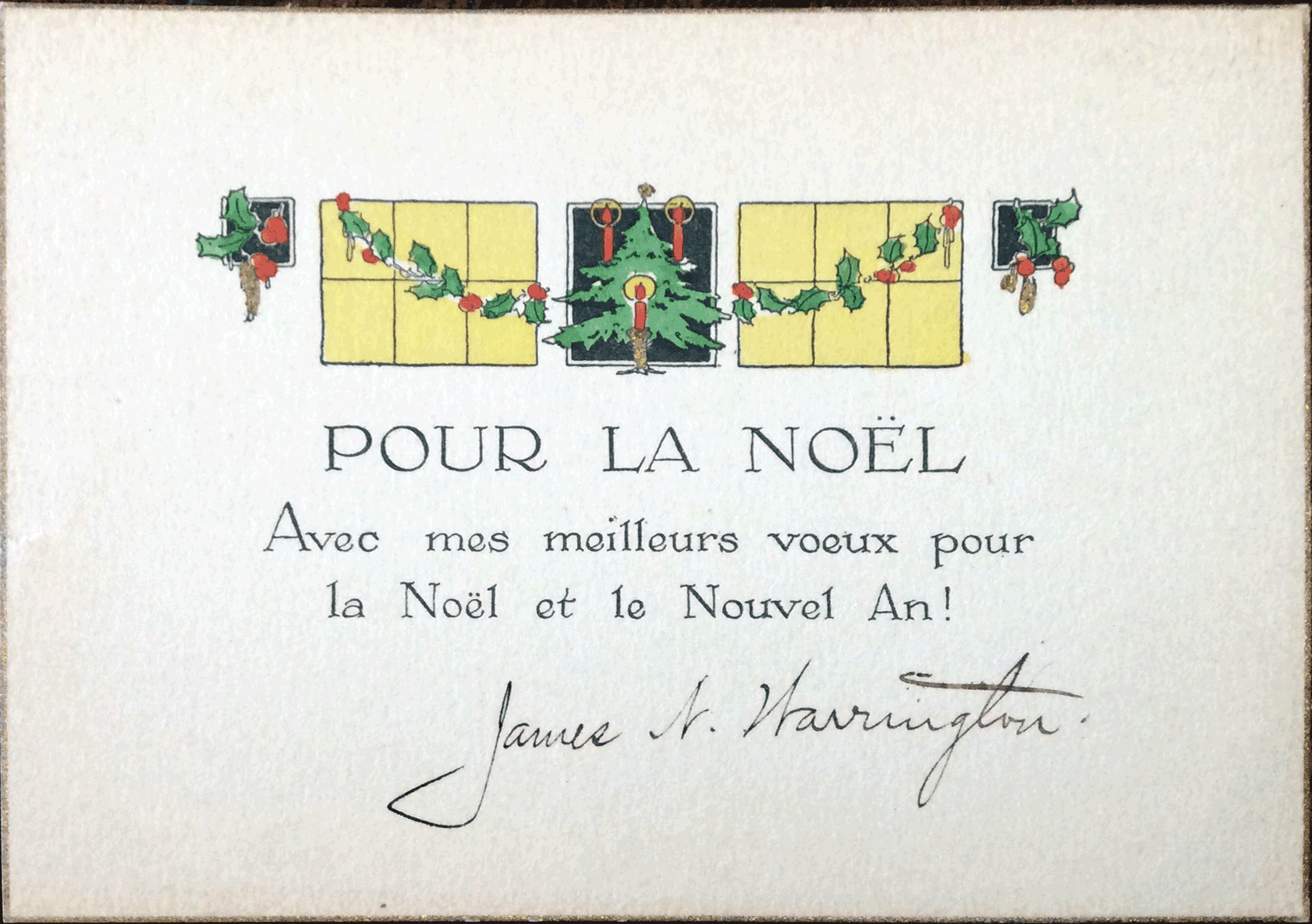
Above is a Christmas card sent by my great-uncle, James N. Warrington. Evidently the Francophone bent in the family predates marrying into the progeny of New France. Yohttps://vulcanhammer.info/2017/08/18/california-series-pile-hammers/u can read more about him and his accomplishments here.
-
@AndyStanley and his own "War on Christmas"
Or, more precisely, the Virgin Birth:
Andy Stanley, founder of North Point Ministries, a network of six congregations across the Atlanta metropolitan area attended by 30,000 worshipers a week, said in a message Dec. 3 that one of the challenging things about Christmas is the “unbelievable” nature of stories in the Bible describing Jesus’ miraculous conception.
“A lot of people don’t believe it, and I understand that,” Stanley said. “Maybe the thought is they had to come up with some kind of myth about the birth of Jesus to give him street cred later on. Maybe that’s where that came from.”
There are three parts of this debate.
The first is Stanley’s follow-up statement:
“If somebody can predict their own death and their own resurrection, I’m not all that concerned about how they got into the world, because the whole resurrection thing is so amazing,” he said.
It never occurs to Stanley that someone who rises from the dead had the same power leading up to that event, including but not limited to being born of a virgin, and the power to do miracles that Stanley’s fellow Baptists have fought to deprive the church of after the death of the apostles.
Second, we live in a day where alternative methods of procreation other than male-female union, including but not limited to cloning, are being discussed as within our reach. That being the case, how people struggle with the “scientific” problem is beyond me.
Third, Stanley is playing into the modern and post-modern mentality that nothing happens without sex. That, I think, is the biggest stumbling block to the Virgin Birth on a practical level.
The Greco-Roman world, however, had a pretty wide-open society when it came to sexual morality, including the adventures of their gods and goddesses. The Virgin Birth, where something really important took place without sex, broke into that world. That among other things put the Christian sexual ethic at odds with society in general, something we are experiencing today.
Although it’s counter-intuitive now, that was part of the appeal Christianity had. That might still be the case were it not for popularity seekers like Stanley, whose appeal in the Evangelical world is likewise beyond me.
Today many are saying that Evangelicalism is losing its appeal, and that it’s harder to get people to admit to the label. It’s getting hard for me to admit to it too, but that’s because of bottom feeders like Stanley who do not understand that while grace is free, living for Jesus is costly.
-
Russell Moore Loses His "No Win" Position
Now Moore himself, as the ERLC leader, is under attack from some of the religious right figures he criticized during the campaign…
“There are a number of churches that I have heard of in the SBC, fairly large churches, that are going to withhold their funds from the ERLC,” Harrell says, “until this gets straightened out.”
This was predictable, and I did so for both of the Moores (the other being Beth) who are in the doghouse over this. Back in October, I made the following prediction:
The second is that it puts her (Moore) in a classic no-win position. If Trump wins, she’s on the losing side, and Evangelicals are too busy running a popularity contest to want to be there. If Hillary wins, she’s going to eventually have to explain the bad consequences of an inevitable kulturkampf which is coming in a Clinton presidency, or that the neocons are mostly behind her because they think she’ll get us into another war.
Given Trump’s nature, a more sensible approach would have been for Christian leaders to have made the decision on practical grounds and skip the gaudy rhetoric. (After all, choosing the candidate least likely to throw you in jail isn’t insignificant, is it?) But Moore on the one side and leaders like the Jr. Jerry Falwell on the other couldn’t resist grandstanding the issue; since Moore is on the losing side, he will have to bear the worst of the blowback.
The biggest threat to Evangelicals of a Trump presidency is the one not verbalised: the nature of success. Evangelicals have told the country for years that their clean-scrubbed ideal is the best way to run lives and nations. Trump may well prove successful, but it won’t be clean-scrubbed by any stretch of the imagination. Being put in the situation where the Evangelical way isn’t the “way up” on either side of the street is a dangerous place in these United States. (Mormonism is in the same place, which is why they waited so late to break for Trump; Mitt Romney is the first casualty of that situation.)
Which leads me back to another question: after this boffo performance by Evangelical leadership, you guys sure you want to repeal the Johnson Amendment?
-
Mirroring Our Creator
Not too long ago, while grading homework for a course I was teaching, I saw a “better than usual” performance from one of my students. I noted that, if she would consistently concentrate on what she was doing, she was capable of very good work. The response I got to this was as follows:
I just stumbled across the feedback you gave me…Thank you for that. It’s nice to hear those things once in a while, and especially from a professor of your calibre.
My response to this was as follows:
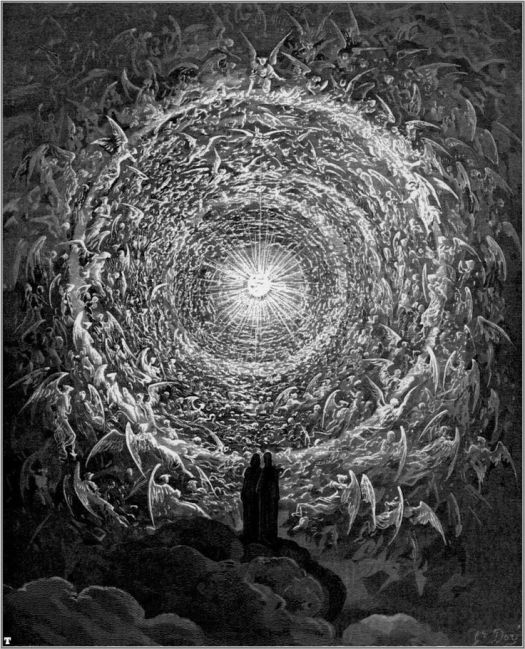
At the beginning of his poem Paradiso, Dante wrote the following:
The glory of Him who moves all things rays forth
through all the universe, and is reflected
from each thing in proportion to its worth.Our first task in life is to point the mirror in the right direction.
I’m sure that it’s the rare professor in the College of Engineering and Computer Science that would quote Dante in a communication with a student, but doing so brings up some things that need to be said.
Today the concept of “equality” is endlessly paraded before us. In practice, however, equality is a tricky concept. It’s one thing to pass some legislation and give each other the high-five that we’ve moved towards a more just society. It’s another to achieve real equality. To do that would require either that we accept that everyone have the same outcome (which was a goal of Communism) or abolish any kind of reward for performance, and frankly we’re not near either one.
No where is that more evident than in education. In spite of the levelling efforts of the last fifty years, we still don’t have real equality, not only among the students and faculty but among differing institutions. There are many reasons for this but the most important one is that people are not the same; thus, inequality is built into the system from the start.
A teacher is presented with a varied lot each time class assembles. In addition to differing levels of intelligence, there are other things that vary. Students learn differently one from another. Some take too many courses in one semester. Some work full-time jobs and/or have a family. Some do both, which can be a real disaster. Some experience personal tragedy, either going into their studies or during them.
It’s tempting for an academic to focus on their “best” students. Having worked in industry first, I am aware that there is more to life than academic performance, and I’ve seen in class that the “smart” students aren’t always the ones who come up with the best solutions, especially on projects. That tells me that, as one of my own professors observed, testing may not be the best was to gauge performance, but it’s the best we’ve got. We need to understand its limitations, along with those of the whole academic system.
Getting back to Dante, he lived in a world where inequality was accepted as a fact of life. But he also lived in a Christian world where each and every human being had worth to his or her Creator. Each of those creatures should reflect whatever glory their creator put in them; if they did so, they fulfilled their purpose, and found their value in doing so.
Today our obsession with “equality” leads us to try to do all and be all. But our God doesn’t expect that, and neither do I. As a professor, what I want to see from my students is their best, to bring out that which their God and their creator has endowed them with. If I get that, I’ve succeeded and they’ve succeeded.
That is what I meant by my comment: our first task is to direct ourselves in such a way as to reflect the glory of our Creator best, and that first is towards Him. But that leads to another point of the Paradiso: we get to the point where we realise we cannot achieve our true goal without God’s help and presence in our lives. To fully reflect the glory of our Creator and to fulfil his purpose for us requires that step, and for that the provision is his, not ours.
To make that step, click here

Sailing the Last Voyage with Newton and Pascal
 Positive Infinity