Home

  • The Tory Contender Labour Fears–Unherd

    It’s not easy judging a prospective leader. In 1955, Anthony Eden was the most impressive prime minister-in-waiting that Britain had ever seen. Put to the test in the greatest conflagration in world history, Eden had emerged with his reputation not only intact, but enhanced. He was brave, smart, absurdly handsome and experienced. And yet, within two years of taking over from Winston Churchill, he resigned as a broken man, having overseen the worst foreign policy blunder in Britain’s postwar history — until Iraq.

    Read The Tory Contender Labour Fears

    All these accounts contain elements of truth, of course, but as the conservative commentator, T.E. Utley, frustratedly pointed out at the height of her power in the 1980s, almost all popular accounts of Thatcher underestimate the extent to which she was also, fundamentally, a far more pragmatic and skilful politician than she is usually given credit for, willing to dodge, weave and compromise to win power and then keep it. “It is inconceivable that her devotion to doctrine would ever persuade her to do anything which was plainly politically suicidal,” Utley observed.

    The same kind of flexibility can be said of Ronald Reagan as well, although his ideologue successors have likewise conveniently forgotten this. Donald Trump has shown some of this, but he is too often in his own way, which is why this election is not a romp for him. Unfortunately, as noted in Tim Walz and Midwestern Resentment, it’s too tempting for politicians to simply spew talking points rather than speak to needs. It gins up the base but doesn’t get past that, which is why our gridlock is self-perpetuating.

  • A Reminder of What Happens “When Church Becomes Pointless”

    One of the oldest posts on this blog–one that has survived platform changes over the years–is When Church Becomes Pointless.  Written in 1997, it was primarily directed at the Episcopal Church, where I was raised, but as evident then and now it can happen to any church.

    That time was an interesting one in Episcopal History.  (What time has been boring the last half century?)  The Episcopal Church took a major fall in its attendance since the tumultuous days of the 1960’s and 1970’s, and by the time I posted the original piece the downward trend had levelled off or even shown a small uptick.  That didn’t last long: in 2003 the church opted to ordain V. Gene Robinson as bishop and that began an era of conflict and more downward trends that resulted in much litigation and the formation of the ACNA.  The decline has continued, mostly now driven by the church’s aging demographics.

    Driving the downward trend was the existence of serious unbelief in what the church traditionally taught, and few believed less and talked about it more than the bitter Southerner John Shelby Spong.  So how would people react to being told this from the pulpit?  In my original piece I set forth the following:

    Let’s suppose that you really believe that a) the basic teachings of Christianity are false and b) that you’re idealistic enough to want to “do good” under the new rules. What’s the quickest way of getting going? Well, to start with you have the usual plethora of political groups, environmental organizations, the government, the United Nations, and countless other organizations that have nothing to do with the church but which propagate your message. All your church is succeeding in doing is to add one more organization to the confusion. It would be simpler to simply dispense with the church and proceed with the secular organizations.

    So let’s take this a step further; suppose you are sitting in an Episcopal pew listening to John Shelby Spong go on about why the basic truths of Christianity have no basis in reality and that those who teach them are a bunch of morons. Suppose that you finally realize that you think that Spong is right; that all that you’ve said when you’re repeated the Apostles’ or Nicene Creed is false and that the life you have is all you’re expected to get. What should you do? You should first realize that life is short and that, if you’re going to live you’d better hurry. So the sensible thing for you to do is to get up, gather your family, walk out of the church, get into your Lexus or Mercedes, and head to Atlantic City or Las Vegas or South Florida or wherever you need to go to live it up while you still can.

    That was based on the experience of the first drop, and the second, to use the BCP/KJV’s expression, was like unto it.

    So how did this take place? The demographic of the Episcopal Church–and its Main Line counterparts–explains part of this, but another important factor was the introduction and propagation of modern Biblical criticism in Episcopal seminaries, starting in the last part of the nineteenth century. Although we’ve moved from modern to post-modern criticism where we shift from “the Bible isn’t reliable enough to say anything” to “the Bible says (a) but really means (b),” the corrosive influence remains the same. It starts with the academy but then filters down through the clergy to the laity, who are the last to get the memo but the first to wonder “what happened?” when things change.

    So how to the people who brought us this justify their idea, both after the first drop and certainly after the second? There are two shared assumptions of left and right that underlie this, neither one of which hold water:

    • People “need” church. Both left and right are right about this for a certain universe of people. However, as we say in the Church of God, I have come here to tell you today that for a wide swath of the populace this assumption is wrong, and that swath is getting wider. They may need church and they certainly need God, but they either don’t know it or don’t want to face it.
    • The church needs to be “in sync” with the culture. One the left it involves adopting all of the causes of the secular left, which leaves us with the differentiation problem noted above. On the right the imperative to evangelise pushes the church to adopt the forms of the world, but eventually there comes the point where they “cross the line” and adopt the culture’s idea, and that’s where a good portion of Evangelicalism is at these days. What neither side understands is that, if the church is leading the culture, this works; when it’s following, it does not.

    So what is to be done? With churches like the Episcopal, there isn’t much with the institutional inertia that can be done. With those churches who are “further upstream” from this process, they need to recognise two things: a) they don’t need to bend to every demand of the academy, which is trapped in a system designed for scientific pursuits but applied to non-scientific ones with poor results, and b) they need to figure out where to stop in moulding themselves to fit the culture, especially in the name of the income stream.

    This is where we’re at after all these years; may God help us to discern his true will and do it.

  • Tim Walz and Midwestern Resentment

    Next week we’ll have what looks to be the last debate between the two major party tickets in this Presidential election cycle: the Vice Presidential debate between J.D. Vance and Tim Walz. It’s easy to dismiss it but in this case it has some special interest, as both parties have nominated interesting running mates, to say the least.

    Tim Walz, the Democrats’ Vice-Presidential nominee, can’t get over the fact that his direct opponent, Republican J.D. Vance, is an Ivy Leaguer. How could he be, coming from his Scots-Irish start? (I’ll bet he never asked that question about Bill Clinton, and he was a Scots-Irish politician to the core, including the womanising.) That in turn introduces another issue: why is it that the Democrats have skipped nominating Ivy Leaguers while the Republicans, supposedly the party of the ignorant and uneducated, have two on the ticket? It’s worth noting that the Democrats have done this two times in a row; Joe Biden was the first non-Ivy Leaguer President (Republican or Democrat, again including Bill Clinton) since Ronald Reagan.

    I’ll get to that but Walz’ remarks–even being proud of his students never making the Ivy League when Vance did–remind me of something that happened very early in my time in my family business when I went to see a Midwestern distributor. We were driving down the road when I mentioned that I went to Texas A&M, the undergraduate school I picked in bypassing the Ivy League. (I got a lot of flak for that, where was Walz when I needed him?)

    He cut me off in mid-sentence. “I went to the school of hard knocks,” and that was the end of that discussion. It never occurred to him that, in the early years of a very Midwestern Vulcan Iron Works and Warrington family, most of those who designed this durable piece of equipment had some kind of technical education. (That never occurred to some inside of Vulcan, either.) I always value people’s ideas no matter where they’re coming from but the concept of “the less education the better” has really grated and, ultimately, cost my family a lot of money.

    I’ve never been an advocate of the idea that those who “run the show” in our country should only come from one small set of schools. But why has this concept been abandoned –at least at the top–by the Democrats first, supposedly the party of the college educated? I think there are two reasons for this.

    The first is that the Democrats really don’t need a leader to run the show. Biden and Harris are effectively fronts for what their moneyed masters tell them to do. The United States has become like a church that’s run by the “big bucks” and the last thing same big bucks need is a strong leader who might turn on them. That’s created many of the tensions that have made this race a contest; the Democrat party, supposedly the party of unified intersectionality, has to deal with Muslim (and their deluded allies) vs. Jew, trade union vs. environmentalists, immigrant vs. native born (and many immigrants who went through the system.) The Republicans continue to nominate Ivy Leaguers because they are still the party of the aspirational, who think that they can move up too. In that respect J.D. Vance, the product of (by his own admission) a highly regressive culture, is the perfect representation of this ethic.

    The second is that, with the above step in place, they realise they need to try to connect with the people. Joe Biden is the representative of this, with his “kitchen table” appeal. This explains why it took the Democrats so long (and a disastrous debate to push them to a decision) to ditch Biden. Harris, in spite of her mantra that she was raised in the middle class, isn’t quite as convincing in this role. Walz is another ball game altogether; he is the representative of what I call Midwestern resentment.

    I’ve spent a good deal of time with Scots-Irish resentment, as I did in my piece Elizabeth Warren and the Resentful Scots-Irish. The Democrats never connected with that, which is why Warren represents Massachusetts and not Oklahoma (and can’t get past first base to become President.) But Walz is likewise a product of a culture with its own form of resentment, which principally comes out in trade unions (like the UAW) and other ways. I can remember sitting in meetings with our major foundries in Ohio and other places and looking around the room to see the “Florida retirement look” staring back at me.

    Scots-Irish and German-English cultures are two which mix like oil and water in the Midwest. Walz cannot believe that the former could produce anyone of worth, and that’s an attitude that’s more common that anyone might care to admit. The Vance-Walz debate will be an exhibit of that on stage, and I am sure that Walz thinks he will romp to victory over someone he thinks just fell off of the turnip truck.

    But he needs to be careful. True to his origins, Vance has a “good jaw.” If he can get past the irritating habit of Republican politicians to simply regurgitate talking points and speak directly to the suffering that the inept policies of the current administration have wrought on the people, Walz–and everyone else–will discover why Vance made the Ivy League and he did not.

  • Thoughts on Conception and Abortion

    This piece is different from most in that it’s a guest piece, in this case by Lee Wilczynski, who back in the 1980’s worked for a dealer for my family business. It’s a very deep piece on these subjects, which are very controversial.

    Download Thoughts on Conception and Abortion

    Lee and I are products of a tough business that makes you a realist. Neither one of us is under any illusion that convincing people of the pro-life position is going to be easy. Much of that problem comes from the deficient leadership we have experienced on the pro-life side. But what he says needs to be said, and I’m thankful he said it.

  • When Two or Three Are Gathered Together…
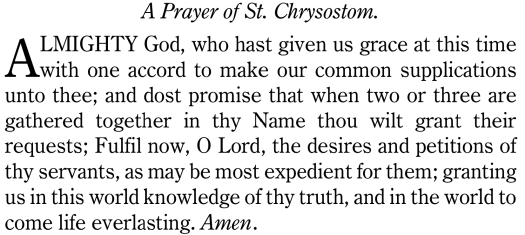
    When Two or Three Are Gathered Together…

    The prayer above is a familiar one to those who recite the traditional Anglican liturgy. It comes at the end of our petitions (and not to forget the General Thanksgiving that goes with them) and is based on the following passage of Scripture:

    Again, I tell you that, if but two of you on earth agree as to what they shall pray for, whatever it be, it will be granted them by my Father who is in Heaven. For where two or three have come together in my Name, I am present with them. (Mat 18:19-20)

    Those who are church planters or rectors/pastors or smaller churches are grateful that Our Lord set such a low minimum for a gathering number. As enamoured as we are with big crowds and churches, we should remember that the most important thing about Christian gatherings is not their size but whether our Lord and Saviour Jesus Christ is there among us.

  • Why We’re In the Mess We’re In Over Abortion

    With “election season” (which actually started with the end of the last one) officially upon us, we need to stop and consider the biggest mess the Republican Party finds itself in: the hard pushback against making abortion illegal in any stage of pregnancy.  With the Dobbs decision, I’m sure that many in the pro-life movement thought that the war was basically over and moving forward we simply had a mopping-up operation in the states, with a federal prohibition on abortion to follow.

    It hasn’t worked out that way.  Batting zero at the state level, facing more defeats in November, and with the standard bearer waffling in a major way on the subject, pro-life people are bewildered at the result.  How could this happen in the shining city on the hill, this righteous nation we’ve been taught about for the last half-century or so?

    The answer to that question is simple: in classic American fashion, the pro-life movement has been fighting an asymmetric war without really coming to grips with what that means.  For the pro-life movement, this whole thing has come down to one thing: saving the babies.  And objectively that’s what this is all about.  Unfortunately a good portion of the population doesn’t see it that way, and that’s why we’re in a mess on this issue.

    The basic problem is that, for the last fifty years or more (it’s getting to be sixty now) Americans have had drilled into their skulls that it is impossible to be authentically human without being sexually active.  In this scenario abortion is a necessary tool in the toolbox.  Buttressed by the fact that SCOTUS made it a “right” in Roe vs. Wade, large segments of the population have gone into panic mode at Dobbs and we have the result we’re getting.

    The pro-choice people are likewise in a state of denial.  The transgender movement is implicit proof that the sexual revolution has failed to bring the secular nirvana it was supposed to.  We’ve shifted from good sex to real identity.  Pro-choice people also don’t realise that they’re really no different than Chesterton’s Carthaginians.  That basically makes the United States a business deal rather than a shining city on a hill, which in turn may explain why the party of George McGovern is letting the neocons lead them around by the nose.  (The idea that this country is a business deal was set forth by Charles and Mary Beard, and they were cancelled for it.)

    If the pro-life movement ever wants a chance of getting off the backfoot in American life, they need to go to the root cause of the opposition and convince people that there’s a better way.  That’s going to take a lot of education, which in turn takes time.  We’ve lost a half century of “classroom” time and it’s not coming back.  Evangelicals can’t make up their mind whether they want to promote the Christian sexual ethic in a meaningful way or do their usual “moving up” routine with the compromise it entails.  Catholics, lost in post-Vatican II amnesia, have forgotten that they won the Roman Empire with an austere sexual ethic with the renunciation of sex at its monastic centre.

    As for me, I think we’ve lost too much time and don’t have enough left to reverse our strategic errors.  Pretty soon we will find out that the warning of the Persian “King of Kings” Cyrus is our own: that we who chose to cultivate rich plains (literal and metaphorical) will be subject to others.

  • Connecting the Dots on Bill Ayers and the Democrats

    Connecting the Dots on Bill Ayers and the Democrats

    In the wake of Robert F. Kennedy Jr.’s decision to suspend his campaign and endorse Donald Trump for President, his siblings issued the above statement.

    Evidently they in general and Chris Kennedy in particular have forgotten a few things. In 2010 Chris was involved in getting Bill Ayers denied emeritus status at the University of Illinois, and made this statement at the time:

    But in an emotional statement, Kennedy discussed his reasons for voting against Ayers’ request.

    “I am guided by my conscience and one which has been formed by a series of experiences, many of which have been shared with the people of our country and mark each of us in a profound way,” Kennedy said.

    He said he could not confer the title “to a man whose body of work includes a book dedicated in part to the man who murdered my father.”

    Kennedy was referring to a 1974 book co-authored by Ayers, “Prairie Fire,” which was dedicated to a long list of people including Robert Kennedy assassin Sirhan Sirhan and “all political prisoners in the U.S.”

    Today the Democrat Party is de facto the party of Bill Ayers, and has been so since Barack Obama rose to prominence. Their tactics–from the way they booted Joe Biden (after years of covering for his decline) and squeezed RFK Jr. himself (and Bernie Sanders, in his case twice) out of the nominating process show a party with a decidedly “politburo” mentality. Their weaponisation of the justice system (which they laughably project on Trump) is of a piece of people who have figured out at last that you can’t control society without the “pigs” (to use the Sixties lingo.)

    But those who have caved–even going against your own family–cannot see reality.

    Lights Out, Comrades.

  • The Suspension of RFK Jr.’s Campaign

    Well, it’s done now:

    His speech was one of the most interesting–if a little too lengthy–speeches of this campaign cycle. He hits our country’s establishment on a number of fronts, especially the way his own party–the party of his uncles Jack and Teddy Kennedy and his father Bobby–relentlessly squeezed him out of the primary process and repeated that during his independent campaign. Part of that was refusal of Secret Service protection, which was a brutal rejection given the family’s history.

    It’s probably worth going back a couple of generations, to his grandfather Joe, who set himself to break the power of an oligarchy, one with more going for it than the one we have now:

    Turning to Jack Kennedy, to understand the political idea of Jack, Bobby, Ted and their descendants, you have to go back to their father, old Joe Kennedy.  This was a man with an axe to grind.  Growing up in Boston, he was rejected by Boston’s very WASP Brahmin aristocracy, Ivy Leaguer though he was, because he was a) Irish and b) Catholic.  That induced hatred, hatred that passed down to the sons.  His ambitions for them were in no small measure to prove that he could beat the WASP’s at their own game, and he was largely successful, although his family paid an enormous price in the process.  In some ways their signature accomplishment was Teddy’s promotion of the Immigration and Nationality Act of 1965, when legal immigration was opened up to more than white Europeans.  My guess is they figured that, if the first wave of immigration couldn’t finish the WASPs off, the second would.

    It’s ironic that the immigration that his uncle Teddy made possible is represented by the Democratic candidate for President who has spurned RFK Jr.. But, like the Jews and civil rights, RFK Jr. is finding out that gratitude is a scarce commodity.

    Robert F. Kennedy Jr. will probably be the last Kennedy to take on the establishment the way his grandfather, father and uncle did. The rest of the clan is satisfied to trash him while integrating themselves into the current oligarchy. But my warning on the 50th anniversary of Jack’s assassination–an act we almost saw repeated–stands:

    In that respect Jack Kennedy’s legacy—or more properly his father’s—was fulfilled, but sad to say they and those who have come in their wake forgot that, if you arrange another’s Gotterdammerung, don’t forget to leave Valhalla before you torch it.

  • Why can’t the Church say ‘church’?—Unherd

    Remember Consignia — that disastrous rebrand of the Post Office? It sounded more like a sexually transmitted disease or an obscure Roman battle than …

    Why can’t the Church say ‘church’?
  • Lights Out, Comrades

    Lights Out, Comrades

    In 1988 my brother and I visited what was then the Soviet Union. Our intent was to sell them pile driving equipment for their offshore oil exploration, but before it was all over we acquired some valuable technology from them that has been useful both before and after my time in the family business. We (well, I, it was his only trip to the place, he usually got to go to Singapore and Italy) learned quite a lot about the country; had our rulers not been so boorishly provincial and more observant, they might have learned something too and avoided some of the mistakes they have made with the country.

    To get there we took an overnight train from Moscow to Leningrad. We had a two-bed (first class) compartment, but as we lumbered away from Moscow the conductor threw the master switch and the lights went out. We looked at each other. We knew. “Lights out, comrades.”

    This election cycle I get the feeling that, barring a real miracle, we’ve reached a “lights out, comrades” moment in our own history. I’ve been saying for a long time that you cannot run a country the way we have and expect it to go on in the same way. That’s especially true with an elite whose own new articles of faith have taken hold with the ascent of the Boomers, who have been beating the same drum since the 1960’s:

    • The central purpose of life is to get laid, high, or drunk. It is also important to beat down people who think otherwise, which is a big reason they hate Christianity so much. They have succeeded in propagating this idea to the population at large. A major evidence of that has been the serious pushback on abortion that has taken place since the Dobbs decision. The right thought it was over with this decision, but they were wrong. The reason for this is simple: it wasn’t about the babies (as they thought) but the idea that people weren’t fully human unless they were sexually active, and abortion is a necessary tool in the toolbox of such a mentality. (I noted that the transgender movement is a tacit admission that the sexual revolution was a failure, but Boomers aren’t much in admitting their mistakes.) Failing to recognise this in advance is a major–and potentially fatal–fault in their strategy, but it is typically American to be totally incapable of understanding the motivation of one’s opponents.
    • There are too many people on the planet, thus we must reduce their number. Getting volunteers to get the ball rolling is difficult, as I noted in We’re Looking for a Volunteer, Ted, so we may have been seeing calls for draftees. All of this in the face of declining fertility rates, but we still hear calls for fewer people, as noted in Should My Students Be Here?
    • The suburbs are full of phonies who take up too much space and consume too much. The homeless are truly “authentic,” although no one wants to answer the question “authentically what?” So, I suppose, are those who vote for this agenda, which is why we see so much appeal to suburban women this time in the election cycle. Authenticity and self-actualisation have been the hallmarks of the modern and post-modern world, but as Modris Ekstiens shows in The Rites of Spring, such quests lead to disaster. In the meanwhile getting suburbanites to lower their standards of living to suit their “betters” has been a tough sell for half a century.

    So much for the legacy of the Sixties and Seventies. Have these people come up with anything else since then? There are two things that have turned in their favour, mostly in the last decade.

    The first is that the security apparatus has flipped to the left. I don’t think anyone really saw this coming, although there have been signs of this out there for a long time. But such is understandable when you consider that the Right has adopted an anti-government agenda; what else did we expect bureaucrats to do?

    The second is the whole “equity” business. Now the call for equity–which really means that everyone who works (or doesn’t) has the same income and lives in the same circumstances–does have Marxist roots, although the American Left has never been up to a Marxist standard. This is evidenced by contrasting classical Marxism with what’s going on these days. Classical Marxism tells us that, as capitalists centralise more of the wealth and the working class is driven to the margins, same working class will revolt and establish the “dictatorship of the proletariat.” In the current equity movement same will be enforced via DEI and other race and preferred group rearrangements. But who will enforce all of this? The capitalists who have centralised the wealth in our own time, of course!

    A push towards equity is also a push against personal achievement. Why work hard when there is no forward movement for you? That push against personal achievement is the major reason why the Jews are so unpopular these days, all of the other things they throw up at you notwithstanding.

    So what is to be done? A long time ago I realised that fixing thus broken system of ours will never come from within but from without. The Right has tried to convince me otherwise but they have had 40+ years to finish the job and have not. The Left has the upper hand at this point (had they not taken 20% out of everyone’s wallet with inflation, this election wouldn’t be a contest) but they have neither the inclination nor the expertise to make the productive sector of the country the “Arsenal of Democracy” again, even to help their pet projects such as the war in Ukraine and keeping Taiwan from slipping into the “dictatorship of the proletariat.”

    Even the lights are in danger. Our masters are so unscientific and fixated on lowering our standard of living that they have embraced “renewables” as our only hope to lower our carbon footprint. These aren’t really ready for prime time yet; nuclear power is the only technology at hand to insure a base-load source of electricity until these get up to speed down the road. In the meanwhile we can expect blackouts, either scheduled or unscheduled.

    Lights out, comrades.

Design a site like this with WordPress.com
Get started