-
The Realm of the Unseen
Joshua Ferris’ post on the North American Anglican entitled Part I: Have Christians Forgotten How to See a Mysterious World? was a surprise, but one which Christians in general and Anglicans in particular need to address. For me it really hits home because much of the core of my Christian life has been driven by coming to grips with the unseen world, and having to do so in an environment which both encouraged and opposed it at the same time.
At the start let me note that the graphic chosen for Ferris’ article–Gustave Doré’s depiction of the beatific vision from Dante’s Paradiso–is also the icon graphic for this site. I’ll come back to why that’s important later.
At the start there are two facts of life that have driven me in the direction of looking beyond the physical world.
The first is that one lesson my parents–especially my mother, product of the untransparent South–passed to me quietly is that the ultimate reality–and the truth necessary to navigate the world–was “beyond the curtain” and at best not obvious to those on this side. In addition to regional characteristics it’s a product of something that was embedded on both sides of my family: Masonry, which is the progressive revelation of secrets to the initiate and also relies on truth–such as it believes to be there–to be “beyond the curtain.” That may not seems remarkable, but in a country of “poker playing dogs,” it means that anything you say that goes against whatever CW the culture attempts to drill into you will get a sharp reaction.
The second that, as I have alluded to over the years, my coming to Jesus Christ was the result of direct divine intervention, complete with a command to repent and read his Word, and a focus on being baptised. When my mother and I went to our Rector at Bethesda-by-the-Sea Episcopal Church, one Rev. Robert B. Appleyard, D.D., blew me off when I mentioned my encounter with God earlier in the year. (Yes, Diocese of Pittsburgh types, that’s the same Robert Appleyard who was later your bishop.)
More broadly, the reaction I do get from Christians has been either one or two things: similar to Appleyard’s, or the shock that I would become a Christian without going through the “system.” Evangelicals may proclaim that they don’t believe in one true church, but they do believe in one true system of getting saved and joining the church, and the distinction of the two on a practical level isn’t as great as either side would have you think. It’s so bad that, in the More than Dreams video of the Nigerian Mohammed, who saw Jesus in a dream and came to him there, Mohammed was forced to go through the “conversion experience” all over again by an Evangelical minister!
Outside of Christianity things actually get more interesting. I cover an encounter with a New Age type in my post To Reach a Destination, You Have to Have a Course: My Reply to Ron Krumpos, and to Rob Bell Too. Turning to what my Algerian lab assistant referred to as “the religion,” I had a long email debate with an Indonesian Salafi geotechnical engineer who, when I mentioned my experience, had only one question: “What did He (God) say?” On a slightly lighter note, when my PhD program was in trouble, one of the Iranian faculty members believed that our situation was due to “bad spirits” in the main engineering building! I think that, unless we recover the reality of the unseen, we’re going to be at a disadvantage vis a vis Islam.
All of that is one reason why I’ve stuck with being in a Pentecostal church. I don’t think that Anglicans, in common with other Christians such as Baptists and Presbyterians, have made the link between believing who God is and what he has said through his Word and his present supernatural operation in his people. It’s a lot easier to believe the Scriptures when the same things recorded there still take place today, done by a God who has not changed. The weakness of Pentecostal and Charismatic churches is that they spend too much time hanging around their Evangelical counterparts, which means that they focus too much effort on getting God to show up when the preacher does and not getting preachers and laity alike to show up when God does.
As far as Ferris’ recommendation to start with Dante, I cover that in my post Book Review: Dante’s Divine Comedy (Inferno, Purgatorio and Paradiso). Encountering it was life changing, not only in the church I went to but, followed by actually reading Aquinas, saw a merger of the spiritual and intellectual that has served well through the ups and downs of life in church ever since.
Anglicans have done themselves a disservice adopting an uncritical acceptance of cessationism, one that has done more damage then they realise. Until we understand that the ultimate reality is one we cannot see, we will not be able to deal with the demonic forces that are coming against us.
-
Coming Home from Heathrow
In 1976 I made a month-long trip to the UK. At the end of this I headed to Heathrow Airport for the flight back to Miami and from there home just up the coast. Originally written in 2006, I’m reposting this with a few modifications on the fiftieth anniversary of the flight and of the trip itself. Its relevance is undimmed, especially with events after October 7. I apply the label “prophetic” sparingly but this is more like, as an employee of mine would say, “Only a fool couldn’t see it coming.”
Any time terrorism or its threat strikes our air travel system, things turn into a mess, with long lines, cancelled flights, and a lot of precious cargo ending up as rubbish. Our security agencies keep “moving the goalposts” on what’s contraband on board and what’s not in response to the latest threat, successful or not. Because of the drastic change in security wrought by 9/11, we’re conditioned to start our “security clocks” at that date.
In reality, things really got going on airport security in the late 1960’s and early 1970’s in response to two events. In North America, people were hijacking planes and taking them to Cuba. In Europe and the Middle East, the Palestinians were hijacking planes and blowing them up. Zero Halliburton tried to capitalise on this: their advertisements showed their aluminium luggage surviving the plane’s demolition. So, when it was time for me to make my first overseas jaunt to the UK, I trotted off with a Zero Halliburton case.
I spend some time—probably too much—on this site about my first trip to the UK. From Hergest Ridge to watching a film about Mohammed with a theatre full of his followers, the trip was fabulous. But it was also at an important point in my own walk with God. I had grown up in a church and society which tended to set definite limits on how transforming the power of Jesus Christ in one’s life could be, and now those limits could be discarded without retreating into a monastery.
In this quest I was not alone. As an engineering student, I had many friends who were experiencing the same kind of thing. Some experienced renewal; others were simply reborn in Jesus Christ for the first time. For me, I had concluded that ridding our country of those who were destroying it was beyond the existing political process. Living in love with fellow Christians deflected my thinking from that. Many of those watching us thought we had gone off of our individual and collective rockers. But the aftermath has been singularly boring: most have married and raised families in the intervening years, complete with gloriously bourgeois careers in industry or government.
Thinking about engineering students in the 1970’s should make a person think about one in particular. The scion of a successful family, he wandered about his native region as a student, visiting various places of sin on the way (sangria at the Mexican restaurant was about as far as most of us got in that.) At one point, this engineering student had a religious experience that changed his life and catapulted him in a trajectory that ended up crediting him with a well-publicised “engineering” feat: the destruction of two of the world’s tallest buildings. The student, of course, is Osama bin Laden, and the buildings were the World Trade Centre, destroyed on 9/11. The religion is Wahhabi Islam.
Liberals, of course, would be unhappy with both of the courses taken on either end of the oil patch (they weren’t happy with the oil patch either.) But they need to have a serious, collective reality check and come to the understanding that all religion isn’t the same. There’s a significant difference between people who’s most potent political weapons are prayer and the ballot box and those who are willing to kill themselves if they can take enough “infidels” with them. Christianity has, in some ways, been too kind to its mortal enemies. Think, for example, what the result of l’affaire Dreyfus would have been in an Islamic state rather than Catholic-secular France? Dreyfus wouldn’t have made it to Devil’s Island, let alone back.
Getting liberals to see daylight isn’t easy. In the meanwhile we must go on, hoping that our civilisation has enough grit to stand down its most serious rival this century without throwing Christians into jail to satisfy their leftover hatred from the last one. The stakes are high because, if the West fails, all of these baubles we count as necessities will vanish and there will be no coming home from Heathrow—or anywhere else.
If you want to see the message that made the difference, click here.
-
Advice to Graduates: The Two Promises I Made to Myself
Ten years ago, I received my PhD and published this. I don’t do much “practical life advice” but this was an exception. I trust it will be helpful.
It may seem an odd time to do a pseudo-graduation piece. Obviously the University of Tennessee thinks so: this weekend I am supposed to officially receive my PhD degree, but the university, having spent a great deal of money on a new, traditional looking quad, doesn’t do an August graduation ceremony, with a graduation speech of any kind. So this will have to suffice.
In accreditation standards, this degree is referred to as the “terminal degree.” I agree: by the time you’re done with it, you’re just about dead. But I have other things to commemorate this year. One of those is the twentieth anniversary of our family divesting itself of our business. Accompanied by the loss of my father and brother, it was one of those times when everything was different at the end than it was at the beginning. In the wake of those events I took stock of things, sought God and made myself two interrelated promises that I have pretty much kept in the score that followed. I think they’re worth passing on because, in the midst of swelling words, it’s easy to lose sight of practicalities.
The first was that I would never again allow myself to be dependent upon one source of income. Up until that point the family business—a company with one product to boot—had been my main livelihood for eighteen years. In those years it was impressed upon me that, from a professional standpoint, the business should be like segregation to George Wallace: first, last and always. Although I had the usual consulting contracts, they wouldn’t last that long, and there were the equally usual non-compete agreements in them. With the unhappy memory of every day being a “hero or zero” event, I decided to diversify my income. It’s been very helpful. We’re supposed to sleep a third of the time; that decision made that third (and the other two-thirds) a lot happier.
One of those diversifications has been my online activity, which started the year after the business went away. It hasn’t been the most lucrative thing, but in the process of putting stuff up I’ve delved back into our family history. We’ve been successful since we’ve been here, and for my father’s family that’s about a century and a half. Much of that success has been due to the diverse nature of the income: my great-grandfather’s yachts, my grandfather’s cars and airplanes, etc. Even the “one product” family business, at the turn of the last century, had a diverse offering which included bridges, dredges, and other products. There was a historical lesson that had been forgotten, and this is a country which habitually forgets historical lessons.
To make that really work involves another family habit: living below your means and staying out of debt to the greatest extent possible. That flies in the face of a credit-driven society driven by instant gratification, and it isn’t always easy in a country where wages are compressed the way they are. That being so, without it, the advantage in your life will always shift towards those who make the payments.
The second was that I would never let my professional (or other) identity be taken over by another institution or individual. This will take a little more explaining.
When your family has been in our business as long as ours was, the public image of the two tend to run together. But which came first? My great-great-grandfather started the company in 1852, sold it eleven years later, his sons bought it back in 1881, we got out of it in 1996. It should be obvious that the company was ours as long as we had it. But that wasn’t the message I heard, especially from the family and those in the company. The message I heard all too often was that the business made us what we were and that we owed the business in perpetuity because of that. That justified the aforementioned idea that it should be the sole source of income.
Getting out of the business didn’t solve that problem. I worked for people who wanted my professional identity completely contained in the work and institution which they ran. That wasn’t any better at what was strictly a job than it was at my own business. But there are others who saw it to their advantage to let “me be me” and they reap the benefits from that. In those cases it’s been a “win-win” situation for everyone. (Remember that, in job hunting, they’re not only choosing you; you’re choosing them.)
There are two parts to this issue: the practical and the “theoretical.” From a practical standpoint, in a world where companies, institutions and even lines of work are in a perpetual state of upheaval, it doesn’t make sense to have one’s reputation in the marketplace dependent upon one institution. Sometimes one can end up the “last man (or woman) standing” in a profession, where the skill set has gone out of currency and you’re the “go-to” person. But even then the reputation needs to be yours, not your employer’s.
The “theoretical” part is a little trickier but just as important, because it goes to how you look at life in general, which in turn will determine where that life goes.
Christianity teaches that we derive our worth and value from God who created us and made our salvation possible. That being the case, it’s always amazing that, in what has been up until now a predominantly Christian country, that so many in church every Sunday pursue personal validation in this society with such gusto. We insist on driving the proper car, living in the proper house, and raising the proper children to communicate the message of success, when the Gospel tells us that none of these things is necessary for happiness.
Secularizing the country will only make this problem worse, because it takes away the alternative to worldly success without obviating the need for perpetual validation in the society. The enforced online groupthink, where we are forced to go along with the herd’s course or else, is only the most distasteful manifestation of this problem. Consider the matter of same-sex civil marriage; in a society as polarized as our is and where cohabitation is as common as it is, it’s really strange that neither or both sides could bring themselves to pitch the institution of civil marriage altogether. Everyone argued under the assumption that the state had to validate a marriage in order for it to be one. The same thing goes for our elite institutions. Whether they provide a better education is open to question; whether they confer on those who endure their degree programs a glow of respectability is not.
I used to think that my family I was born into didn’t like my Christianity because it put God in charge of things, not them. That’s true as far as it goes, but the more I think about it the more I realize that they didn’t like the fact that God defined who I was and not them. The person who defines who you are controls you, which is why identity is such a big deal in this society. My God loves and forgives, and that’s more than I can say about many people and institutions in this world.
These, then, are the two promises I made to myself past the mid-point. I am glad I did. I think you will be glad if you do too. May God richly bless you.
-
The Methods and Effects of the Oxford Movement on Missions in Victorian England — North American Anglican
This is an excellent post and I commend it to my readers. The way Anglo-Catholicism has gone–especially on this side of the Atlantic–one wouldn’t normally associate it with missions but here we are. I have a couple of comments to make:
It was not enough, Pusey argued, based on Romans 10:14, for Bibles to be simply translated and distributed around the globe without a teacher of the faith to proclaim the message of the gospel.
I attend a Bible study at my church led by Dr. R. Lamar Vest, former president of the American Bible Society. One of his objectives as president of that organisation was to get it past just translating and distributing Bibles and facilitate the reading and studying of the Bible as well. Obviously sending “boots on the ground” was beyond the Society’s mission but the recognition that it’s necessary to do more than just get the Bible out the door goes back a long way in Christian missions, and still needs to be emphasised.
Since Protestant churches overall did not seem to be earnest for missions, Stephen Neill notes that this was the era of “voluntary societies, dependent on the initiative of consecrated individuals, and relying for financial support on the voluntary gifts of interested Christians.”
I got in a lot of trouble for pointing this out based on another source, and you can see the online food fight that followed in my post The Reformation and Missions: Theology and Doctrine. The tricky part has been how to integrate the churches founded outside of the home country with those within, and that issue is very much with us today, as I pointed out for my own church in Some Thoughts on the General Council Agenda for the 2026 Church of God General Assembly. There are numerous solutions with uneven success (the Anglican Communion is a prime example of that) but I think that, for all its difficulties, Modern Pentecost has finally matched Roman Catholicism’s ability to expand Christianity outside of a “home base.” That, in turn, was laid out by none other than Roland Allen, who was mentioned at the end of the piece and whose work is linked to in my post Modern Pentecost’s Use of an Anglican’s Missionary Method.
-
Some Thoughts on the General Council Agenda for the 2026 Church of God General Assembly

Well, it’s that time again: at the end of the month the Church of God (at least some of it) meets in Orlando for our General Assembly. From a formal procedural standpoint it’s a two stage process: first the General Council of ordained bishops meet to debate and pass on appointments and resolutions/changes to the minutes and then the General Assembly (consisting of everyone) makes final approval or disapproval of what the Council has voted on. It’s not a delegate system but a “whosoever shows up” system.
It took me a little longer than usual to get the General Council agenda for this year but it’s here. Thanks to an odd (and fairly recent) quirk in our elected officials’ terms, the General Council/Assembly doesn’t vote this year on the Executive Committee (Presiding Bishop, the three Assistants and the Secretary-General) but other elective positions are up for a vote. I don’t get into handicapping these elections; I stick with the agenda, and it’s an interesting one this year.
One thing that isn’t on the agenda this year is WO. Given the way the ACNA and the SBC have heated up their politics on this issue, it’s probably for the best, although there are some other items that should have likewise stayed off of the agenda. So with that in mind here goes: I won’t reproduce the agenda itself, you can see the whole thing by downloading it here.
Global Harvest
This is one of those “mother, apple pie and the flag” resolutions that nevertheless should be restated from time to time. It is the core mission of the Church of God. One good addition is the commitment “To engage in advocating for religious freedom around the world,” something the Church of God has not been very proactive doing (unlike the ACNA, for example.) One thing that really needs discussion is putting the Church of God internationally on a “even footing,” instead of the implied home/mission field dichotomy, in its governance.
Ordinances of the Church
I hate to be the fly in the ointment, but I don’t think that giving people a blanket indult that those who are at the Lord’s Supper to be “allowed to participate.” We need to consider the following:
23 For I myself received from the Lord the account which I have in turn given to you-how the Lord Jesus, on the very night of his betrayal, took some bread, 24 And, after saying the thanksgiving, broke it and said “This is my own body given on your behalf. Do this in memory of me.” 25 And in the same way with the cup, after supper, saying “This cup is the new Covenant made by my blood. Do this, whenever you drink it, in memory of me.” 26 For whenever you eat this bread and drink the cup, you proclaim the Lord’s death-till he comes. 27 Therefore, whoever eats the bread, or drinks the Lord’s cup, in an irreverent spirit, will have to answer for an offence against the Lord’s body 28 and blood. Let each man look into his own heart, and only then eat of the bread and drink from the cup. 29 For the man who eats and drinks brings a judgement upon himself by his eating and drinking, when he does not discern the body. 30 That is why so many among you are weak and ill, and why some are sleeping. 31 But, if we judged ourselves rightly, we should not be judged. (1 Cor 11:23-31)
The lack of a penitential rite of any kind preceding the Holy Communion is a major fault of the way it’s done in Evangelical and Evangelical-Adjacent churches in general and ours in particular. In the past our people were exhorted to examine themselves, but in some cases that’s gone by the wayside. Any call to “come to the table” should be done with either of these approaches as a part of that, this resolution doesn’t address that important Biblical issue. Personally I think we need to work on losing Bill Clinton’s Eucharistic Theology: It Depends on What ‘Is’ Is, but that’s another uphill battle…
Elected Officials
My wife was speaking with a friend who was comparing the salaries of some leaders of parachurch ministries with our Executive Committee, and was surprised that our EC people were paid much less than the parachurch people. Being the International Offices veteran that I am, I was handed the phone and assured her that our people were doing just fine because of the honoraria and other outside income they were allowed to have.
That loose attitude towards outside income goes back to the beginning of the church, when our church people and their ministers were very poor and preachers were “pounded” (with pounds of food.) I’ll be honest: I collected a few of those honoraria myself while working for the church, most unexpected and grateful for all of them. I never thought until I spoke with my wife’s friend that there was a real upside for the church in our “loose” policy!
But let’s get real: you can only have one full time job. This kind of “double dipping” goes too far. The one thing I would change is the time to make the transition. I would do ninety (90) days at the most. The one hundred eighty (180) days is too long, it spans a quarter of a two-year term.
Filling the Vacancy of the Secretary-General
This is a technical correction, and I think it’s fine.
Youth and Discipleship Board, Boards and Committees
We did some “house cleaning” in 2010 that we shouldn’t have, and getting rid of this board–of a large and important part of our International Offices–was one of them, and bringing it back is a good idea.
Full disclosure: I am a member of one of those divisional boards (Care Division) and it’s one of the best things I have done in the Church of God, being involved with great ministries and interacting with the people on the board and in the division. For those who think that these boards are an expense, they are not: members are leaned upon to financially support the ministry the board oversees. And it’s worth noting that may of the ministries my board oversees (Chaplains’ Commission, Real Life Village, Smoky Mountain Children’s Home, etc.) have their own boards. So this move has precedent.
Related to this is another amendment to the minutes, that all board members in these kinds of boards be members of the Church of God in good standing. This is also a good idea.
Modifying Exhorter Licensure
This ministerial credential is a sort of diaconate for those outside of the church. “Doing something” about this has been kicked around for some time and this would do a number of things, from requiring specialisation in the credential to having to renew it every two years. I think the last has the idea that the exhorter’s licence–which is to be renamed “licensed minister”–is a transitional phase to becoming an ordained minister (who don’t and won’t have that requirement,) and would force these people to “fish or cut bait” on their ministerial calling and course. This is opposite of what many churches are doing, but it wouldn’t be the first time we lived in an alternative universe.
Ministerial Reporting
Our ministers at all ranks are required to report their statistics and activities. Now our minutes will reflect that this is done online. One interesting sideline is that, if you retire from the ministry, you need to separately petition not to have to report. This is because some of our ministers never really retire. I remember recording a men’s ministry for a church back in South Florida, and the pastor’s status was recorded as “retired.” Turns out he had pastored in New York state, “retired” and then took on another church in Florida!
Anti-Human Trafficking
This is necessary, especially considering that many of our members both here and elsewhere are more subject to this than we might think, as many live in poverty.
Ethical Use of Artificial Intelligence
This is also timely. In a recent post on another website, I said the following from a pedagogical standpoint:
AI, for all of its potential and actual benefits, encourages mental laziness. There, I said it.
We can add spiritual laziness to that, and this resolution addresses that.
Immigration
Given the heated debate over this, I wish we didn’t have to deal with this topic. The way the framers of this resolution tried to get around it was to reaffirm a 2012 resolution (you approved this once…) This may or may not work in the present climate.
Putting aside the political objectives of either unrestricted or severely restricted immigration, as a church if we do not grow our church with nonwhite people groups (and most immigrants are) we will neither grow at all nor fulfil our mission as a Pentecostal church which seeks to see the Spirit poured out on all flesh. Most of the people from elsewhere who populate our churches are hard working God fearing people, the kind of people a nation which has its head on straight really wants to have.
Limited Ministry/Restoration Process
Our church has a good ministerial restoration system. I guess I’m biased because of my role on the Care Board (which directly oversees this) has informed me of what we actually have. There are two extremes to be avoided: one where any infraction means getting your license pulled with no recourse and the other just letting things and people get away with anything. Unfortunately there are supporters of both. I think both of these resolutions are fine.
Offending Ministers (Ministerial Discipline)/Rights of the Plaintiff in Ecclesiastical Trials
The ACNA has made these processes something of a legend these days. Our system is not as convoluted as theirs but we do have ministerial trials, I discussed one last year. These resolutions tighten up some of our procedures, which is not a bad idea.
State Women’s Ministries Board
Women’s Ministries have been in the Minutes since the 1920’s, so it came as a shock in 2010 that the department for those was abolished along with our Lay Ministries department, which handled Men’s Ministries. So, like the Youth board, this is a restoration of something we had before. Men’s and Women’s Discipleship is now one department and has made progress from its beginnings.
Financial Transparency in Pastoral Appointments
The idea that a prospective pastor should have access to a prospective church’s financial condition is only fair for a pastor coming into a church. I think, however, that we should also include the opposite: any church considering a prospective pastor should have information on the financial status of the church he or she is leaving. It is not right to bounce ministers which do not have some basic financial discipline from one pastorate to another.
The Church
This is an item that, on the surface, is another “mother, apple pie and the flag” business, but if we dig a little we will see that there are some issues it doesn’t address (or readdress) but needs to do so.
Let’s look at a quote from the proposed resolution:
That the Church of God is a New Testament church, which recognizes the local church, delineated by its geographical setting, as the foundation of all ministry activities where the pastor nurtures and leads all members to exercise spiritual gifts.
What this means in practice is that the pastor is expected to receive the vision from God, communicate that to the congregation, and the latter is expected to follow that vision. I’ve heard this enunciated from the pulpit on numerous occasions, including our Presiding Bishop. It in turn brings up another question: where does the Church of God and its ministers get their authority? It’s a question I’ve been asking since my 2007 piece Authority and Evangelical Churches and dialogue with the “Ugley Vicar” John Richardson (of blessed memory) three years later entitled Women in Ministry and Authority in Churches: A Response to the Ugley Vicar (and the issue of WO is most assuredly tied up in determining the concept of authority in churches.) And I haven’t gotten much in the way of answers.
The Church of God actually addressed this issue head on in our first General Assembly in 1906:
Our Articles of Faith are inspired and given us by the Holy Apostles and written in the New Testament which is our only rule of faith and practice…After due consideration the Assembly accepted the following motto or ruling: We do not consider ourselves a legislative or executive body, but judicial only. (from Like a Mighty Army.)
As a judicial body the General Assembly (and by extension the entire church) can only interpret the laws, which was the accepted way American civics was taught back in the day and which has been brought back into fashion (much to the consternation of half of the electorate, alternating between which half.) This means the the church’s mission is to carry out and live by what was left by same Holy Apostles in the Scriptures. It is not to legislate. The authority of God is the only authority that matters.
The ideal for a Pentecostal church is a church led directly by the Spirit in accordance with same New Testament. Unfortunately the unique pastoral demands of Pentecostal congregations–specifically the exercise of the manifestations and gifts–coupled with the nature of our congregations have led to a more authoritarian system, which has deflected us from that ideal. The resolution’s emphasis on the church being the people of God is a salutary step in that direction but our structures need to reflect our convictions in that matter. In saying this I don’t want to give the impression that I believe the Church of God has this problem all to itself. Anyone who lived through the Charismatic Renewal in the 1970’s knows that, when compared to the excesses of the Shepherding Movement that Pat Robertson called out, the Church of God had an superior pastoral system informed by years of experience. It’s one reason why, on an operative level, our church feels more like a family than an institution.
I think the best solution to the problem is to add language to it which explicitly reproduces the quoted sentiments from our first General Assembly as to where the ultimate leadership of the church–credentialled ministers and laity alike–must come from.
Priesthood of All Believers
This is set forth because, as the rationale states, “…prevalent belief systems involve intermediaries as a theological necessity.” These usual suspects are the Roman Catholics. Coming from a department which definitely promoted this concept, I’ve come to realise that this whole subject needs a deeper dive.
When I co-authored Ministering at the Altar about twenty years ago, it became apparent that our use of the term “altar” didn’t line up with the term’s use elsewhere, including the Scriptures. With that reality I did my best to close that gap. In both Temple/Tabernacle Judaism and Roman Catholicism, the altar is a place of literal sacrifice, and putting the two in the same breath is intentional.
Non-Catholics generally associate the intermediary business with the confessional, but the principal point of mediation is the Sacrifice of the Mass. Roman Catholicism considers itself the replacement for Temple Judaism, which is why its enthusiasm for the State of Israel is and always will be lukewarm at best. The sacrifices performed there when Our Lord was on the earth are continued, in their idea, on the altars of Catholic churches–be they against or pulled out from the wall–every day.
I have pushed back against this concept in my piece Why I Don’t Agree With the Concept of the “Sacrifice of the Mass” and elsewhere. Contrary to their teaching, it is unnecessary to agree with this idea to then believe and be convinced of the real presence of Christ in the Eucharist. I’ll reproduce the classic Anglican formula for the consecration of the elements, from the 1928 Book of Common Prayer:
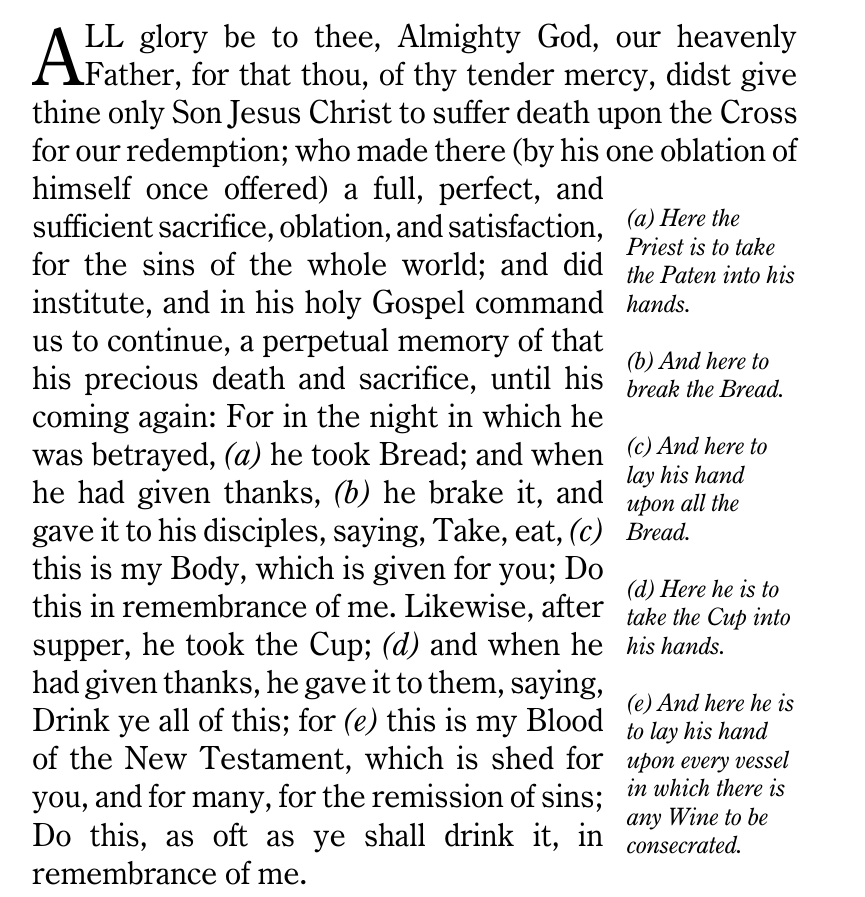
The New Testament teaches a different concept. Christ’s sacrifice is once for all, sufficient and complete. He is our great High Priest and the priesthood of Temple Judaism is abolished as insufficient. As the resolution states, we are all priests, albeit not sacrificing ones as his sacrifice is all that’s needed. In a sense one result of Jesus Christ’s finished work on the Cross is that we all got a promotion.
That being the case, this resolution needs to be backed up by giving our laity a larger voice in the course of the church. We could start with restoring the pastoral preference vote, which hasn’t done anyone any favours. This also speaks to the pastoral concept I discussed in the previous resolution.
Biblical Worldview
This is always a good thing to have. The problem in implementation is that churches like ours don’t integrate the Scriptures very well with the world around us. That’s something that Roman Catholicism has done a better job of, although it has laid eggs of its own, as the previous resolution commentary demonstrates. Taking some judicious lessons from them would be useful, and might avoid losing people who are ideal in background for our church like Vice President J.D. Vance.
But I’ve gone to meddling…I better shut up. To paraphrase Origen, this blog post having reached a sufficient length, we will bring it to a close.
-
Once More With Feeling with Joe Colletti and His Reconquista
The North American Anglican has given Colletti his opportunity to respond and he does so with Colletti: A Response to My Critics. His response mostly stuck with those who were given an opportunity in the North American Anglican itself. I’ve said most of what I want to say in my pieces The Cattle Have Already Checked Out: My Response to Joe Colletti’s “On the Theology of Communion and Separation” and “Dreaming of the Red Churches”: My Wrap on Joe Colletti’s Theology and the Responses. I would like to make a few observations that I think have gotten lost in the discussion:
- Colletti’s statement that “I actually do believe there have been instances in history that did warrant a positive separation, namely the Council of Trent. This is because I do believe the Council of Trent imposed automatic excommunication against people attempting to hold the orthodox position on justification, which was a fundamental pertaining to the doctrine of salvation.” is simply wrong. The concept of merit and its implementation (which IMHO is objectionable) which was building in the later Middle Ages was precisely the one that Luther objected to and began the separation of the Reformation; Trent came after and codified Catholic practice. One thing that complicates this debate is that classical Augustinian concepts of justification are viewed on either side through the lens of respective ecclesiologies. Catholics–and Augustine himself–viewed it through the mediating role of the Church, Protestants generally don’t, and Anglicans adopted a “compromise” view that is evident in the classical BCP’s. A more classically Augustinian view can be seen in parts of Catholicism even after Trent, as was the case with the Jansenists and Bossuet.
- Colletti’s endless appeals to what the Episcopal Church officially teaches are not “in the real world.” I don’t know a more charitable way to put it. Episcopalians are masters at reciting the Creeds Sunday after Sunday and not believing half of them. The introduction of critical Biblical studies had a corrosive effect on what the ministers believed and taught, which in turn led to a predictable effect on the laity. The 1960’s put two issues front and centre in the Episcopal Church: the sexual revolution (which led to the likes of Bishop Gene Robinson) and the social justice movement, which became an obsession in a church whose demographics were unsuited to a meaningful response.
- The ACNA’s problem–and those of the Continuing Churches, who to their credit have worked to resolve their divisions–is that there are too many disciples of Diotrephes in the mix: “I wrote a few lines to the Church; but Diotrephes, who loves to be first among them, declines to recognize us. Therefore, when I come, I shall not forget his conduct in ridiculing us with his wicked tongue. Not content with that, he not only declines to recognize our Brothers himself, but actually prevents those who would, and expels them from the Church.” (3 Jn 1:9-10). That’s true, for example, on both sides of the WO debate; it is a battle of authority and who will be first in the church. This is especially an occupational hazard of churches with Episcopal governance, but it will destroy the ACNA if it is not addressed soon and forcefully.
You can’t solve problems unless you define them correctly, and for all of his mastery of Church history this is something that Colletti–and for that matter some of his critics–have failed to do.

Sailing the Last Voyage with Newton and Pascal

