-
You Could Just Stand There and Look Stupid: An Ascension Day Reflection
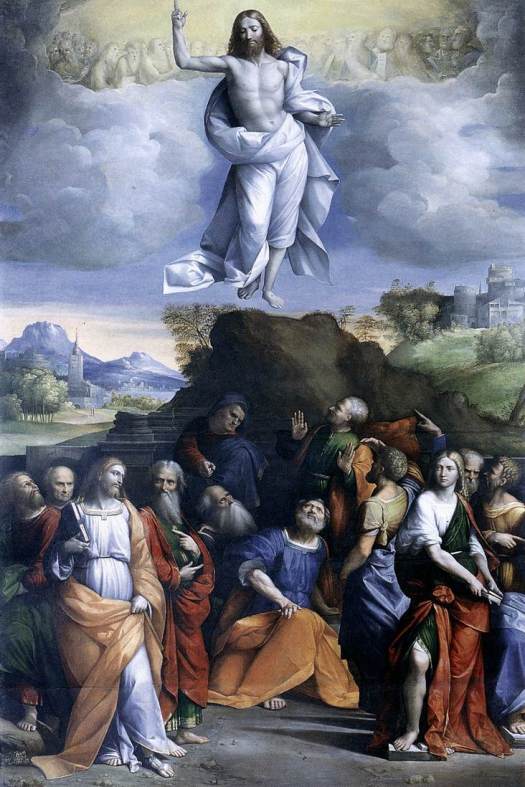
Today is Ascension Day, when we celebrate Our Lord’s bodily ascension into heaven. The Acts of the Apostles describe the “aftermath” on earth as follows:
While they were still gazing up into the heavens, as he went, suddenly two men, clothed in white, stood beside them, And said: “Men of Galilee, why are you standing here looking up into the heavens? This very Jesus, who has been taken from you into the heavens, will come in the very way in which you have seen him go into the heavens.” (Act 1:10-11 TCNT)
For some reason, this reminds me of an encounter I had with one of my students. This student was unique in many ways. I found out independently that he had a hard life: abandoned by parents, brother in jail, poverty, but that he had given it his best shot in life and was working on his civil engineering degree (which he completed.) Helping students like this makes teaching worthwhile.
One day he came to see me in my office. My office is away from most of the College of Engineering and Computer Science in a building with 24-hour card access. If you don’t have a card, during the day you can ring the doorbell and be admitted. He did that and got to my office, but then he asked me a serious question: “What would I do if I didn’t know to ring the doorbell to get in?”
“Well, you could just stand there and look stupid,” I replied.
He thought a second and sad, “I could just stand there and look stupid.” In spite of this inauspicious start, we had a good meeting.
Every time I read the passage in Acts I cited above, I always think to myself, “You know, those two men were certainly angels, otherwise they would have said, ‘Men of Galilee, why are you standing here looking stupid up into the heavens?’” Our Lord had just given them instructions as to what they were supposed to be doing:
So, when the Apostles had met together, they asked Jesus this question–“Master, is this the time when you intend to re-establish the Kingdom for Israel?” His answer was: “It is not for you to know times or hours, for the Father has reserved these for his own decision; But you shall receive power, when the Holy Spirit shall have descended upon you, and shall be witnesses for me not only in Jerusalem, but throughout Judea and Samaria, and to the ends of the earth.” (Act 1:6-8 TCNT)
But they just stood there looking upward until the angel gave them the reality check they needed.
Two thousand years have passed, and many Christians, mesmerized by whatever “spiritual happening” is going on around them, or what’s trendy in the church. But Our Lord not only gave us a mission; he sent the Holy Spirit to empower us to accomplish that mission.
Our Lord’s messengers were too polite to tell the disciples to quit looking stupid and get on with their task. But, polite or not, it’s the truth: the mission has not changed, and is still out there for Christians to accomplish it.
-
New Series on vulcanhammer.net: STADYN Wave Equation Program
We’re starting a new series on the companion site vulcanhammer.net about the STADYN wave equation program. This may be a little arcane for most readers of this blog, so it will be over there.
The first installment, however, concerns using a very old language (FORTRAN 77) to generate HTML code, which of course appears on just about every web page out there that isn’t a pdf file. So the interest may be a little more general…for now.
Enjoy!
-
Women's Ordination: The ACNA's Trickiest Minefield
…and they’ve stepped into it with their report on the subject, visible here.
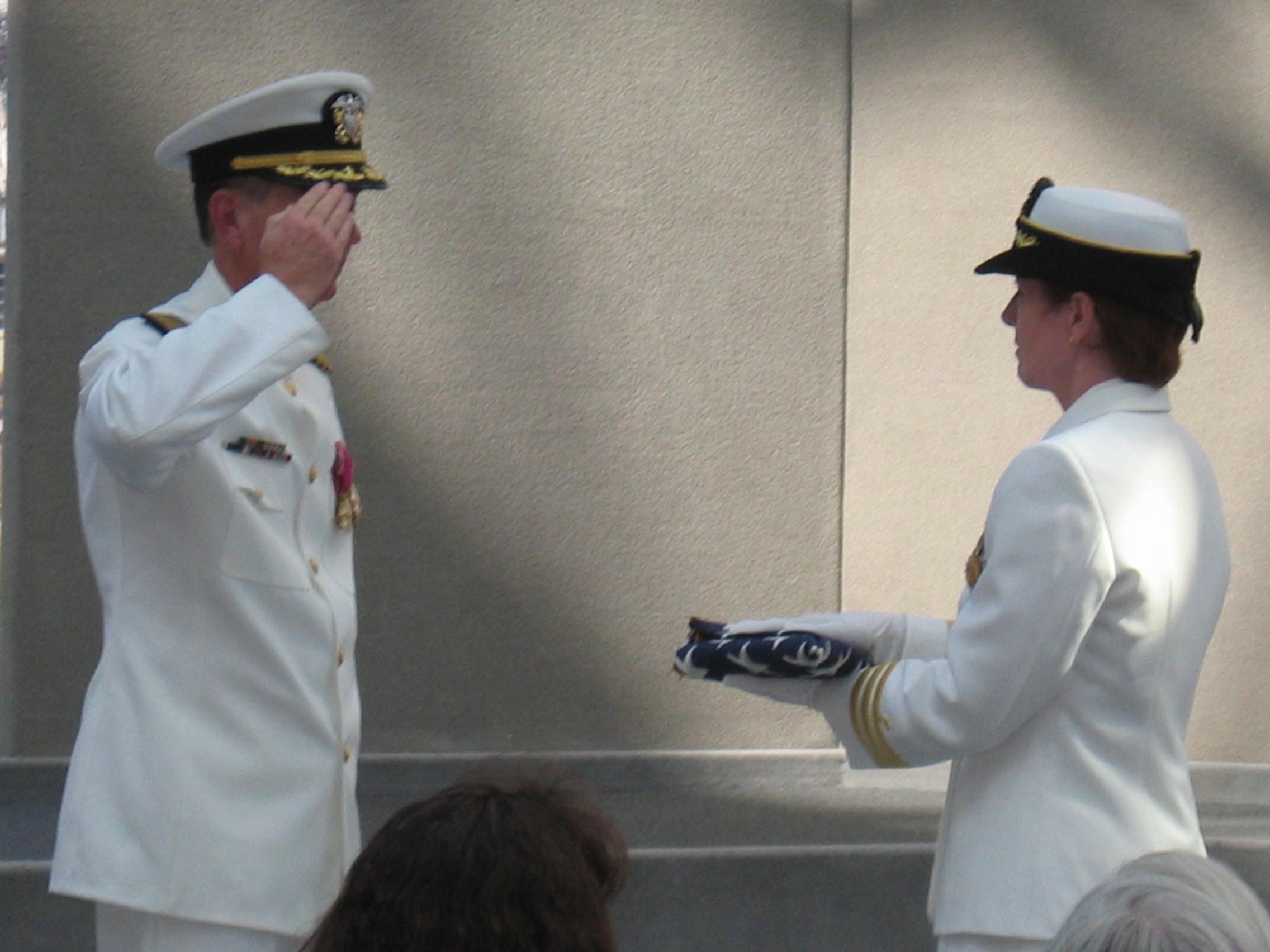
The moment WO opponents dread the most: Navy Chaplain Jerry McNabb saluting his superior at his retirement. The ACNA came into the world with considerable baggage, some of which was due to the way they had to “patch together” the institution from several provincial efforts. That was one of those things that led Greg Griffith to swim the Tiber, characterising the effort as having “…the institutional feeling of something held together by duct tape and baling wire.”
But the ACNA also came into the world with two unresolved issues: the Anglo-Catholic vs. Reformed (or Evangelical, or Charismatic, or…) divide and women’s ordination. The two are related to some degree but are certainly not same. This report represents trying to “start a conversation” on the subject, and that in the Anglican/Episcopal world is always a dangerous proposition.
The report makes it clear that, for the moment, there is no change in real policy, which leaves the issue as a diocesan option. And I would confess that I have not gone through its 316 pages myself. Having said that, I will outline my position on the subject, one which I have discussed before.
In supporting the practice, Lord Carey has referred to Acts 2:
‘It shall come about in the last days,’ God says, ‘That I will pour out my Spirit on all mankind; your sons and your daughters shall become Prophets, your young men shall see visions, and your old men dream dreams; Yes, even on the slaves–for they are mine–both men and women, I will in those days pour out my Spirit… (Act 2:17-18 TCNT)
That’s a pretty strong statement and a strong case. If women can get the prophetic gift, why not the rest? That said, and looking at everything else, for a church to have women’s ordination, two things must be in place.
The first is that the gifts of the spirit must still be operating in the church. It doesn’t make sense to ordain women based on the prophetic gifts when same have ceased. That leaves the cessationists out, which takes most of the Reformed types with them.
The second is that the church cannot claim the magisterium, i.e., the ability to authoritatively interpret the Scriptures and establish doctrine. That leaves out Roman Catholicism and the Anglo-Catholic community, although the latter has its own authority issues.
Protestant churches de jure deny the magisterium, but de facto you’d never know that based on the way many act. I discussed this issue in my piece Authority and Evangelical Churches. Beyond that, a church which claims the continuance of the gifts of the Spirit enters into a different concept of authority whether it wants to admit it or not.
With Anglicanism things are a muddle, because, while they retained the episcopal form of government and set forth the Articles of Religion, they denied the magisterium. I had an interesting discussion on this and other topics on the authority of the church with the “Ugley Vicar,” the late John Richardson.
At this point I think the ACNA is between a rock and a hard place because, while it could go one way, the other, or take its half out of the middle, it embodies so many other contradictions in its borders it’s going to have a hard time doing things consistently one way or the other. It’s an unenviable position.
There are two other important points that I would like to make.
The first is that WO isn’t a “women’s rights” issue. The Episcopal Church has discredited the concept by making it one. There were women ministers in Pentecostal churches long before Robert Appleyard ordained the first ones in what was then PECUSA, but they not only didn’t do it as a women’s rights issue, they were of an entirely different character.
The second is that you cannot separate the issue of women ministers from women bishops. If the laity must come under the “authority” (see above) of a woman as rector, then the clergy can do the same under a bishop. Clergy exempting themselves from things like this is about as admirable as Congress exempting itself from the many things it imposes on us.
-
Prevention is Still the Best "Kill Switch" for Malware
A very ingenious solution to a very serious problem:
An “accidental hero” has halted the global spread of the WannaCry ransomware, reportedly by spending a few dollars on registering a domain name hidden in the malware.
The ransomware has wreaked havoc on organizations including FedEx and Telefonica, as well as the UK’s National Health Service (NHS), where operations were cancelled, x-rays, test results and patient records became unavailable and phones did not work.
However, a UK cybersecurity researcher tweeting as @malwaretechblog, with the help of Darien Huss from security firm Proofpoint, found and activated a “kill switch” in the malicious software.
But it’s important to note that Microsoft had released a patch against this malware back in March. Microsoft, for all the jibes it takes from the digital community, has made updating its software just about as seamless as it can get. And I haven’t run into the dreaded “this software worked until the update and then…” problem in a long time. (I actually run Windows, MacOS and Linux on my various machines.) Either the NHS’ admins didn’t have their machines set to automatically update or they’re still running XP and Vista. As good of an operating system as XP is, it’s just too vulnerable to keep it online, especially in a network situation.
Lesson: make sure you’ve got your automatic updates working, in addition to the anti-virus software. Backing up is also important, but with ransomware the hostage files can get into your backup system before you can stop it.
One more thing: the Guardian told us that the UK based researcher “spent a few dollars” registering the domain name. Have some pride in your currency; “dropped a few quid” would have been better. (Unless, of course, he was a Remain supporter and used Euros, or a Bitcoin fan…)
-
Those African Immigrants Sure Are Encouraging
She married in her teens and wound up a “divorced welfare mother of two sons.” It was a fellow shift worker at the Liberty House Nursing Home, an African immigrant named Abou, who persuaded to try her hand at higher education. Against these steep odds, she climbed the academic ladder all the way from Virginia Western Community College to a law degree at Yale and professorships at Princeton and Vanderbilt. Prominent mentors along the way—at Roanoke College, where she completed her bachelor’s; Virginia Tech, her first master’s degree; and University of North Carolina at Chapel Hill, her doctorate in political science—helped make it possible. But these days, she reflects, “In some ways, I feel like I didn’t always turn out the way people had hoped I would turn out.”
Seven years ago, my Kenyan department head and his Cameroonian assistant sat me down and told me I needed to get my PhD. He’s told others that, but I took his advice. The rest is history.
-
So What Will We Do When We Don't Have to Think?
In this article about my friend Ethan Hereth, the following:
Like others before me, I have the perception that the education of quality engineers in the field of CFD has been falling short recently. It feels to me like there are very few engineers in this arena that grok CFD like many of the founding fathers and engineers of CFD did before us. I feel that the latest generations of CFD engineers have become used to applications that do much of the work, often shielding them from having to really understand the underlying concepts.
That perception has been around a long time. Forty years ago when I was in the aerospace industry and working for Texas Instruments, I developed some software (had to write the code for it in this language) which automated some of our analysis work. My boss was impressed with the results, but asked the question: what will happen when we just let the computer do all the work and we dummies just look at the results it spits out without knowing how they were produced? My answer was that those of us working on the code know, but those who come after are the ones we have to be concerned about.
Well, as we used to say at Texas A&M, next year is here. Most people who use technology today–and that includes some people in the STEM fields–have no clue how computers do their work, how the answers are arrived at, the theory behind their methods, or how easy it is for bugs (and security flaws) to get into the code that makes the software work. The result is that, while the computer should make us smarter, the reality is the opposite effect.
The place where fixing that problem starts is in STEM education and the way we look at computers. We need to get away from the accepted point of view of STEM education as people learning to push buttons in software they use, and we need to teach people how to code, even at the most elementary level. One of my math professors observed that coding was a form of mathematical proof, and that in turn teaches you how to think. But that skill is in short supply in our educational system, and if you think the results are not pretty now, just wait until “next year.”
-
Beating the Baptists to the Mission Field
For all the money they’ve sent to Richmond, not much to show for it:
Whatever the overall totals, what’s striking is the continuing size of the U.S. proportion. The largest 40 or so Baptist groups when combined account for around 55 million people, 40 million of whom adhere to bodies in the United States. That compares with 7 million members in Africa, 5 million in Asia, and 2 million in Latin America. Non-U.S. numbers rise if smaller denominations are included, but they count their numbers not in the millions but in the tens of thousands, and applying the same standard also raises U.S. figures comparably.
Jenkins’ explanation of these laggard results doesn’t satisfy. I would first observe that the “900 pound gorilla” (or 400 kilo gorilla, for those of you really mission minded) in the Baptist world is the Southern Baptist Convention. That being said, their target home mission field is the Scots-Irish South. I think that the cultural state of these people is so specific that being successful with them forces a church to adopt a life and method that hinders the communication of the Gospel to just about anyone else.
That hasn’t stopped people like Billy Graham, probably the best known Southern Baptist on the planet, from using his background as a springboard for world evangelisation. The SBC gave him roots and wings, and he flew; the basic problem with Southern Baptists (and many others in this culture) is that they are stuck in the roots and lack the wings to fly.
In the South, the teetotalling Baptists did more than anyone else to make that Southern eating institution, the cafeteria, great. Since the Baptists became punctual at ending their services, if the rest of us got there first for whatever reason, we told each other that we “beat the Baptists to the cafeteria.” Today the very Baptistic place I live in has no cafeteria to beat the Baptists to, but there’s still a mission field out there, and it seems that we’ve beat the Baptists there too.
Sailing the Last Voyage with Newton and Pascal
 Positive Infinity