-
Bill Gothard’s Poison Pill for Southern Baptists
This is Memorial Day weekend, when we as Americans remember those who gave their lives for our country. For me that turns back to my uncle, Don Gaston Shofner, and his sacrifice even before he could get to enemy skies. But that brings up another point: Gaston (as he was called in good Southern tradition) and his family were (and those who are left mostly are) Southern Baptists. Now the Baptists tend to get the “left hand of fellowship” on this site, starting with Bill Clinton’s Eucharistic Theology (another Arkansas Baptist) and going downhill from there.
These days they’re getting it from many sources, especially in the wake of the mess surrounding Paige Patterson. Patterson, with others, was a leader in one of the most successful ecclesiastical coups of the last fifty years: the ascendancy of conservatives in the Southern Baptist Convention and the prevention of the leftward drift that has plagued just about every Main Line denomination. (I wouldn’t describe the SBC as Main Line for a long list of reasons, but that’s another post…) I was actually in the SBC during the central part of that drama, and it was interesting. The “moderates” in power appealed for people to “get with the program” of the denomination, while the conservatives appealed to the authority and inerrancy of God’s Word. For someone like me who had spent much of his growing up years struggling against the tide to place God’s Word above the program, the choice wasn’t difficult. Evidently most of the Convention felt the same way.
In a sense both were appealing to authority, the moderates to the established authority of the convention and the conservatives to God himself. At this point, however, something strange happened that got lost in the victory: the conservatives, having justified themselves on God’s authority, proceeded to make getting human authority a big deal. Although many wouldn’t admit it then (and certainly not now) a good deal of their inspiration came from Bill Gothard.
Gothard, in my humble opinion, had more influence on Boomer Evangelicals than any other single Christian teacher during the 1970’s. He taught that God’s way was a top-down authority structure, one that started with God himself and permeated through the state, church and ultimately the family itself. For a generation mired in rebellion, Gothard offered an authority-driven order as not only a way out of the chaos of the 1960’s and 1970’s but as a way of papering over past rebelliousness.
The problem with this as applied to Baptists in general and Southern Baptists in particular is that the Baptists had pretty much torn up the whole top-down authority structure in the church in favour of a bottom-up, congregational model. Baptist churches are locally autonomous; they call their own ministers, regulate their own finances and ordain their own ministers, to be recognised by other local churches. The SBC was founded with the idea that some functions, such as home and foreign missions, were best handled “cooperatively” by organisations such as the Foreign Mission Board. The wonderfulness of that idea wasn’t shared by all Baptists: the Landmark movement, which Gaston’s parents were very much a part of when he went off to war, was started in part as a disagreement over the FMB.
So how did the Southern Baptists hold things in the road with their anarchic system? Traditionally they did it through an emphasis on rigid conformity and peer pressure. This appealed to their core ethnic group, the Scots-Irish, because it allowed them to have an organised religion without someone obviously telling them what to do, which they hated more than death itself. This system can have serious problems but introducing a top-down system like Gothard’s, which seeped into even a self-contained system such as the SBC, was the introduction of an alien idea, one which has turned into a “poison pill.”
Perhaps that alien idea was forwarded by the most distasteful aspect of Gothard himself: his sexual advances on women in his organisation. The whole fight over WO in the SBC, and the serious complementarianism that is used to oppose it, is based on women not having “authority” over a man. In a system where authority is a dicey proposition to start with, it’s difficult to see how a hard line can be taken.
The church isn’t the only place where authority is a question. Gothard and his Baptist allies apply it to the home, but that’s where Patterson got into trouble: he advised a woman to stick it out under “authority.” Personally I don’t see that the New Testament justifies the use of violence against another human being, and certainly any of Gothard’s advances should be lumped with fornication and adultery, neither of which has Scriptural sanction. But once you make human authority a central part of church life, you open up the possibility of people exercising their “authority” for unBiblical purposes of all kinds.
Our society has changed, and mostly not for the better. Much of what the Southern Baptists and other Christians do was once lauded and now cursed because of changes in society, not changes in God’s standard for his people. But most systems fall when their own weaknesses overtake their own strengths, and that’s a lot of what we’re seeing with the SBC. In addition to some of the things discussed here, we have the Baptists’ metastable idea of election and perseverance and their lack of success in breaking out of their own ethnic ghetto.
I don’t see how the Baptists plan to get out of the mess they’re in. Some things would be helped if they reverted to a more autonomous, bottom-up view of church life they used to have. Others would benefit from throttling back the regional obsession with status and “moving up,” but one could apply that to American Christianity in general. But structures survive storms and earthquakes not as much from sheer strength and rigidity but because they can deflect and return to their original state during times such as this. The whole Baptist system strikes me as too rigid to do that. This is sad, because many people’s eternity has been changed through the tireless outreach of Southern Baptists, and that–followed by discipleship–is ultimately what the church is all about.
-
If Michael Curry Really Wants to Confront Donald Trump, He Should Start in Palm Beach
He did the “Jericho March” around the White House last night:
The Holy Spirit came a knocking for President Trump Thursday night … in the form of royal wedding preacher Bishop Michael Curry.
The standout star of Prince Harry and Meghan‘s big day was part of a candlelight vigil in the Capitol that included prayer and song outside the White House. The Bishop told us their goal was spreading a message of “love of God and love of neighbor.”
Frankly this is ridiculous because, if Curry had a little patience, he could even make a bigger splash because Donald Trump visits one of his own churches, Bethesda-by-the-Sea in Palm Beach, for Christmas and Easter. And, when that auspicious moment comes, he could do one of two things. He could stand in the front door and block Trump’s entrance. Or, he could mount the pulpit and rail against the usual Trump sins the left is so obsessed with while Trump sits there. He has the potential of being the religious left’s John Chrysostom and Thomas More rolled into one.
But then again…if he did that to Trump, he’d be aiming at a good portion of Bethesda’s own membership, including the Trumpettes who have stuck with the President through thick and thin. And many of the social justice charges he would level against Trump would apply to those members as well. Then they would leave and take their offerings with them, and for a church which has just blown USD60 million on litigation to keep its property and faces declining membership, that would be hard to take.
As I mentioned earlier, Curry needs to take a hard look at his own house before he keeps doling out his version of Anglican Fudge against the rest of us.
-
Build a House with 3D Printing? An Anglican Divine Shows the Way
But, when Christ came, he appeared as High Priest of that Better System which was established; and he entered through that nobler and more perfect ‘Tabernacle,’ not made by human hands–that is to say, not a part of this present creation. (Hebrews 9:11 TCNT)
For the structures that are made by human hands (with a great deal of help from stuff like this) we can now turn to 3D printing for possible solutions, and that brings up Anglican divine Bruce Hilbert. We’ve featured him before and this brief video shows what he does and a little of how he does it:
In the past Anglican (and other divines, such as this Lutheran) have been involved in scientific and technological discoveries and advances. Bruce continues in that tradition. Should there be others? Why not!
-
Why I’m in a Pentecostal Church and Not an Episcopal One
All of the blather we’ve been hearing about Presiding Bishop (not Archbishop) Michael Curry’s sermon at the royal wedding last weekend obviously focuses attention not only on Curry and the duplicitous Justin Welby but on the Episcopal Church in general. I don’t doubt that same church, faced with years of declining membership and self-inflicted litigation costs, would like a shot in the arm with a few more visitors and members.
Those who have criticised Curry on doctrinal issues have, IMHO, missed a point. Episcopal ministers have been doling out vacuous, unchallenging fudge for as long as I’ve been on the earth and then some. The serious question is “Has their departure from the Gospel paid off for them (the leadership) and their parishioners?” The simple answer is no, and there are many ways this failure has happened, but I’ll concentrate on one: the social justice aspect. Curry told us that love will transform the world; they’ve had at least fifty years to pull that off with their obsession with social justice, has it taken place?
One thing that hasn’t taken place is a demographic shift. The Episcopal Church is still a largely white denomination with an elite demographic, even after all these years of trying to be the advocate of the poor. You’d think that some of the recipients of this support would show up just out of gratitude, but few have. For me, that runs into two serious problems from two separate sources.
Karl Marx told us that people like the Episcopalians were exploiters of other peoples’ surplus value; thus, they would always be the problem, to be overthrown in the revolution (and subsequently liquidated according to the usual Leninist and Maoist pattern.)
Jesus Christ gives the rich an entirely different challenge:
And a man came up to Jesus, and said: “Teacher, what good thing must I do to obtain Immortal life?” “Why ask me about goodness?” answered Jesus. “There is but One who is good. If you want to enter the Life, keep the commandments.” “What commandments?” asked the man. “These,” answered Jesus:–“‘Thou shalt not kill. Thou shalt not commit adultery. Thou shalt not steal. Thou shalt not say what is false about others. Honor thy father and thy mother.’ And ‘Thou shalt love thy neighbor as thou dost thyself.” “I have observed all these,” said the young man. “What is still wanting in me?” “If you wish to be perfect,” answered Jesus, “go and sell your property, and give to the poor, and you shall have wealth in Heaven; then come and follow me.” On hearing these words, the young man went away distressed, for he had great possessions. (Matthew 19:16-22 TCNT)
When these disparate authorities tell you that you’re wrong from two standpoints, you have a problem. But TEC hasn’t addressed either of these; in fact, it’s embraced the pansexual agenda to paper over the inequality/social justice problem, just as the secular elites have. Moreover Bishop Curry, as a black man, is an outlier in a denomination that is even more unsuccessful in breaking out of its Caucasian trap than the Southern Baptists.
Personally I found the elite nature of the Episcopal Church not only unBiblical but stifling. That started to change when I swam the Tiber. Now I got to go to church where people, as my brother observed, actually looked like they worked with their hands. That expanded during my years at Texas A&M.
Today I go to a Pentecostal church. The demographic is the mirror image of the Episcopal Church. Real people have real problems that they cannot solve by throwing money at them, which was the usual approach in the bubble I was raised in, but must turn to God. The ethnic diversity of the church is amazing, not only on a national/international level but now on a local level. And the Gospel goes forth, to use the BCP’s phrase not only with our lips but in our lives.
It’s not perfect. It still suffers from the American obsession with moving up, although with some of our people to see God bring them out of where they started is wonderful. It’s too deferential to their “betters,” who usually turn out to be those in the church with the higher AGI. (To be fair, that problem even turned up in a church like Bethesda.) And the Scots-Irish are always there to complicate things.
Sometimes in my superannuated state, when I’m tired of one more maudlin paean to “the old time religion,” or I’m forced to worship to yet another new chorus “from the throne room,” I have moments like this. But I think that I would have to leave behind the people I go to church with, those who are, at the end of the service, happy, and whose lives have been meaningfully transformed by Jesus Christ. That gives me pause. A church isn’t made by its ministers but by its laity.
Curry can talk all he wants about love, but I’ve seen more of it in the church I’m in than the one I started in, namely his. And more social justice acted out, too, in the church which is the preferential option of the poor rather than just for it. If Curry and Welby want to show they’re serious, their respective institutions will have a “shoes of the fisherman” moment, rather then blowing smoke in the face of credulous elites. But I’m not holding my breath.
-
The Faustian Bargain of Being the State Church
The upside of that status was very much in evidence at the royal wedding yesterday, but every silver lining has a cloud. We’ve discussed this issue before. One normally expects the chief objectors to be Evangelicals, but this comes from the Anglo-Catholic Herbert Luckock’s The Divine Liturgy:
Every thoughtful ecclesiastical ruler recognises the absence of a sound and wholesome system of discipline as a real hindrance to the well-being of the Church and it cannot be denied that without it the rubrics which form the prelude to her highest Service are little more than a dead letter. The Church and the State, though allied in theory, are antagonistic in practice, and the civil power is found to cripple the ecclesiastical in every attempt to revive her discipline. It may well be felt that to gain discipline at the price of disestablishment might form a disastrous bargain; but there is no denying the fact that the retention of the disciplinary rubrics in this Office is a bitter revelation of the pitiable degree of impotence to which the clergy are reduced through the action of the State.
Finding thoughtful ecclesiastical leaders is no mean feat these days. We now have the sad spectacle of a church with a small proportion of the population (where a few choice expulsions would have little impact) which pretty much works to reflect the values coming from the government and the top of the society.
As an aside, Luckock also has an interesting observation regarding the effect of the removal of the requirement that officials in the government be communicating Anglicans, one which was long past in his day:
The abolition of religious disabilities, and the withdrawal of all temptation to qualify for civil offices by participation of the Sacrament, have removed one of the greatest dangers of irreverence. The strongest safeguard is really the exaltation of the ordinance.
Those disabilities were a source of irritation for many, including the mathematician Augustus de Morgan, who flatly stated that he would not confess his Lord openly because it might be taken opportunistically. It is a strange juxtaposition of doing one unBiblical thing to avoid another, but that’s another thing that happens when you make the Faustian bargain of the state church.
-
Delight in Books: Contempt for Sports

Pliny, Letters 9.6: “I spent this entire time among my notes and books in the most pleasant repose. ‘How,’ you might ask, ‘could you do that in the city?’ The Circensian Games were on, and I am not attracted by that kind of spectacle in the least. There is nothing new, nothing interesting, nothing which needs to […]
via Delight in Books; Contempt for Sports — SENTENTIAE ANTIQUAE
-
What We Really Need to Do is to Unhitch @AndyStanley
Atlanta’s Christian management guru is at it again, this time with the Old Testament:
North Point Community Church Senior Pastor Andy Stanley has stated that Christians need to “unhitch” the Old Testament from their faith.
In the final part of a recent sermon series, Stanley explained that while he believes that the Old Testament is “divinely inspired,” it should not be “the go-to source regarding any behavior in the church.”
In making this pronouncement, Andy Stanley does two things that drive me batty about Evangelical Christianity.
The first is that he accepts the literalistic hermeneutic that dominates Evangelical Christianity as normative. Once you do that, then his idea to “unhitch” is just about the only thing left to do. It never occurs to him that Christians–and Jews like Philo–have tackled this problem a long time ago and dealt with it, without denigrating the Old Testament the way Stanley does. But taking lessons from the Patristic witness is something that Stanley, like most evangelicals, is allergic to.
The second–and in some ways worse than the first–is this:
For Stanley, the difficulty lay with the Old Testament and his concern that many Christians are turning away from the faith because of certain passages in the Hebrew Bible.
For evangelicals, and especially those like Stanley, church is an endless popularity contest. Fortunately Our Lord thought otherwise:
“In truth I tell you,” answered Jesus, “unless you eat the flesh of the Son of Man, and drink his blood, you have not Life within you. He who takes my flesh for his food, and drinks my blood, has Immortal Life; and I will raise him up at the Last Day. For my flesh is true food, and my blood true drink. He who takes my flesh for his food, and drinks my blood, remains united to me, and I to him. As the Living Father sent me as his Messenger, and as I live because the Father lives, so he who takes me for his food shall live because I live. That is the Bread which has come down from Heaven–not such as your ancestors ate, and yet died; he who takes this Bread for his food shall live for ever.” All this Jesus said in a Synagogue, when he was teaching in Capernaum. On hearing it, many of his disciples said: “This is harsh doctrine! Who can bear to listen to it?” But Jesus, aware that his disciples were murmuring about it, said to them: “Is this a hindrance to you? What, then, if you should see the Son of Man ascending where he was before? It is the Spirit that gives Life; mere flesh is of no avail. In the teaching that I have been giving you there is Spirit and there is Life. Yet there are some of you who do not believe in me.” For Jesus knew from the first who they were that did not believe in him, and who it was that would betray him; And he added: “This is why I told you that no one can come to me, unless enabled by the Father.” After this many of his disciples drew back, and did not go about with him any longer. So Jesus said to the Twelve: “Do you also wish to leave me?” But Simon Peter answered: “Master, to whom shall we go? Immortal Life is in your teaching; And we have learned to believe and to know that you are the Holy One of God.” (John 6:53-69 TCNT)
Maybe it’s time we unhitch ourselves from Andy Stanley…
-
Two Plus Two Equals Four Until You Redefine Addition
Like everything else, the Babylon Bee had fun with this:
In a mathematics lesson delivered to her kindergarten class Tuesday, local teacher and closed-minded bigot Becky Delatorre reportedly insisted that two plus two equals four, all the time, to the exclusion of all other numbers, no matter how anyone feels about it.
Well…we turn to the famous Russian mathematician Israel Gelfand’s Lectures on Linear Algebra (Dover Books on Mathematics)
, who at the start makes this definition:

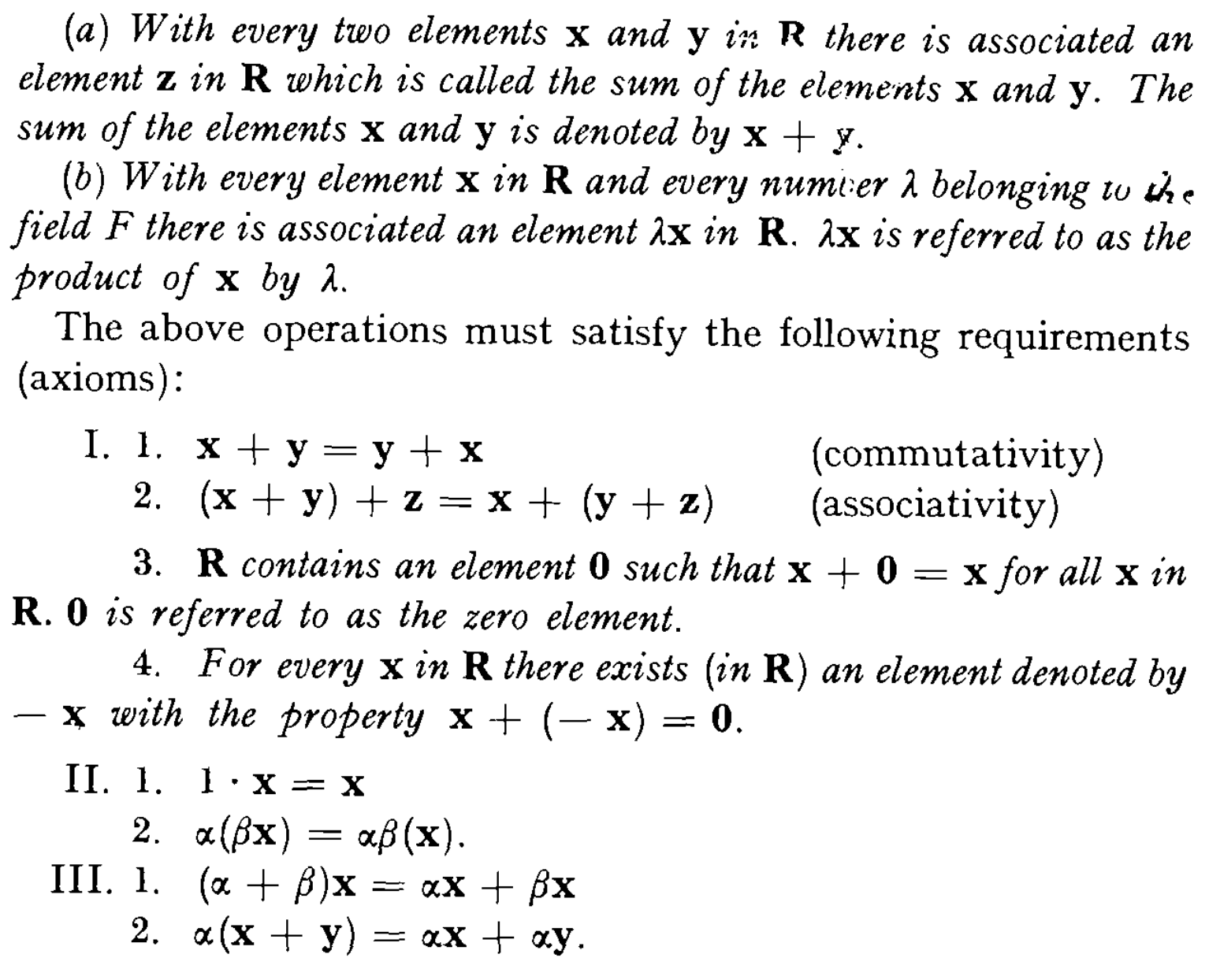 Breaking it down, in the italics he makes a definition of what a vector space is. At the core of that definition is what linear algebra (which itself is at the core of numerical methods, computer simulations, etc.) is all about: everything that happens is basically scalar addition (which is what the kindergarten teacher in the Bee was trying to teacher her bratty students) and scalar multiplication, and lots of it for large models.
That definition made, Gelfand sets forth eight (8) rules for these two operations to follow in order to be valid. At this point, Gelfand puts in the kicker:
It is not an oversight on our part that we have not specified how elements of
are to be added or multiplied by numbers. Any definitions of these operations are acceptable as long as the axioms listed above are satisfied. Whenever this is the case we are dealing with an instance of a vector space.
What he is saying is this: for a valid vector space, we can redefine addition and multiplication as long as it meets the eight rules! An example of how that works is here.
This is an interesting twist in mathematics that, mercifully, doesn’t have much practical application. But I suppose it’s possible to shut up (or put to sleep, either result works) a class of unruly kindergartners with the eight rules. And having endured stuff like this makes attacking Bill Clinton’s Eucharistic Theology even more fun.
Better stick with
…

Sailing the Last Voyage with Newton and Pascal
 , who at the start makes this definition:
 Positive Infinity