-
First outdoor church-in-a-box, surrounded by redwoods — Ad Orientem

Celebrated a 1928 BCP said (and social-distanced) mass using an antique chaplain portable altar.
via First outdoor church-in-a-box, surrounded by redwoods — Ad Orientem
-
The Answer, Fleming Rutledge, Is Blowing (in Part) in the Lectionary
This interesting exchange between Danté Stewart and the well-known Episcopal theologian Fleming Rutledge appeared in my Twitter feed:
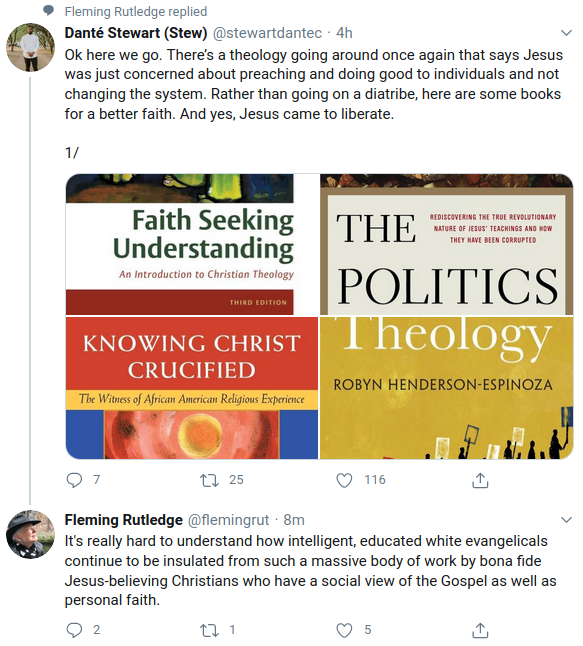
It’s not a simple subject to unpack but it’s not as hard to understand as Rutledge thinks it is.
First, no matter how you try to make it happen the New Testament doesn’t really advocate changing, let alone overthrowing, the existing social order. As John McKenzie pointed out in The Power and the Wisdom, “…if any image represents the encounter of Church and state, it is the image of Jesus before Pilate.” Although it’s a stretch to say that the Roman Empire ruled for so long bereft of the consent of the governed, it’s also true that it did not have the “democratic” means to effect change in a peaceful fashion the way we take for granted. Those democratic institutions–imperiled by our current political situation–are a necessary prerequisites for the kind of change that is generally advocated by the SJW’s. The New Testament moved in a world where such change was effected by armed revolt, as the Jews disastrously tried two score after Our Lord’s death and resurrection. That’s still true in many parts of the world today.
Second, when white Southern evangelicals had much less education than they do now, they pushed through some pretty populistic, anti-moneyed establishment things which we, with our venal political system, would struggle to replicate today. I discuss that in my piece on Elizabeth Warren (a product of that culture) and won’t repeat that analysis here. A major reason why Southern Evangelicals have gotten away from this or any other “social gospel” is that they’ve shifted to a more aspirational mode of life, and if there’s anything people on the left hate, it’s being aspirational.
Third, there’s always the natural enmity of the secular left to Christianity, one that goes back to the Enlightenment and the French Revolution. That’s one which is hard to get away from no matter how Christians view the situation. I discuss some of that in a European context in my review of Daniel-Rops’ A Fight for God.
My last point, however, is that the difference between what parts of the Bible Evangelicals and others are fed in church. Evangelical pastors can pick and choose the parts of the Scripture they want to for their sermons, and they know their audiences better than most of us care to admit. Growing up as an Episcopalian, I was presented (esp. in the Sundays after Trinity) with some pretty challenging stuff, as I document in my pieces on ordinary time and my “return” to my home church, Bethesda-by-the-Sea. That will raise your consciousness on what the Gospel really means when lived out as our Founder intended it to be lived.
The problem with that consciousness raising, at least for me, is that it became soon apparent that the Episcopal Church, with its elevated demographics (and largely white ones too) was inherently unsuited to be the engine of social change. So I took my leave. There is no substitute for personal action. At this point it’s nice to point out literature to people, but really, if you can’t manage to sell all or shut up, the least you can do is quit your job.
-
From Covid to crime: how media hype distorts risk, or the creek water will get you every time
We all rely on the news to give us information about the world. That information lets us make decisions: whether it’s safe to fly to Spain, whether red wine causes cancer, whether we’re likely to lose our job for tweeting something. We use the media to help us understand the risks that surround us. The…
via From Covid to crime: how media hype distorts risk — UnHerd
This reminds me of something my Fluid Mechanics and Heat Transfer professor told his undergraduate classes. He was a native of Lenoir City, TN, and had a dry sense of humour that frequently went right past his mostly Texan students. He told the story of the guy in the hills who first drank whiskey with creek water and got drunk, then drank bourbon with creek water and got drunk, then drank moonshine with creek water and got drunk. The guy’s conclusion: the creek water got him drunk.
That creek water will get you every time…
-
Review – Prolegomena: A Defense of the Scholastic Method by Jordan Cooper — The North American Anglican

Prolegomena: A Defense of the Scholastic Method. By Jordan Cooper. A Contemporary Protestant Scholastic Theology. The Weidner Institute: A Division of Just and Sinner, 2020. 358 pp. $21.60 (paperback) Whether you realize it or not, a heated debate has been taking place in Protestant circles these past few decades, over the usefulness or even compatibility…
Note: This article notes the “heated debate.” I’ve defended Scholasticism before, but generally in a Roman Catholic context. But I’ve also seen the heated debate within Protestantism on this topic, especially from one belligerent and rude Barthian blogger from the Portland area. (What is wrong with this part of the country? It’s worse than South Florida!) I still think Scholasticism has merit although it’s best done within a Catholic context. (Unless, of course, you’re trying to revolutionise mathematics…)
Sailing the Last Voyage with Newton and Pascal
 Positive Infinity