-
The Ten Weeks, In the Palace
 The laughter and good times drowned out the gentle ocean surf in the background at the Serelian royal palace, situated as it was on the seashore. Evening had come and so had the time to put aside affairs of state and enjoy good times with old friends.
Around the table at the end of dinner were the hosts, King George and Queen Darlene, moving from early to mid-thirties. Darlene was pregnant with their third child, their daughter Miriam having been born the previous spring. With medium blonde hair and matching complexion, George’s shrewd leadership skills were hidden under an affable and slightly cynical demeanour. Darlene’s long red hair and piercing blue eyes deflected attention from her stocky build and revealed a woman who loved and ruled with the same intensity, evidenced by her holding the hands of the two people on either side of them when not using them to talk. One of those people was her husband; the other was her favourite bishop, Terry Lewis, and next to Terry husband Julian. Both of them were resplendent in their Anglican ministerial garb, Terry’s purple and Julian’s black, and both were taller than their royal counterparts. The purple matched well with Terry’s dark features which reflected her Chinese heritage; although considerably taller than the King, Julian’s colouring was similar, possibly because they were second cousins.
Next to George was the youngest of the group, Caroline Luwayo, and her mother Madeleine. Madeleine’s shoulder-length dirty blond hair and clear blue eyes made her a near replica of her Norman mother. Caroline was almost her mother made over except that she was several shades darker in both hair and skin, the latter nearly the colour of the Serelian café au lait that the party sipped with dessert. Comparing the two showed how the years had fallen gracefully on Madeleine, as they had on Terry.
Next to Madeleine was her father, Pierre des Cieux. Definitely the senior of the group, his white hair and moustache were his remaining trademarks, having left his straw hat with the lackey out of respect for his hosts. With him was his wife Marguerite, Madeleine’s stepmother. Both of them showed the signs of too much good French cooking, which made them rival Darlene in girth, although the Queen had a better excuse.
At the opposite end of the table was the Queen’s sister Theresa and her husband Barton Caldwell. With relatively short hair nearly Madeleine’s colour, Theresa’s appearance and countenance revealed someone who had started out with great beauty but who allowed life to pry too much of it from her. Barton also reflected a hard life, one largely wrought by war injuries which deprived him of one leg. However, they both had a happy attitude about them which helped to compensate for the rough years, and neither betrayed the weight gain that the senior des Cieux did.
“I find it hard to believe that you home schooled her,” Darlene declared to Madeleine as the help began to take the used silver and china up. “I had no idea that Belgium permitted such. It’s not even easy in parts of the U.S..”
“She has known nothing else,” Madeleine replied with her soft French accent. “I started out sending my children to school, but, by the time she was ready to start, the others were already in home school, so she stayed with me.”
“With five children, I’m surprised they didn’t make you get the proper license to operate your ‘school’,” George quipped, to laughter.
“Do you have home schooling here in Serelia?” Madeleine asked.
“We do not,” Darlene flatly replied.
“And why is this?” Madeleine asked. “Is there a religious reason?”
“The Church operates all of the schools here,” Pierre answered. “Traditionally, the problem is truancy, if I may be so bold to say.”
“If we had home schooling,” Theresa chimed in, “they’d all be home schooled—learning fishing, farming and whatever else their parents could find to make money. I know we fought this when my first husband Anselm was a rector.”
“Since we are speaking of school,” Marguerite came in, “isn’t your son and his wife starting university just now?”
“They called me today,” Theresa said, her face glowing with the thought. “They’re doing great, getting settled in. Her parents are helping them to get the kids’ flat started, they grew up not so far from the university. Barton and I will go later in the fall, after we see how this hurricane season goes.”
“Don’t you have a daughter in the Sixth Form?” Caroline asked, finally getting a word in edgewise with her garrulous elders.
“Yes I do,” Theresa said, the glow continuing.
“She is presently dining with His Excellency,” Barton said in an pompous, mocking fashion. Caroline looked puzzled.
“What he means to say,” Theresa informed her, “is that she’s courting the new Minister of Defence’s son. They’re over at his father’s house.”
“I know it is your custom,” Madeleine declared, “but so soon to court and marry for both of your children?”
“You’d better be careful up here,” Terry said, looking directly at Caroline. “I came here at nearly forty. It only took me five months.” The room burst out laughing at that, to Julian’s embarrassment.
“So,” Darlene said to seize the conversation in the wake of this merriment, “Caroline, after being home schooled in Europe’s capital, what made you decide to come here to Serelia, so far away from home?”
“And everything else,” George added.
Caroline was speechless for a bit, collecting her thoughts. “It is not so far from my grandfather. He is only able to come to see us two or three times a year. Now I can go visit him at every break.”
“That’s sweet,” Theresa said.
“St. Anne’s has an excellent reputation for its academic programme,” Madeleine continued. “And it doesn’t hurt her to be in an Anglophone environment—as regrettable as it is to many, we live in such a world.”
“She can see the results of a St. Anne’s education for herself, with two alumnae sitting here,” Pierre noted.
“Now don’t discourage her!” Darlene declared.
“But. . .” Caroline came in hesitantly, “. . .there is one more reason.”
“And what’s that?” Darlene asked, sensing an adventure.
“Last year, we heard a guest preacher in my father’s church talk about one of your ministers praying for someone to come back to life.”
“That minister was Diana Morgan,” Terry noted. “A really sweet girl.”
“After that, the Lord showed me that this was the place of miracles. So I wanted to come.”
“Getting in on such short notice was one of them,” Theresa added.
“With des Cieux, anything can happen,” George quipped.
But Caroline was undeterred in her serious attitude. “In any case, this is where my mother performed her miracles, although she doesn’t like to talk about them. That has drawn me to this place.”
The room fell silent at this. Everyone was looking at everyone else to see who might want to pick up on this.
“Is she talking about the ‘Ten Weeks’?” Darlene finally asked.
“The ‘Ten Weeks’?” Madeleine queried.
“That’s what I have called that time when I was in Fourth Form and you in Sixth when all of those things happened. I think Pierre came up with the name first,” Terry informed her. “Come to think of it, I’ve never discussed it much myself.”
“Then you must tell us about the Ten Weeks!” Darlene declared, her intense blue eyes focused directly on Madeleine.
Madeleine returned her gaze with one of fright. “It was so long ago. . .” she attempted to excuse herself. Pierre uncharacteristically squirmed in his chair at the thought, as did his wife. Even Terry and Theresa looked nervous.
“You cannot refuse me!” Darlene persisted. “You must tell me. This is an absolute monarchy. I demand it.”
“I’m not Louis XIV,” George observed, “but I do have an excellent security service. They have their ways. . .”
Pierre’s sigh broke the silence. “Eh bien, I suppose we must tell them. In any case, since Caroline has made such an effort to come here, she deserves to know everything.”
“Very well,” Madeleine said with resignation.
“But, since we are in the presence of the children of Beran, we will begin this tale at their own estate,” Pierre added. “It was twenty-seven years ago, let me see, Her Majesty was living there and. . .five years old, I think.”
“What month?” Theresa asked.
“December,” Pierre said. “We will start just about in the middle of December, 1970.”
“Coming up on six, thank you,” Darlene said. “So what does that have to do with anything?”
“Because, at the start of this tale, you were a very important attraction there.”
Darlene thought for a second. “Oh. . .oh, dear, now I remember.”
“You may live to regret your impetuosity,” Theresa said, looking at her sister.
“Ye shall know the truth, and the truth shall set you free,” Terry confidently quoted.
“But it will humiliate you first,” Darlene sighed. -
The Ten Weeks, The Rise of Allan Kendall
The Ten Weeks is at its simplest a story about several teenagers—and their parents—who are forced to deal with change, not only from within but from the world around them. To get some idea of what they went through, and what their response meant, we need to look at the political situation of the nation they lived in, the Republic of Verecunda, at the south-western end of the Island. At the centre of these changes was one man—Allan Kendall—who dominated the Republic for nearly three decades.
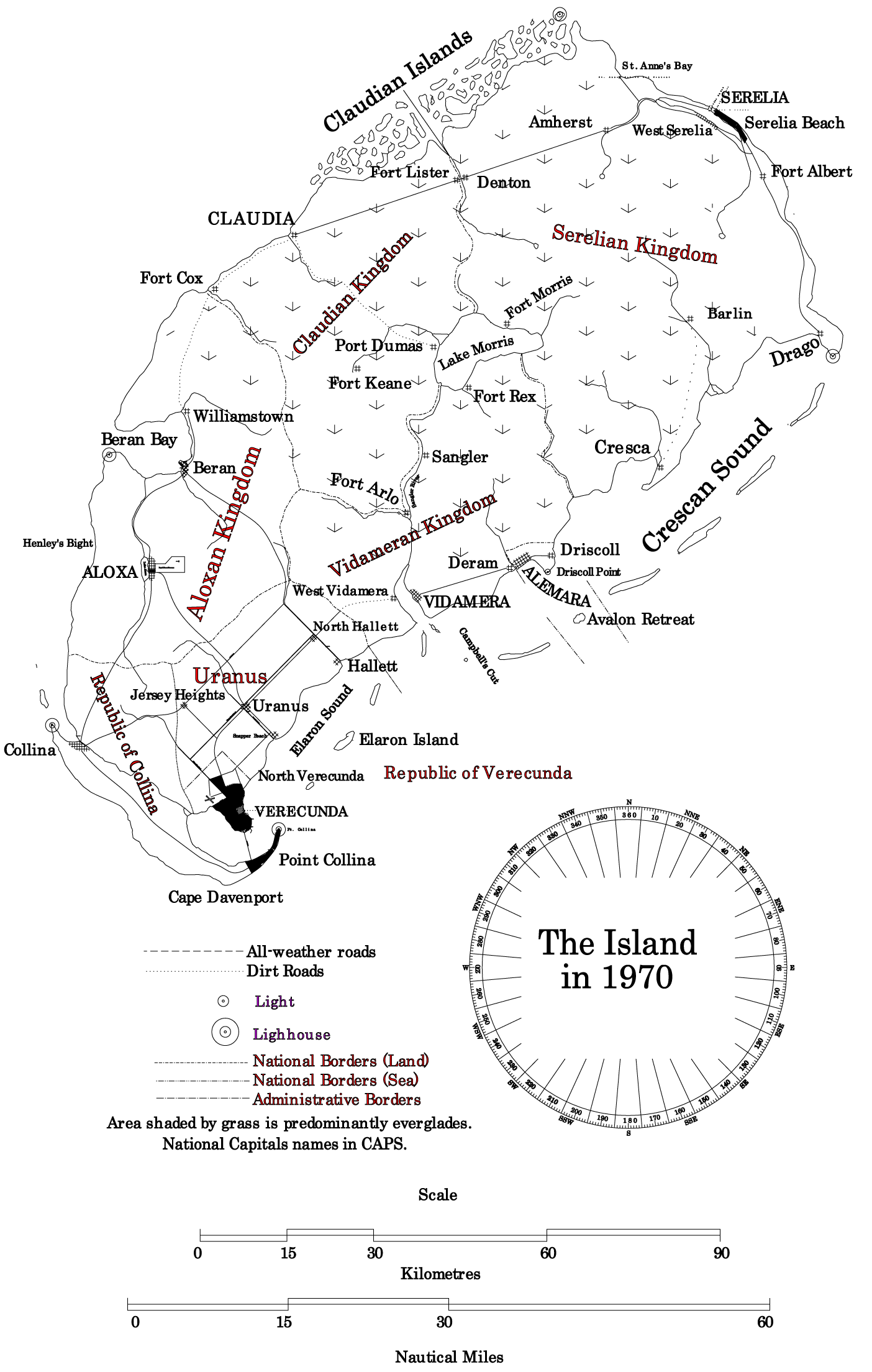
Allan Marshall Kendall was born in 1930 in New Jersey, but when he was five his family moved to Verecunda. The Island had seen a boom during Prohibition; at the end of that social experiment, Verecunda and Collina saw some retreat but were also better known with the travelling American public. Kendall’s family had seen its hard knocks from the Depression and hoped to start again. His father was a greengrocer and started a small store in the north-western part of Verecunda, across the canal from the so-called “Dillman-Arnold” addition, which was just starting to be developed.
Since its founding in 1828, Verecunda had been dominated by its “first families,” the Arnolds, Dillmans and Hervers. Multi-generational wealth splits and family problems had diluted their holdings both individually and collectively, which invited a power challenge. That power challenge came in the form of Lucian Gerland, son of Italian immigrants and an aggressive player. Gerland’s main base of wealth was his real estate holding, but an extension of this was his retail activities. Independent greengrocers such as Kendall’s father stood in his way; he planted a rival store nearby and, through very aggressive pricing, drove Kendall’s father out of business. Kendall never forgot nor forgave his father’s business failure; it drove him on through his entire career.
Through all of his father’s business difficulties Kendall was a diligent student; upon graduation from secondary school, he returned to his native state to attend and graduate from Rutgers in 1952. In spite of the ongoing anti-Communist scares, there was plenty of left-wing activity to take in, and Kendall, nearly a Marxist by that time, did so with a vengeance. At a time when American leftists were wondering how to get back at a McCarthyite nation, Kendall realised that he had a reasonable shot at doing so himself on a much smaller scale. During his time at Rutgers he got another shot of inspiration when he met Laura Millburn, a fellow Verecundan two years his senior. They married in 1950; their only daughter Denise was born three years later.
Laura was more to Allan than a lover and wife. She was the granddaughter of Maximilian Herver, who owned the largest estate in Verecunda proper, extending along the eastern seaboard of the city. Herver had no male heirs and an impending fight amongst the daughters—one of whom had married into the Dillmans—was brewing. Unfortunately Herver wasn’t the best manager of money, and Gerland saw his chance. Whipping up popular support through his political operatives, in 1946 Gerland managed to get a real property tax enacted. Gerland and his other rivals had enough income from their commercial holdings to afford such a tax, but for Herver—whose estate had largely reverted to a wilderness—the burden was unsupportable. Gerland had lent him money, so he called the loans, Herver went bankrupt and committed suicide, and Gerland ended up with the entire tract.
Like Allan, Laura bore a grudge against Gerland. At this point, however, Gerland miscalculated. Having no desire to bear this new property tax alone, and hoping to cool the backwash from his takeover of the Herver Estate, Gerland donated about half of the land, some to the Republic for a seashore park, but most to the University of Verecunda, which relocated to its new spacious campus from what became the government’s central complex. The growing university needed teachers, and Kendall came back from Rutgers to teach history and just about anything else they needed him to.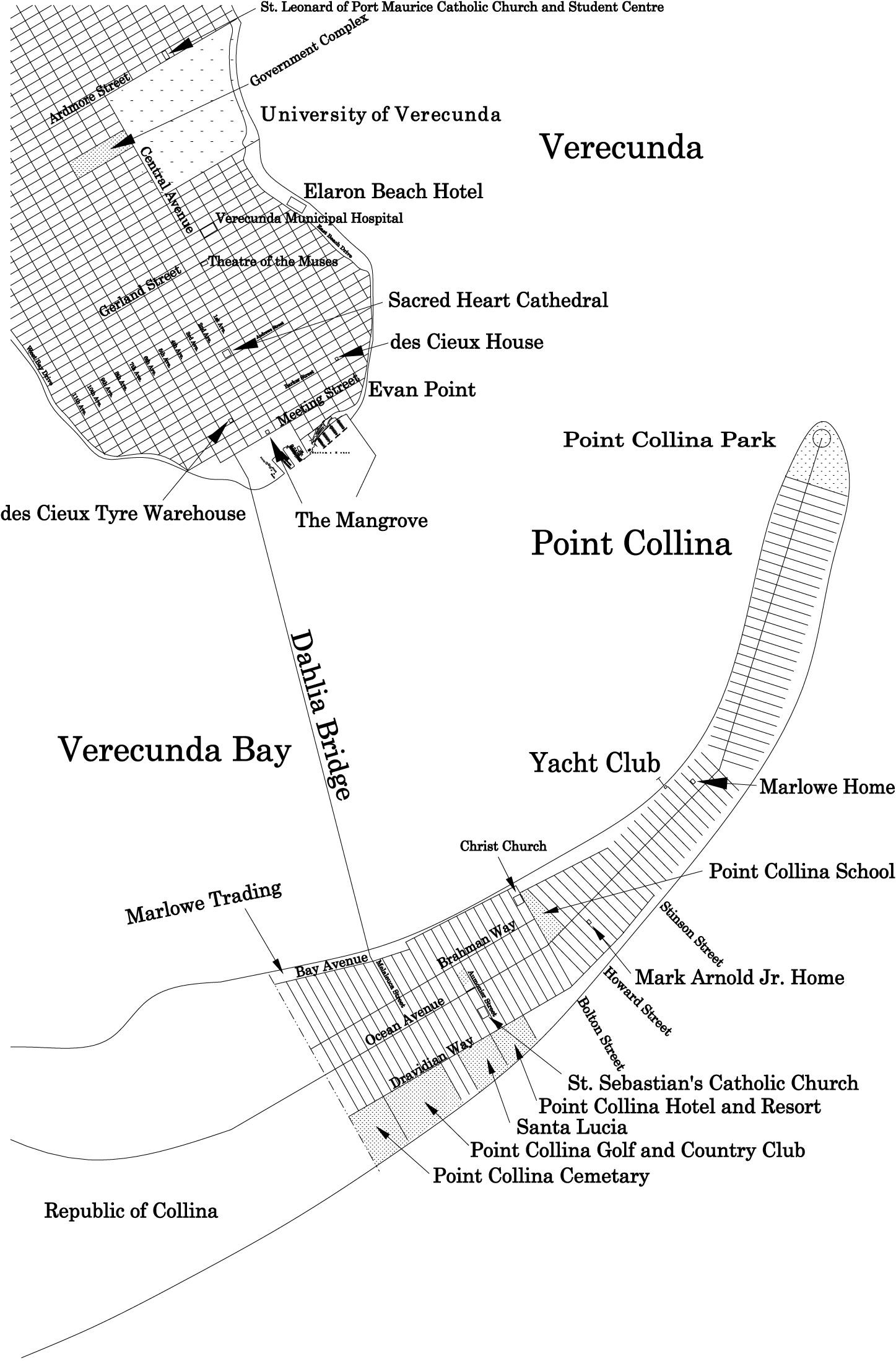
Although nearly a Marxist, Kendall understood that a straightforward, “proletarian” revolution would not succeed in a tourist-agrarian economy such as Verecunda’s. He also realised that, if Verecunda went formally Communist, it would face the serious possibility of American intervention. He also had some ideas on his social agenda that went beyond standard Marxist-Leninist thought. So Kendall decided to “go it alone” without help from the Soviets, hoping that the vulnerabilities in Verecundan society would bring him victory.
His first move was to found the Committee for Personal Liberty (CPL) in 1955 with fellow faculty member Arthur Moran. They spent the next decade radicalising the student body through their own classes and through the meetings and activities of the Committee. Kendall also used the broad structure of the Committee to include off-campus elements. Chief amongst those were the underground trade unions. All of the ruling families of Verecunda—including Gerland—had stoutly resisted the right of workers to organise. With Kendall’s encouragement, the unions resorted to sporadic violence in an attempt to organise Gerland’s hotel empire, among other companies. This led to the authorities arresting Kendall on two occasions, although he was released when the authorities could not directly connect him with the attacks. Kendall’s release was also related to sympathetic people in the police force, which made Kendall see the house of cards he was up against.
But Kendall was patient; he resisted attempts by his trade union allies—to say nothing of Moran—to rush the process. In 1960 the CPL, operating as the Verecundan Peoples’ Party, elected two members to the Verecundan Senate, from the same part of Verecunda that his father had operated his grocery a quarter of a century earlier. But Gerland wasn’t idle either; the same year he secured the National Party nomination and subsequent election of Roland Campbell as President of the Republic. Campbell strengthened the police and managed to get both Kendall and Moran expelled from the University faculty. Moran fled to Alemara to avoid arrest. Kendall would have been arrested himself, but Laura got her Dillman relatives to intervene, and Kendall was able to get a job teaching at Collina Comprehensive. With its leaders on the run, the CPL was in disarray, its senators were an isolated minority, and all seemed lost.
But it wasn’t lost, in part because Kendall’s anti-Gerland stance was getting traction amongst land-holding people in both Verecunda and Uranus. Gerland continued to acquire property under duress. In 1962 he finally managed to buy out the Arnolds’ holdings out at something of a discount, the result of family splits and Gerland’s financial power. In addition to the large Uranan land holders, the branches of the Dillmans which held large tracts (urban and rural) were under pressure. They decided to throw their lot in with the People’s Party, against the (well justified) objections of their other relatives, especially those in the medical profession. With that they began to prepare for the 1964 elections.
Moran was the first of this “dynamic duo” to return to Verecunda, which he did in early 1963. Kendall left Collina Comprehensive to return that summer. The CPL was reactivated. Campbell wanted to move, but by that time he was embroiled in a power struggle within Gerland’s own organisation. Gerland wasn’t getting any younger, and his own interests were more focused outside of Verecunda. Gerland discovered that several of his own people were involved in a scheme to defraud him and that Campbell was involved in covering for them. The two main leaders of the plot were tried and imprisoned; others fled the country, some becoming CPL members. Campbell would have been forced to resign but Gerland didn’t want the embarrassment, so he put Campbell on a short leash until his term expired. That “short leash” prevented Campbell from moving against the CPL, and in any case Campbell was drawn towards Kendall’s organisation (he was Kendall’s first Secretary of State/Foreign Minister.)
Gerland was left with a decidedly “second string” group of people to work with, and this showed in the election of Joseph Bucek in 1964 as President. A reasonable hotel manager, Bucek was totally unprepared for the situation in the Republic. The fact that he was Roman Catholic didn’t endear him to the other leading families either. The People’s Party had grown to hold about a third of the seats, and many of his own party were sympathetic. The CPL became a dominant force through its protests. Moran wanted to start pushing their social and political agenda through the Senate but Kendall held back; he felt that Gerland’s people would get the credit if they did so at this time. So paralysis was the order of the day. What looked like a stand-off was in fact a situation where Kendall’s situation improved as Gerland’s deteriorated.
Making Gerland’s situation worse was the situation in his own family. After years of secret accounts and corporations, it became clear that his desire was to leave his entire empire (except for some cash trusts) to his son Ernie. This enraged his daughters Victoria and Eleanor, especially since Lucian had sexually abused them as children. Victoria was the first to openly come out against her father, joining the CPL in 1966. Eleanor was slower to come out but joined the Committee two years later.
Kendall decided that his time had come in 1968, and so he was nominated as the People’s Party Presidential candidate, with Moran as his running mate. He was handed the best gift of all in that Gerland decided to run himself. Not an effective campaigner and the object of many Verecundans’ hostility, he still would have beaten Kendall had the Uranans not given the latter protest votes over Gerland’s land acquisition schemes. The People’s Party did even better in the Senate, sweeping that body, and Kendall became President of the Republic, a position he would hold for nearly a quarter of a century.
Kendall’s proceeded aggressively on the social front, with liberalising legislation on a variety of issues ranging from the nationalisation of health care to the legalisation of abortion on demand. From a political standpoint, the aim of this and other legislation was to consolidate his own political power along with that of the CPL and the People’s Party.
Kendall had some personalities to deal with as well. The first one was Moran himself, who died in a mysterious private plane crash just seven months after he took office. Moran was replaced by none other than Roland Campbell, who owed a great deal to Kendall. But Kendall’s greatest challenge was still Lucian Gerland, wounded but not yet down. Kendall had many operatives in Gerland’s organisation. Moran wanted to finish Gerland off through a show trial, but Kendall was, as usual, more patient; he knew that Gerland still had a good deal of offshore money and friends. He also knew that Gerland, who felt betrayed by the country that he had “built,” was sick at heart; he didn’t even choose exile to escape the inevitable doom, whether in life or in death.
As the Unix Era began, Gerland’s health slipped away as he isolated himself in Santa Lucia, his palatial estate on Point Collina. But before we go to those fabled times, we start our story at the royal palace in Serelia, on the opposite end of the Island and twenty-seven years after the events of this tale. -
The Ten Weeks, A Preview of What’s to Come
Now that we’re off, below is a “preview” series that I did ten years ago (for the fortieth anniversary of the novel’s setting):
- Week One (13-19 December): In the Clutches of Nationalised Health Care
- Weeks Two and Three (14 December-2 January): A Lovely Catholic Confession, An Ugly Secularist Rejoinder
- Week Four (3-9 January): Dinner with the Freemasons
- Week Five (10-16 January): A Baby Dedication, and Strange Visitors, at the Baptist Church
- Week Six (17-23 January): Learning About French Kissing From the French
- Week Seven (24-30 January): Two Blondes Explore Islam
- Week Eight (31 January-6 February): Before Texting, We Actually Had to Talk on the Phone
- Week Nine (7-13 February): A Little Corporal Punishment for the Road
- Week Ten (14-20 February): When God Touches Your Life, You Will Never Be the Same
-
After What We’ve Been Through, It’s Time for “The Ten Weeks”
Today is the beginning of many things. It’s the First Sunday in Advent, the beginning of a new liturgical year for Anglicans, Catholics and others who follow such things. It’s also the eve of St. Andrew’s Day, which is appropriate because my experience at the prep school named after it was in part the inspiration of what’s going to dominate this blog for the next three months–my novel The Ten Weeks. It’s timely for reasons I’ll set forth, in addition to being (hopefully) entertaining.
How It Was Written
The early part of this millennium was for me a time of rediscovery: of my Anglican/Episcopal roots, of my family history, even of my golf game. One result of those rediscoveries was the Island Chronicles, which had its genesis in the mid-1970’s. Those really haven’t been widely published, because I’m not the kind who likes to fill up my garage with books, and many fiction authors end up doing just that.
As the first decade of the millennium lumbered on, I had the feeling that there was one more place to discover, and that place was the Island in the early 1970’s (the beginning of the Unix Era for computer people.) In January 2006 I was appointed Ministries Coordinator for the Lay Ministries Department of the Church of God; in August this site became a WordPress blog. Somewhere between those two milestones I began organising and writing The Ten Weeks, which was completed early the following year. With one minor revision in 2008 it has stood ever since; it is the only novel which has passed into distribution, but again with no desire of spending a great deal of money getting it published–and fiction in general being the crapshoot it is–it hasn’t gotten a great deal of exposure either. This blogging series is an attempt to fix that problem.
Why Now?
Christian political involvement in this country is based on two narratives, one of which is vocalised, the other hidden, neither true.
The first is that, until some recent time, this country has been a seamless Christian country with seamless Christian virtues. Although I’d be the first to admit that the arc of our morality hasn’t been upward in my adult lifetime, the truth is more complicated than that, complicated by such things as Masonry, Judaism and, to some extent, Roman Catholicism.
The second is that the wealthy (and later the educated) are, by virtue of having risen to their status, more virtuous and better, and thus deserving of deference. This has always been a thread in Christian life in this country, but there has been pushback, especially in the South. With a major shift in that culture, it made it easier to sell “Reaganomics” to the Christian community during the 1980’s and beyond, and thus merge the two into one political movement. But the truth of the matter is that, the closer you get to the wealthy, the more you realise that this is false, and moreover they are the source of many of the social ills that have degraded our society, as they can afford the blowback of their failure and the rest of us cannot.
Recent events should be a wake-up call that our failure to recognise the falsity of these narratives has gotten us into serious trouble. Many are shocked that things have turned out the way they have. But for those of us who were in the storm of the late 1960’s and early 1970’s and were not raised on another planet, where we’re at was predictable; the surprise is that it took as long as it did. The Ten Weeks is, in one sense, a thought experiment as to what life would have looked like if the timetable had matched our expectations.
Blogging the Novel
Although it’s been done successfully, blogging a novel isn’t as straightforward as it looks. The Ten Weeks is no exception. The title implies a timetable, and the book is built around a very tight chronology. The original narrative is set from December 1970 to February 1971. In blogging the novel, I was aided by two providential circumstances which greatly helped things along. The first is that we are at the fiftieth anniversary of the setting of the novel. The second is that the days of the week for that anniversary are identical to the setting of the novel. This means that the narrative can be presented realistically in the novel’s time sequence. The trout in the milk is that fiction, like life, is more eventful on some days than others, so I have had to split up some of the days and move them back some to keep the blog posts from becoming too long. With that my success is mixed; I have done my best, I trust that you will find it acceptable.
If you don’t, of course, you can order the novel in paper or virtual form; places to do that are all around you on this site. In any case it’s time to start the adventure that is The Ten Weeks.
-
The Tough Lesson of Augustine’s “Dear Marcellinus”
At the beginning of Augustine’s City of God we have this opening:
My dear Marcellinus: This work which I have begun makes good my promise to you. In it I am undertaking nothing less than the task of defending the glorious City of God against those who prefer their own gods to its Founder.
Flavius Marcellinus was a high official of the Western Roman Emperor Honorius. In 410–the year Alaric sacked Rome–he was given orders to suppress the Donatist churches in North Africa, which he proceeded to do. But the Donatists resorted to the old Late Roman trick of laying a charge of treason against Marcellinus and his brother, accusing them of supporting a separate rebellion. The Roman general Marinus, who had just put down the rebellion, put them on trial, secured a conviction, and had them executed just two short years after Augustine began the City of God. Honorius exonerated Marcellinus the following year, but by that time it was too late.

Jean-Paul Laurens’ portrait of the Roman Emperor Honorius When it came to “what happens when careerism goes south,” Rome was never a walk in the park, but after Marcus Aurelius things really got bad. Careers of the great and incompetent alike ended in execution; Honorius, the weakest emperor at the most critical time, had his capable general Stilicho executed a few years earlier because he saw him as a rival. The informant system–with information true and false–was destructive or deadly for many Romans, carried out by such masters of the art as Paul the Chain. The river of blood continued after Rome fell apart, with Boethius writing his classic The Consolation of Philosophy while waiting execution, which came, after his fall. Gregory of Tours’ account of Gaul beginning its transition to France was likewise a river of blood of those who ended up on the wrong side of ruthless power-holders such as Fredegund.
Christians tend to consider the fall of Rome as a result of a decline in their sexual morality, but there’s no evidence that Rome’s sexual morals were worse in the late period than the earlier one. What was worse was what the French historian Ferdinand Lot referred to as the “corruption of the public spirit,” the decline of civic life and the communal idea that goes with it. The Roman system was patronage driven from top to bottom, but when it was working properly it meant that those who aspired created a clientele which benefited from them while they moved up. When the system broke down it was replace by an autocratic system where money and resources were forcibly pushed to the top to be dispensed to a bureaucracy which kept the power holders in place. This led to the onerous taxation system of which Lactantius was the most famous chronicler. Lactantius also noted that those who lived off of the tax system were more numerous than those who paid the taxes, and although that may have been an exaggeration there was definitely a retreat of the productive portion of the society, which in the end led to the system’s bankruptcy.
Christianity was unprepared for its legalization under Constantine, but its response to the deteriorating situation–and the corrupt morals of the political system–was to call at least some of its flock to a higher, if withdrawn, calling. How this played out depended upon the end of the Empire in question. In the East it led both to the growth of monasticism (withdrawal from the evils of the world) and to the Caesero-papism that complicated the doctrinal disputes that raged in the fourth and fifth centuries. In the West monasticism took longer to get started but when it did the result was the same: the withdrawal from a system in breakdown with which Christianity couldn’t quite get the upper hand. (It’s worth noting that Pope Siricius wouldn’t let people who had been in the civil service become priests.)
Protestants generally put down monasticism, but it represented an attempt to live in a more Christlike fashion in a world which made that very difficult. Is ours any better? To some extent it never has been, but in a world where laid, high or drunk is the battle cry of those at the top, and which is prepared to ignore blatant influence peddling and employ cancel culture (and also vindictive prosecution, as Marcellinus experienced) to enforce their idea, it’s time for American Christians to re-examine their naive belief in the lack of moral and personal hazard in moving up. That may seem like blowing retreat, but in blowing retreat Late Roman Christians laid the groundwork for the advance which transformed European civilization, and ultimately ours.
Today our left is making “little lists” of people to destroy. Our current game is to intimidate law firms from representing clients we don’t like; that’s a quick way to skew our justice system, and not in good ways. Most of those lists are those who might achieve high position; they don’t want the competition. Is it worth it to find yourself on one of those? There are times when we have to endure persecution for bearing the name of Christ, but if it’s for our careerist ambition, that puts things in a new light. It’s time for American Christians to stop being so reflexive about moving up, and to look at their eternal objectives more than their temporal ones. This empire, like Rome, will pass, and we need to take some lessons from those who responded to its decay.
-
Word of God: Amen Our Hearts Cry
Word of God W/G 7711 (1977)
This is another in a series of albums that the Word of God put out featuring their worship songs and the music group that led them. It has an interesting mix of songs, including some of the community’s own (Psalm 8, Psalm 18,) non-Catholic choruses (Therefore the Redeemed, Our God Reigns) and an ancient Catholic hymn (Holy God, We Praise Thy Name.) It also includes Pauline Mills’ Thou Art Worthy, which is performed by the composer elsewhere on this channel.
I keep getting heat about my opinion of the musical style and performance on these albums, but I really think that, as was the case with other groups, from a creative and performing standpoint, this album is not up to the standard of the earlier ones.
1977 was a turning point year for the Catholic Charismatic Renewal, with the Kansas City conference. It was also a turning point for me in that I considered and declined to join the Community of God’s Delight in Dallas. I think this may have been the first Word of God album I bought and the others came later.
The songs:
- Ex. 24:3,7
- Isaiah 60
- One Thing I Ask For
- Hallelujah, Our God Reigns
- Lift High the Banners of Love
- Therefore the Redeemed
- Psalm 18
- Psalm 8
- Thou Art Worthy
- Holy God, We Praise Thy Name
- Our God Reigns
- Producer: James J. Cavnar
- Conductors: Donald E. Fishel, Donna Kelly, Abbie Root
- Performers: Chorus and Orchestra of the Word of God
- Orchestral Arrangements: Donald E. Fishel, Donna Kelly, Richard Rhodes, Linda Speck
- Recording Engineer: Henry J. Root
- Cover design and photography: Gerry Rauch, John Leidy, Charismatic Renewal Services, Inc.
- Back Cover Photograph: Jack Taipala
Sailing the Last Voyage with Newton and Pascal
 Positive Infinity