-
At the Inlet: August, Part 2 (A Fateful Meeting)
Table of Contents and Overview for At the Inlet | Information and ordering instructions for all of our fiction
Later that day Julian, Terry and Priscilla resumed their tour. Their next stop was St. Simon’s Church in Fort Albert. Until the war all of the Anglican churches in what is now Drahla were Churches of Serelia. When the Drahlans declared independence, they forced these churches to provisionally affiliate with the Church of Alemara, the Anglican province to the west; that affiliation became permanent with the formal treaty of Drahla’s independence.
This was Terry’s first trip back to Drahla since she had left, so it was another opportunity to be nervous. When they reached the border, the guards gave Terry a funny look as they checked her very Serelian paperwork, but they were admitted and went on St. Simon’s.
St. Simon’s was an attractive church that had managed to survive and prosper the change of affiliation, the war, and the loss of government funding. As customary, they arrived in mid-afternoon, but it wasn’t long before an elderly Anglican minister, his wife and two teenagers came in. Priscilla recognised them immediately and introduced them to Terry.
“This is Reverend Anselm Gant’s father and mother, Bede and Lydia Gant, and Anselm and Theresa’s children, Mary and young Bede.” Mary curtsied at her introduction. Terry was always impressed at how polite children and young people on this end of the Island generally were—as opposed to their Verecundan counterparts—but these two were above average in manners even by Serelian standards. As the conversation progressed, Priscilla focused on the elderly Gants. Although retired, Bede helped out at the church, so Priscilla and them caught up on Anglican news “south of the border.”
Terry for her part talked with the children. Mary was a boarding student at St. Anne’s, like her mother and aunt had been. Bede went to St. Matthew’s School in Serelia Beach. What they wanted to know, however, was the kind of life Darlene was living in the palace. This is something Terry was prepared to discuss at length; it also gave her an opportunity to share their spiritual activities as well. Mary and Bede wanted to go there at some time other than Court and get a real tour of the place and spend some time on the beach; Terry promised to try to make that a reality.
About that time the children were informed that they needed to go help set up the after-recital tea in the parish hall. This they did; both of them left with the elder Gants to do this. Five minutes later Mary came back and told Terry, “There are three gentlemen outside who would like to see you, Miss Marlowe.”
“Thank you, Mary,” she replied. She was puzzled by this but went out through the narthex to find three men in suits waiting. She recognized them immediately. One was Rev. Peter Kelly, the current General Superintendent of the Drahlan Pentecostal Fellowship. The second was Rev. James Sillender, pastor of the Fort Albert Pentecostal Church. The last was Rev. Oliver Hackett, who pastored another church in the Fort Albert area.
“Sister Marlowe,” Kelly said.
“Bretheren,” she replied.
“We didn’t come here for camp meeting,” Sillender noted. “We have a serious matter to discuss with you.” Kelly pulled an envelope out of his pocket and handed it to Terry. “These are ministerial charges which are being laid against you.”
“Charges? What of?” Terry asked.
“Conduct unbecoming of a minister,” Kelly said. “There’s also the matter of your lack of reporting since you’ve been in Serelia.”
“We’re sorry it had to come to this,” Sillender said.
“You know you’ll have the opportunity to answer these charges according to the minutes,” Kelly said. “I would appreciate it, though, if you would at least give us your preliminary response before you leave Fort Albert.”
“With God’s help, I will,” Terry answered. With that she left the committee outside of the church and went back in.
Julian was finishing up getting the organ ready when he looked out and saw his visibly shaken love seated at the front. He came over and asked, “Is there something wrong, Terry?”
“Yes, Julian, there is. But I don’t want to discuss it now. We’ll talk about it later.” Julian was miffed but went along.
Terry might as well have been on a barrier island by herself as to be at the recital. All she could do—and pray about—was her ministerial charges. By the time the recital was over, she was more at peace with the situation.
At the tea she met some old political colleagues from the Citrus Growers Cooperative. “I need a favour out of you guys,” she said.
“What’s that?” one of them asked.
“First, I need to borrow some of your office facilities—early, about 0800 tomorrow. Second, Brother Peter Kelly is in town. I need to see him and the two other ministers who came to see me this afternoon in your conference room about 1000.”
“We’ll be glad to,” was the response. They suspected what was going on but said nothing.
Terry arrived at the Cooperative at the appointed time, borrowed a typewriter, did a letter, and made some copies. By the time the brethren filed into the conference room there to meet with her, she was ready for them.
“So what is your response?” Kelly wanted to know. “When can you come back for a hearing?”
“My only response is this,” Terry said, handing the original of the letter to Kelly and copies to Sillender and Hackett. They read the letter as follows:
Rev. Peter Kelly
General Superintendent
Drahlan Pentecostal Fellowship
Dear Brother Kelly:
This is in response to the letter you presented to me yesterday concerning the charges of conduct unbecoming of a minister and failure to report.
First of all, I am surprised that these charges were presented to me without any preliminary consultation with you or with Brother Sillender. Having been involved in several proceedings such as this in my fifteen years of ministry, I find this rather abrupt.
Second, I deny the charge of conduct unbecoming of a minister. I have done nothing to dishonour God since I have been in Serelia, any more than I did while I was in Drahla. Since your letter has absolutely no specifics about the basis of the charges, I cannot answer further.
Third, having been a Provisional District Superintendent, I find it rather unpastoral to include the charge of failure to report without any “friendly reminders.”
I am prepared to defend myself against all of these charges. However, I realise that my entire expedition to Serelia has been controversial in many quarters, even though it is pastoral in nature. It has always been my policy to put the interests of God’s church above my personal ones. Therefore, not desiring to prolong either the agony of the Fellowship or my own any further, with this letter I resign and surrender all ministerial credentials that I have with the Drahlan Pentecostal Fellowship, effective immediately.
May God bless you and all of the Fellowship as we all continue to do the work that our Lord as commissioned us to do.
Until Jesus comes,
/s/
Terry Marlowe
The brethren read the letter in silence. Then Kelly said, “This is very noble of you, Sister Marlowe.”
“I believe this matter is at an end, Brother Kelly,” Sillender said. The three rose, said their goodbyes, and left. Terry left just after them, thanking the Cooperative for their help. When she got outside, Hackett was still there, waiting for her.
“Can I ask you one question,” he asked her.
“Sure.”
“Do you think you’ll marry that Anglican minister who played the organ last night?”
“Only God knows that,” Terry said. “Just because I turned in my license doesn’t mean I still don’t want God’s will for my life.”
“Nobody else may like this,” Hackett said, “but I hope you do. You’ve been single long enough. Not many of the rest of us would have stayed single for this long.”
“I guess that’s what bothers me the most about this whole thing. But keep me in your prayers.”
“I will,” he answered. “A lot of people here will. You still have a lot of friends here.”
“Thanks,” she said. They shook hands and departed. Terry made her way back to St. Simon’s. Julian was waiting for her.
“Did it go well?” he asked. Terry handed him the two letters. Julian read them with progressive concern coming over his face.
“Oh dear, I had no idea it would come to this. I was hoping something could be worked out.”
“Evidently, it can’t,” she replied. “I guess I’m all yours now—my bridges are officially burnt.”
“You’re God’s child, Terry,” Julian reminded her. “He will be with you. As the Holy Scriptures say, ‘Can a woman forget her sucking child, that she should not have compassion on the son of her womb? yea, they may forget, yet will I not forget thee. Behold, I have graven thee upon the palms of my hands; thy walls are continually before me.’” They were both in tears as they embraced each other as closely as they ever had.
Julian’s last recital was at St. Mark’s Church in Drago. They loaded the car and proceeded down the Old Beran Road. After what she had been through in Fort Albert, the idea of going to Drago, where most of the pressure for the abolition of Royal Counsellor had come from, wasn’t so bad.
St. Mark’s was near the waterfront; from the church through the trees you could see the Crescan Sound and boats at dock or anchor, more numerous all the time. They didn’t have much time to sightsee, though, as they were running a little late due to Terry’s problems. As always, though, everything came together.
Terry was in her usual position before the service started when she felt a tap on the shoulder. She turned around and saw no less than the Princess Andrea, her mother Cecile, and Andrea’s oldest daughter Deborah. They were so excited that even Julian, making final adjustments and practice, could hear them over his organ playing. Andrea was down visiting her mother. They had a lot to catch up on, which they did both before and after the recital.
“So you resigned your credentials,” Andrea told Terry during the tea. “I hate to hear that. I was hoping you could come back and dedicate my next child, due in April.”
“You’re pregnant again?” Terry asked.
“Yes, it’s just too much fun,” Andrea sighed. “But they’re a joy. But you’ve got to tell me—are you and Julian serious?”
“This country is crazy,” Terry observed. “First, they’re all mad about me going to Serelia and dating Julian. Then they want to know when the wedding’s going to be.”
“This place is crazy—in a lot of ways.”
“How’s your new Prime Minister working out?”
“Duane Peterson? He’s okay. They’re still hashing out a constitution. I leave that to Dennis and Michael—I’d rather raise the children, they’ll mind you. The King is sick about this whole thing—he spends a lot of time out on his hunting estate. He’d rather fight the mosquitoes than the Provisional Committee. They’re trying for a referendum on the constitution in October. I wouldn’t be surprised if he abdicates. Then we’re going to have to had constitutions for all of these ‘cantons’ we’re getting—Drago, Cresca, Barlin, etc.. By the time we get this government figured out, we’ll have wasted enough time to have blown any advantage a ‘democracy’ is supposed to bring. If it weren’t for Cathy at the Central Bank, we’d be in really serious trouble.”
“Duane was in my youth group in Cresca,” Terry reminisced. “He was a good kid. I hope he does well. Thinking about him as a teenager then and Prime Minister now makes me feel old…I didn’t know that Queen Annette was your aunt until recently.”
“My mother will hardly discuss the whole thing,” Andrea answered. “The whole thing about her father and brothers is too painful. I’ve tried to get her to go visit the Queen in Serelia but she won’t go—says she won’t set foot in the place.”
“Maybe you and Cathy and Queen Janet can invite her to Barlin, or here. Annette is lonely. She doesn’t get out much. I spend some time with her between everything else—we play mah-jongg.”
“I didn’t know you played that,” Andrea said. “My mother loves it. We used to play it growing up.”
“I guess I didn’t want anybody to know,” Terry sheepishly admitted. “But the Serelians have an extensive intelligence file on me and that’s how they found out. I’ve had a lot of stuff like that happen.”
“Next time Dennis and I come to see you, I’ll find out just how good you are.”
Priscilla’s sister was the rector’s wife at St. Mark’s, so they wanted to spend time together in the morning. Julian and Terry went out to promenade on the dock at Drago when they saw a nice looking black couple coming up to them.
It was Arthur and Elizabeth Millington; Terry recognised Elizabeth, they embraced and the introductions were made. Elizabeth was the daughter of Andrew Vickers, the pastor of the large Pentecostal church in Beran. The men were properly introduced and then they decided to look for somewhere to drink coffee or tea. It took a little doing but they found the dining room of the guesthouse still open. Their porch overlooked the harbour so they were able to socialise and still take in the beautiful scene.
“How is your church doing in Vidamera?” Terry asked.
“It is difficult,” Arthur confessed. “Vidamera is a hard place, as you know. I have had to work quite a lot but that’s getting a little better. It’s good enough so we can take a little holiday here in Drago. Now that Father Raymond is now a bishop, I’m not sure whether they will still want Elizabeth at the school—the new priest is from the mainland, he doesn’t understand our ways. But we hear you’re having your problems also.”
“I certainly am,” Terry admitted.
“We heard a rumour that the church here revoked your credentials,” Elizabeth said.
“I didn’t give them the chance,” Terry answered. “I resigned them just yesterday.”
“It’s a pity what’s happened,” Julian added.
“Talk about you—the two of you—is all over the Island,” Arthur stated.
“My father got up at our camp meeting and told everyone that he believed that you were on God’s work in Serelia and that a lot of the talk wasn’t true,” said Elizabeth. “He asked me to stand in for you and asked the ministers to come down and pray for you. Almost all of them did. That’s helped a lot. Now my father told me that, if I ever saw you, to tell you that, if you needed them, we would extend credentials to you if you ever came to Aloxa. He also wants you to come back for a revival and Bible teaching session.”
“I want to more than you’ll ever know,” Terry said. “You people are great. I’ve just been tied up with everything.”
“I’ve also heard that we’re about to get an embassy in Serelia sometime this year,” Arthur added. “Maybe that will make things easier.”
“I hope so,” Terry said. They talked about everything and everyone for a long time. As the noon hour approached, Julian reminded Terry that Priscilla might be wanting to get on back to Serelia. They embraced each other as they left.
“You know,” said Julian, musing as they walked back to St. Mark’s, “that’s the first time I’ve ever actually socialised with black people in my life, other than when I was at university.”
“They’re wonderful, aren’t they,” Terry replied. “White people, they love you one day and hate you the next. When you have a black friend, you have a friend for life.”
The Millingtons were likewise talking about their meeting. “They make a lovely couple,” Elizabeth said. “Terry looks so happy.”
“There’s one rumour I can crush now,” Arthur said.
“And what’s that?”
“That they’re having an affair.”
“And how do you plan to do that?”
“It’s a man sort of thing. Some men, you have your doubts. Him—the whole idea is ridiculous! Just look at him…”
“Now, stop it,” Elizabeth said.
When the three returned to Serelia Saturday afternoon, they let Terry out at the palace. She caught sight of Kyle on the grounds and motioned him to come over.
“I need a favour of you,” Terry told him.
“What might that be?”
“I need to see Tim Mallen. Tonight. Tell him to meet me at the front porch of the Inn at 2000. It’s important.”
“I understand—I’ll get it done.”
The Inn had a large front porch. The evening was calm. Tim Mallen sat on one of the wrought iron chairs there; they were well provided for with padding. Suddenly Terry emerged from the Inn with two cups of coffee. “How do you like your coffee, Brother Tim?” she asked.
“Sister Terry—I didn’t know you were here.” He rose, she put the mugs down, and they shook hands. “I just take mine black.” They both sat down.
“I’m sorry for the short notice—I know you like to use this time to prepare your sermon, but this is urgent—I wanted to discuss things with you before I had to face everyone at the palace.”
“Well, Sister Terry, what we’ve got to discuss is probably more important than any sermon I might prepare right at the moment,” Tim said in his slow, deliberate manner that was almost his trademark. “The whole church is tore up about this.”
“I’m sorry I’m so much trouble,” Terry said. “I was blindsided by what happened at Fort Albert.”
“It’s not your fault, really, Sister Terry. Let me try to explain all of this from the beginning.
“I was real proud when I heard you were coming here. I knew you came for Princess Darlene and all that. But ever since you’ve been here, there’s been a lot of talk going on. Sister Mallen would tell me about it, but I didn’t pay it any mind.
“Right after the hurricane, Brother Sillender—I’m on his district—came to see me. He started asking me a lot of questions about you. I didn’t have a lot of answers, so I asked him, ‘What kind of trouble is she in?’ Serious trouble was his answer. So I asked why. He said he couldn’t discuss everything he knew but he told me the following.
“The first thing he brought up was your going to the beach with Reverend Lewis. He asked if you two were having an affair. I told him that I knew you were seeing each other, but that you were too much a woman of God to have an affair with anyone, let alone the likes of Reverend Lewis. He told me that he understood that they had done things on the beach that were so shameful, he wasn’t sure how he was going to deal with them if it went to trial. I said that I knew that they had been on the beach together, but that the palace beach is very private, and that the King doesn’t permit any foolishness on any beach in this country.”
“Especially since he was watching the whole thing himself, along with the rest of the royal family,” Terry observed.
“The second thing he brought up was about her seeing Reverend Lewis at all,” Tim continued. “I told him that she—you—was free to marry. He said it was a disgrace for any saint to get involved with a priest of an apostate church, but especially you.
“The third thing he brought up was that he had heard tell that you were going to join their church. I told him we’ve discussed this matter before. I reminded him that it was impossible for anyone to hold any kind of government office, or palace or Cathedral position, without being a communicant with their church. I also reminded him that many of my members also maintain a membership with their church just to keep their jobs. He said that that policy was wrong for them and wrong for you, but that maybe if they made an example out of you, Sister Terry, everyone else would finally get the message.
“He said there were a lot of other things that he didn’t want to get into. I asked him ‘What are you going to do?’ He said he’d have to discuss it with Brother Kelly, since you were technically still on the Barlin District, and were so well known. He said that it wouldn’t be long though.”
“It wasn’t,” Terry sighed. “So who went to him and told him all this?”
“Let me tell you one more thing before I get to that,” Tim answered. “I knew we had a serious problem. So I called a meeting of my five house deacons. They had heard a lot of this too. So I asked them what they thought of it. I didn’t get a very positive answer; I knew you were in trouble then. But one of my deacons—the gardener at the palace, actually—suggested that the five of us might want to meet with Princess Darlene to let her tell what had happened to her, since she was the reason you came in the first place. It took some doing, but we got an appointment with her the day she came back from seeing her family in Amherst—I think it was the same day you left for Fort Albert.
“We met in the parish hall at the Cathedral. She spent about an hour with us. She told us about how you prayed with her for salvation on the yacht, how you had given everything up to come and minister to her, and some of the things that you had taught her during Bible study. She was really sweet—I really felt the presence of the Lord during that meeting. At the end we all prayed together for you and for each other. As we were leaving, another deacon broke down and confessed that he knew who it was who went to Brother Sillender.”
“Who was it,” asked Terry, a little impatiently.
“It was Sister Hammett,” Tim replied.
“DeDe—the Queen’s lady-in-waiting.”
“She claims she saw everything on the beach—and elsewhere.”
“She probably did see us there—but what she told Brother Sillender and what she saw probably didn’t have much to do with each other,” Terry observed.
“Turns out, though that we weren’t the only ones to find out about Sister Hammett.”
“Oh?”
“When the news hit here on Friday that you had turned in your license, both the Queen and the Princess were incensed. They dismissed Sister Hammett—Brother Hammett had to lose his job too on the maintenance staff—I feel real sorry for him, he’s a good man. Sister Hammett’s daughter is now lady-in-waiting to the Queen, she just started coming back to our church recently.”
“I wonder who’s going to be Darlene’s lady-in-waiting?” Terry interrupted.
“I’ve heard her name is Althea—used to work on the Amherst estate,” Tim replied.
“I know who she is—she’s the one whose daughter was bit by a rattlesnake and Darlene spent all night with her. Darlene proved both her ability as a servant leader and her belief in divine healing—and that’s before she got saved.”
“God is always preparing people for something,” Tim said.
“So where are the Hammetts going?”
“I’ve heard tell they’re going to move to Barlin.”
“And make Brother Calloway’s life miserable,” Terry said.
“Maybe not,” Tim said. “I think I’ve got the votes to turn her out. She should have come to one or both of us first. That’s the Bible way. Besides, I’m not about to have my members go over my head and run to the DS every time something doesn’t suit them. We live in a different world up here—if we’re going to risk going to jail all the time, the least they can do is to let us work things out the best we can.”
“I’ve learned that the hard way,” Terry agreed.
“This whole thing isn’t right—you’ve done too much for us.”
“Such as?”
“Such as keeping the church constable off our backs. He hasn’t raided a Pentecostal church since you got here. I saw him last week on the beach with his grandkids—we just waved at each other. And there’s that Bible study, and everything else…”
“Thank you—that makes it all worthwhile. Can I ask you one question?”
“Yes.”
“What do you think of Julian Lewis? Honestly.”
“Well,” Tim said after a long pause, “I don’t think these Church of Serelia clergy are very spiritual, except maybe at the liquor cabinet. But him—he’s a good man. Always treated us right. If I were in your position, I wouldn’t mind spending my life with him, but I’m not so sure about his church.”
“Neither am I, Brother Tim. I don’t know what I’m going to do about that, especially now.”
“God will find a way, Sister Terry,” Tim said. “He’s never failed us yet.” They talked about other matters, but finally they took their leave of each other after prayer.
Darlene and Terry went through a long analysis of the past week’s events when they reunited on Monday morning. Darlene was saddened by Terry’s problems with her church, but said she was blessed meeting with Tim Mallen and his deacons. They also talked about Darlene’s family as well. After that session, however, their Bible study and prayer time were altered by one significant addition: the Queen became a regular part of it.
Without a catechism, Julian and Terry had to find another topic of conversation, but Terry’s whirlwind tour of east Island Anglicanism—along with her problems with the Pentecostal church—opened up new vistas of conversation. Julian felt more at liberty to discuss his years as an organist, choirmaster and minister. He also took a renewed interest in Terry’s years in the ministry as well. As he gazed into those dark eyes he so adored, he came to know that he was looking into a world that most Anglicans—especially ministers—were ignorant of, a world that combined material poverty and sacrifice with spiritual exuberance and energy, and not just as a disinterested observer but through the very eyes of one of its most prominent participants.
-
Who Shall Spread the Good News?
 We begin yet another podcast series, this time the contemporary Catholic album Who Shall Spread the Good News? by Roger Smith, Michael Howell and the New Commitment.
Although it may seem a stretch to call this album a “classic,” that is what it is. Personally, I always found this album to be good to hear then things weren’t going well. For orthodox Episcopalians, given the sad events at Camp Allen (down the road from the photo to the right,) some consolation might be in order.
We start the series with the title track Who Shall Spread the Good News?
-
Some Help for Your Acolytes
Holy Week was magnificent. You, the Rector of an Anglican church, know it. The choir was heavenly. The altar guild outdid themselves again. Not a revisionist in sight. Your sermon even ended with more than half of the congregation awake! Your golf game on Easter Monday with the Senior Warden only crowned the whole experience. However, as you dropped that last 20 centimetre putt and headed to the Nineteenth Hole, there was that something that just kept coming back to haunt you.
Face it. Your Senior Warden is right. Your acolytes were pitiful.
But help is on the way. You can click here and go view the “handbook” for the Order of St. Peter acolytes for Bethesda-by-the-Sea Episcopal Church in Palm Beach, FL. This dates before TEC’s current prayer book, in case you’re still using the old standard.
And while you’re working on bringing them “up to standard,” you should know that, when Bethesda’s acolytes messed up (and they did,) all the Rector had to do was to call for a tee time and walk next door.

The field, caddies and gallery of the 1974 Palm Beach Golf Classic at the Breakers wait to proceed. In the upper left hand corner, barely visible above the palm trees, is Bethesda’s spire. -
The Epistle Dedicatory to the Authorised (King James) Bible
Today many of the millions of Authorised (King James) Bibles printed and distributed lack the preface of the translators to the most important translation of God’s Word in the English language. We present it here for the following reasons:- It shows clearly that the Authorised Version is a product of the Church of England, which should give Baptists pause as to why they use it so much.
- It shows how important the accession of a monarch favourable to the Church of England as a demonstrably Biblical institution was and is important.
- The next to the last paragraph is probably as succinct statement of the true nature of the much-vaunted "Via Media" and its results as one could want.
We trust that it will be a blessing to you.
TO THE MOST HIGH AND MIGHTY PRINCE
JAMES
BY THE GRACE OF GOD
King of Great Britain, France, and Ireland, Defender of the Faith, &c. The Translators of the Bible wish Grace, Mercy, and Peace, Through JESUS CHRIST our Lord.
Great and manifold were the blessings, most dread Sovereign, which Almighty God, the Father of all mercies, bestowed upon us the people of England, when first he sent Your Majesty’s Royal Person to rule and reign over us. For whereas it was the expectation of many, who wished not well unto our Sion, that upon the setting of that bright Occidental Star, Queen Elizabeth of most happy memory, some thick and palpable clouds of darkness would so have overshadowed this Land, than men should have been in doubt which way they were to walk; and that it should hardly be known, who was to direct the unsettled State; the appearance of Your Majesty, as of the Sun in his strength, instantly dispelled those supposed and surmised mists, and gave unto all that were well affected exceeding cause of comfort; especially when we beheld the Government established in Your Highness and Your hopeful Seed, by an undoubted Title, and this also accompanied with peace and tranquility at home and abroad.
But among all our joys, there was no one that more filled our hearts, than the blessed continuance of the preaching of God’s sacred Word among us; which is that inestimable treasure, which excelleth all the riches of the earth; because the fruit thereof extendeth itself, not only to the time spent in this transitory world, but directeth and disposeth men unto that eternal happiness which is above in heaven.
Then not to suffer this to fall to the ground, but rather to take it up, and to continue it in that state, wherein the famous Predecessor of Your Highness did leave it: nay, to go forward with the confidence and resolution of a Man in maintaining the truth of Christ, and propagating it far and near, is that which hath so bound and firmly knit the hearts of all Your Majesty’s loyal and religious people unto You, that Your very name is precious among them: their eye doth behold You with comfort, and they bless You in their hearts, as that sanctified Person, who, under God, is the immediate Author of their true happiness. And this their contentment doth not diminish or decay, but every day increaseth and taketh strength, when they observe, that true zeal of Your Majesty toward the house of God doth not slack or go backward, but is more and more kindled, manifesting itself abroad in the farthest parts of Christendom, by writing in defense of the Truth (which hath given such a blow unto that man of sin, as will not be healed), and every day at home, by religious and learned discourse, by frequenting the house of God, by hearing the Word preached, by cherishing the Teachers thereof, by caring for the Church, as a most tender and loving nursing Father.
There are infinite arguments of this right Christian and religious affection in Your Majesty; but none is more forcible to declare it to others than the vehement and perpetuated desire of accomplishing and publishing of this work, which now with all humility we present unto Your Majesty. For when Your Highness had once out of deep judgment apprehended how convenient it was, that out of the Original Sacred Tongues, together with comparing of the labours, both in our own, and other foreign Languages, of many worthy men who went before us, there should be one more exact Translation of the holy Scriptures into the English Tongue; Your Majesty did never desist to urge and to excite those to whom it was commended, that the work might be hastened, and that the business might be expedited hi so decent a manner, as a matter of such importance might justly require.
And now at last, by the mercy of God, and the continuance of our labours, it being brought unto such a conclusion, as that we have great hopes that the Church of England shall reap good fruit thereby; we hold it our duty to offer it to Your Majesty, not only as to our King and Sovereign, but as to the principal Mover and Author of the work: humbly craving of Your most Sacred Majesty, that since things of this quality have ever been subject to the censures of ill meaning and discontented persons, it may receive approbation and patronage from so learned and judicious a Prince as Your Highness is, whose allowance and acceptance of our labours shall more honour and encourage us, than all the calumniations and hard interpretations of other men shall dismay us. So that if, on the one side, we shall be traduced by Popish Persons at home or abroad, who therefore will malign us, because we are poor instruments to make God’s holy Truth to be yet more and more known unto the people, whom they desire still to keep in ignorance and darkness; or if, on the other side, we shall be maligned by self-conceited Brethren, who run their own ways, and give liking unto nothing, but what is framed by themselves, and hammered on their anvil; we may rest secure, supported within by the truth and innocency of a good conscience, having walked the ways of simplicity and integrity, as before the Lord; and sustained without by the powerful protection of Your Majesty’s grace and favour, which will ever give countenance to honest and Christian endeavours against bitter censures and uncharitable imputations.
The Lord of heaven and earth bless Your Majesty with many and happy days, that, as his heavenly hand hath enriched Your Highness with many singular and extraordinary graces, so You may be the wonder of the world in this latter age for happiness and true felicity, to the honour of that great GOD, and the good of his Church, through Jesus Christ our Lord and only Saviour. -
Rising From the Pool
On my first trip to the then Soviet Union in 1988, I noted the following:
After this, we were given tour of the seminary (at the Monastery of Trinity-St. Sergius, outside of Moscow)museum by a seminarian. This contains historical articles of the Orthodox church of all kinds and a special section on the life and work of the Patriarch Alexis, who helped bring the Orthodox Church back to life after its near extinction by Stalin. There was a scale model of a large cathedral in Moscow built to commemorate the victory over Napoleon in 1812. Titov (our Russian agent) asked what happened to it and the seminarian replied “What happened to thousands of other churches in Russia? There is a swimming pool where that one was.”
The model was of the Cathedral of Christ the Saviour, then the largest Orthodox church in the world. Stalin had visions of a grandiose “Palace of Soviets,” so on 5 December 1931 he had the cathedral dynamited to rubble.
Unfortunately the regime that brought the world “scientific” socialism (and some unscientific socialism as well!) had troubles with the foundations, so the palace remained unbuilt. Under Nikita Khrushchev, the site was converted into a giant swimming pool.
With the fall of communism, the possibility once again came to rebuild the Cathedral. Work began again in 1994. Evidently now, as when it was built the first time, the foundation problems were solved, as the Cathedral was dedicated 19 August 2000, once again the largest Orthodox church in the world in the largest Orthodox country in the world.
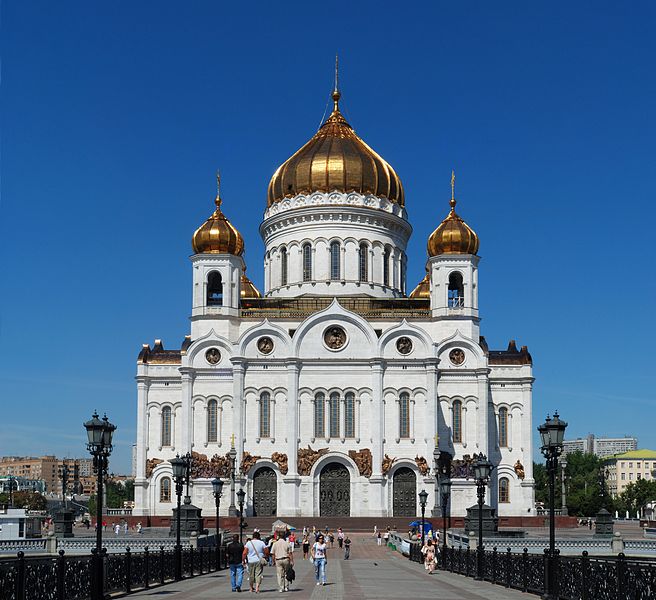
Today we celebrate Easter, the day when we commemorate the rising of Jesus Christ from the dead. Jesus Christ did not rise from the dead simply on his own account, but so that we, believing him to be our Lord, God and Saviour, might rise with him on the last day and spend eternity with him.
In a way the story of the Cathedral of Christ the Saviour mirrors that of the Saviour after whom it is named. When Stalin had the place demolished, many thought that Communism was the way of the future and that they had just blown up the past. But the “Great Patriotic War” (World War II) showed that things didn’t work quite as planned. As was explained to me twenty years ago:
Matters were at their nadir when the Second World War broke out, and when the Germans invaded the Soviet Union the demoralization of the nation was so complete that Hitler nearly succeeded in conquering the country. In its desperation Stalin’s war effort turned to the Orthodox Church and other Christian groups to help with the war effort, to revitalize the people for the war effort. This they did, and in return the Soviet government has granted the Orthodox Church and some other Christian groups limited freedom of existence and activity.
It was only a matter of time from that when the Cathedral would “rise from the pool” and many monuments to Communism would fall.
The Russians are certainly capable of fine work with both foundations and with the equipment to install those foundations. But beyond the technology and science the whole course of the Soviet Union is a reminder that we need a solid foundation of another kind before we start building (and tearing down): “For no man can lay any other foundation than the one already laid-Jesus Christ.” (1 Corinthians 3:11) We need to keep this in mind as we face secularists that seem to be more rabid by the day. We know that the Orthodox, like everyone else, aren’t perfect, but what they have to offer is certainly a big improvement over atheism, as history has borne out.
So, with the Orthodox and others who call themselves by the name of Jesus Christ, today we lift our voice and proclaim the truth that will ring into eternity:
Christ has arisen! He has arisen indeed!
-
We Are Donkeys. Yes, We Are. (A Good Friday Reflection)
As Good Friday comes upon us, one passage of Scripture that bothers many is as follows:
“Now, at the Feast, the Governor was accustomed to grant the people the release of any one prisoner whom they might choose. At that time they had a notorious prisoner called Barabbas. So, when the people had collected, Pilate said to them: “Which do you wish me to release for you? Barabbas? Or Jesus who is called ‘Christ’?” For he knew that it was out of jealousy that they had given Jesus up to him. While he was still on the Bench, his wife sent this message to him–“Do not have anything to do with that good man, for I have been very unhappy to-day in a dream on account of him.” But the Chief Priests and the Councillors persuaded the crowds to ask for Barabbas, and to kill Jesus. The Governor, however, said to them: “Which of these two do you wish me to release for you?” “Barabbas,” they answered. “What then,” Pilate asked, “shall I do with Jesus who is called ‘Christ’?” “Let him be crucified,” they all replied. “Why, what harm has he done?” he asked. But they kept shouting furiously: “Let him be crucified!” When Pilate saw that his efforts were unavailing, but that, on the contrary, a riot was beginning, he took some water, and washed his hands in the sight of the crowd, saying as he did so: “I am not answerable for this bloodshed; you must see to it yourselves.” And all the people answered: “His blood be on our heads and on our children’s!” The Pilate released Barabbas to them; but Jesus he scourged, and gave him up to be crucified.” (Matthew 27:15-26)
This passage has been used to impute the blame for Jesus’ crucifixion on the Jews. Didn’t they call for his blood to be on their heads? Since the Holocaust, it has become a sensitive subject. Or should it be?
From a purely theological standpoint, it shouldn’t. Jesus Christ died for all of our sins, thus each and every one of us had a hand in putting the nails through his hands and feet. (To solve this problem, click here.) But there is a more immediate explanation of the situation in front of us.
The arrest, conviction and execution of Jesus Christ was as much as political act on the part of the Jewish leadership as anything. To start with, they saw him as a power challenger–“For he (Pilate) knew that it was out of jealousy that they had given Jesus up to him.” In the Middle East, power challengers were and are to be crushed. Beyond that, they feared that he would destabilise the Jew’s complicated situation in the Roman Empire, something that even a political creature like Pilate came to realise wasn’t true: “…he went out to the Jews again, and said: ‘For my part, I find nothing with which he can be charged.’” (John 18:38b)
But the Jewish leadership wasn’t to be deterred, and so they whipped up the crowd, probably with a little money-favouring along the way (a tactic liberals still use.) But even with this degree of control, crowds take on a life of their own.
To illustrate this, a hundred years ago the Ottoman (Turkish) Empire was the “Sick Man of Europe,” and the consequences of its breakup were major subjects of diplomacy and war. (The Iraq War currently going on is one of them.) In 1908, a group of Turkish army officers staged a bloodless coup (that’s where we get our term “Young Turks.”) They forced the Sultan to reconvene a parliament and move towards a constitution. At a speech in Salonika, one of the supporters of this new order had the following interaction with the crowd:
…a speaker told them that “Constitution is such a great thing that those who do not know it are donkeys.” The crowd roared back, “We are donkeys.” When the speaker then said that their fathers had not known it either, the crowd roared again, “We are the sons of donkeys.” (David Pryce-Jones, The Closed Circle
)
Besides identifying their political party, the Salonikans showed that, even in modern times, Middle Eastern crowds will say just about anything under the right circumstance. The Jews’ response to Pilate should be seen in that light. That also put Jesus’ words on the Cross in a new light: “Then Jesus said: ‘Father, forgive them; they do not know what they are doing.’” (Luke 23:34) They really didn’t!
Kemal Ataturk eventually managed to get the Turks to accept a constitution, although Turkish men still say that all a man needs to get through life is a horse, a gun and a woman. The Jewish leadership could not hold things together so well, as Jesus predicted. Their balance came unglued, the Temple was destroyed in 70 A.D., and the Jews were scattered without a homeland until 1947, something the State of Israel strives to avoid repeating.
-
To Unite Oneself with Jesus Christ (A Holy Week Reflection)
…I pray that all those whom I have tried to help…may rise beyond it. I shall not say only beyond my thoughts, which are nothing, but beyond all that may be presented to them by the ministry of man. And in listening only to what God tells them in their hearts concerning this prayer, I trust that they will unite themselves to it with faith. For that is truly what is called praying to Jesus Christ and in Jesus Christ; that we unite ourselves in spirit with Jesus Christ praying, and unite ourselves, as much as we can, to the entire effect of this prayer. The effect of this prayer is that, being united to Jesus Christ God and Man and through Him to God His Father, we unite ourselves in Them with all the faithful, and with all men, to be as much as it is in us to be, but one soul and one heart.
In order to accomplish this work of unity, we must no longer see ourselves except in Jesus Christ, and we must believe that there may not fall upon us the least light of faith, the smallest spark of the love of God, that is not drawn from the immense love that the eternal Father has for His Son. This very Son, our Saviour, being in us, the love with which the Father loves Him, extends also over us by an effusion of His kindness: For it is toward this union that the entire prayer of Jesus Christ bursts forth.
It is in this spirit that we can and must end all our prayers, with the Church, Through Our Lord Jesus Christ. For, not being obliged to ask God for the effects of His love, we really ask for them through Jesus Christ, if we believe with a firm and lively faith that God loves us through an effusion of the love which He has for His Son. This is the entire foundation of piety and of Christian confidence. I say that it is the foundation for believing that the immense love that the eternal Father has for His Son as God, makes Him love the Soul, the saintly Soul, which is so narrowly and substantially united to Him, as well as the sacred and blessed Body which it animates; that is to say, His entire humanity. And the love which He has for this Person, Who is Jesus Christ God and Man, shows that He also loves all the members who live in Him and of His vivifying Spirit.
Let us believe then, that Jesus Christ is loved through a gratuitous and engaging love as we are also loved. As Saint Augustine says: The same grace which has made Jesus Christ our Head., has made us all His members.
We are made Christians through a continuation of the same grace, which has made the Christ. Every time that we say: Through Our Lord Jesus Christ, and we must say it every time that we pray, whether in fact or intention, there being no other name through which our prayers may be heard (Act. iv. 12), every time then that we say it, we must believe and know that we are saved through grace, only through Jesus Christ and through His merits: not that we are without merit, but because our merits are His gifts, and the grace of Jesus Christ is the great prize, because it is the merit of a God, and, consequently, infinite.
It is thus that we must pray through Jesus Christ Our Lord, and the Church, which does so constantly, unites Herself through that, to the entire effect of the divine prayer which we have just listened to. If the Church celebrates the grace and glory of the holy apostles, who are the shepherds of the flock, She recognizes the effect of the prayer that Jesus Christ has said particularly for them. But the saints, who are profound in glory, have not been less understood in the sight and in the intention of Jesus Christ, even though He did not mention them by name. Who can doubt that He saw all those that His Father had given Him throughout the centuries, and for whom He was going to be immolated with a particular love?
Let us enter, therefore, with Jesus Christ and in Jesus Christ, into the construction of the entire body of the Church, and rendering thanks with Her through Jesus Christ, for all those who are complete, let us ask for the completion of the entire body of Jesus Christ, and all the society of the saints. Let us ask, at the same time, with confidence, that we may find ourselves placed in the ranks of the blessed, never doubting that this grace will be extended to us, if we persevere in asking for it through mercy and grace; that is, through the merit of the blood which has been shed for us, and of which we have the sacred pledge in the Eucharist.
After this prayer, let us go with Jesus Christ to the sacrifice, and let us advance with Him to the two mountains; that is, to the Mount of Olives, and to that of Calvary. Let us go, I say, to these two mountains, and let us pass from one to the other: from that of the Mount of Olives, which is the one of agony, to that of Calvary, which is that of death; from the Mount of Olives, which is that of combat, to that of Calvary, where, in dying, one triumphs with Jesus Christ; from the Mount of Olives, which is the mountain of resignation, to that of Calvary, which is the mountain of actual sacrifice; and, finally, from the one where we say: Not my will but Thine be done, to the one where we say: Into Thy hands I commend my spirit (Luke xxii. 42; xxiii. 46); that is, from the one where we prepare ourselves for all things, to the one where we die to everything with Jesus Christ, to Whom be rendered honor and glory, with the Father, and the Holy Spirit, for ever and ever. Amen.
Conclusion to Meditations on the Gospel by Jaques Benigne Bossuet
-
At the Inlet: August, Part 1 (The lady becomes an Anglican)
Table of Contents and Overview for At the Inlet | Information and ordering instructions for all of our fiction
Hurricanes were a fact of life on the Island; around the turn of the month the Serelians faced one coming up on their coast. Since Serelia and Serelia Beach were on a coral ridge, they were not only a good place to ride out a storm; they gave some protection to the inland areas also. Everyone just battened down the hatches, took the boats (including the yacht) inland, and rode it out.
At the palace and Cathedral, this meant that, once the shutters were put up and all of the loose items outside brought in or tied down, everyone pretty much stayed in their quarters for the duration. This meant a separation for Julian and Terry; Julian was forced to ride it out pretty much by himself. Darlene had high hopes of spending additional time with Terry, but Annette dashed her hopes when she decided it was time to start a mah-jongg marathon. They tried to teach Darlene the game but she quickly realised that she would never catch up with these two, so she contented herself with either watching Annette and Terry or playing gin with Adam and George, an inclusion they soon learned to regret. But this blow stayed offshore enough so that the damage to the country was minimal, and in a couple of days all was back to normal.
Shortly after that Julian came to see Desmond. “I am pleased to inform you that Terry’s catechisation is complete,” Julian announced.
“You’ve got to be kidding,” Desmond replied.
“Of course not—why should I be?”
“You’ve certainly taken long enough, but I can’t believe that all those evenings about the Cathedral have been spent pouring over the Thirty-Nine Articles. There’s nothing romantic about them, is there?”
“Well, perhaps there is…” Julian mused.
“Don’t be silly—you’re telling me that you’ve gone through the catechism?”
“Yes”
“And the Articles?”
“Of course.”
“And she understands them?”
“Yes, very well.”
“And she agrees with them?”
“We had some interesting discussions, but in the main, yes.”
“In the main? Don’t you realise the consequences of what could happen?”
“I always thought our Church was the Church of comprehension.”
“Comprehension died with the Glorious Revolution,” Desmond snapped. “You saw what happened in those days. We must be careful who we admit to our Church—next thing you know, they’ll be rolling in the floor and barking like dogs.”
“I’ve never seen anything like that,” Julian observed.
“Of course not—that’s their strategy. Look respectable up front, then their real selves come out when you can’t dispense with them.”
“Well, what I have seen is a person who is committed to living a holy life and also one who is committed to the study and following of the Holy Scriptures—and that’s more that I’ve sometimes seen in you.”
Desmond glared at Julian. “I wouldn’t take that if you weren’t my brother,” he said through clenched teeth. There was a silence, and then Desmond resumed. “All right, Julian, I’ll draft a letter to the Bishop certifying that she’s completed instruction and is ready to be received into the Church. But I’m warning you—I hope you know what you’re doing here. If you don’t, there could be consequences for all of us.”
Julian stayed in his office until the letter was typed, reviewed, and signed, and then delivered it personally to the Bishop’s Palace. Much to his surprise, the Bishop asked him to come in. Julian came in to the Bishop’s office and handed him the letter.
“Where is Desmond?” the Bishop asked.
“In his office,” Julian replied.
“He must not think this is important…I suppose we can go ahead and receive her next Sunday, as I will be in the Cathedral.”
“Next Sunday?” Julian asked excitedly. “Thank you, sir.”
“I was hoping this would be done before she left with Mrs. Lewis and you for your organ tour.”
“Oh, yes—this will be splendid,” Julian said breathlessly.
“Since you’re here,” the Bishop resumed, “I thought you might find these interesting.” “These” were letters of recommendation from Bishop des Cieux and Father Avalon. “This is probably Her Highness’ doing—obtained by our diplomatic corps.” He looked up at Julian. “I knew that their bishop was fond of her, but I had no idea that Avalon would speak of her in such glowing terms, especially in view of the way she departed. You have a unique individual in your life—I’m just not sure what we’re going to do with her.”
The one thing the Bishop did know to do, however, is to receive her into the Church, which he did on the following Sunday. Terry was received by herself, making her the centre of attention, but the Bishop dispensed with a long speech about where she came from or how good it was that she came out of it. This was doubtless at royal insistence.
August was a month that alternated between dodging hurricanes, sweltering in the humid heat and getting drenched in the rain. As such it was a slow time at the Cathedral, and so Julian made plans for his annual tour of Churches of Serelia and other Anglican churches on the eastern end of the Island. His recitals were renown, even by those who were usually bored with pipe organ music. The first one was the afternoon after Terry’s reception into the Church; it took place at St. Matthew’s Church in Serelia Beach, built on the site of the old Cavitt plantation. In terms of membership it was the largest parish in the Church; a good crowd came out to hear him. Terry tagged along; although she wasn’t the biggest fan of this kind of music, Julian had inspired an appreciation for it.
The next day the tour started in earnest. Priscilla Lewis travelled with Terry; this enabled her to follow Julian around, and gave her some time out of the house. It was the first time in years that Julian did not have to make the trip alone; it seemed to add an élan to his whole being, even while playing.
The first stop was Amherst, where Julian was to play at the All Saints’ Church there. Darlene went with them for the first leg of the trip; this gave her an opportunity to go see her family. They arrived at the church; Darlene’s mother came and got her while Julian got the organ ready and Terry and Priscilla made sure everything was set in the church. The idea was that the girls would greet the people as they came in; however, here Priscilla did it by herself, as Terry was extremely nervous about meeting Darlene’s family without Darlene.
The recital went well and afterwards Terry was standing with Priscilla next to their usual seats, which were those in the front nearest the organ. When Terry saw Darlene, she knew the dreaded moment had come.
“Terry, this is my family: my father Thomas, mother Susan, my sister-in-law Allison”—Terry realised that this was Ronald’s widow—“and her sons Ronald, Jr., Thomas, and finally their daughter, which they in a moment of insanity named after me, Darlene.” Terry saw the entire Amherst clan that remained in Serelia in front of her. Although the family red hair had turned white, Thomas was still an impressive figure who stood ramrod straight. Terry could see Ronald replicated in his namesake.
“We have heard a great deal about you,” Thomas said. “These are Ronald’s children,” he said, driving home the point.
“Your father was a great general—perhaps the Island’s greatest—whose only fault was that he was carried away by his passions, a good lesson for us all,” Terry said, glad to get out the line she had rehearsed for weeks.
“You really believe that?” Ronald, Jr., asked.
“I really do, in spite of all that’s happened,” Terry answered.
“Those are kind sentiments,” Thomas said. “Well, we must get back to the estate—lots of work to do even before retiring.” They said their goodbyes and left, but Allison lingered. She was a cheery looking blonde who nevertheless showed the signs of the disasters that had befallen her.
“That took a lot of courage to say that,” she said to Terry. “Thanks.” Before Terry could respond she walked away and rejoined her family. Darlene had managed to duck behind Terry long enough to come out and give her a hug before leaving with her parents and relatives.
“I’m glad you were ready for this,” Darlene said. “My father wasn’t.” With that she went on and joined her family while Terry, Priscilla and Julian tested out the rectory. Terry was used to uneven accommodations in a Pentecostal church; she expected a higher quality in a church with more resources. She discovered, however, that state funding was not a panacea for everything, and dumpy rectories were one of them.
The next day they were able to finally flee All Saints’ rectory and make the short trip down the road to St. John the Baptist Church in Denton. The Old Beran Road widened a bit from the stretch that Terry was so familiar with in Drahla; here it took a straight shot from Amherst through Denton to Claudia. They reached the church in mid-afternoon; Julian had insisted on a leisurely departure from Amherst.
As Julian tinkered with the organ to see what needed to be done to it, Priscilla and Terry went through their routine. The church looked like the sexton had been on an extended holiday; they found themselves doing clean-up work. As they tried to make the best of it, Terry looked up from yet another shabby kneeling cushion to see a woman in front of her.
“Welcome to St. John the Baptist,” she said, “I’m Theresa Gant.”
“Darlene’s sister?” Terry asked. She had heard that the two sisters didn’t resemble each other much; now she knew it for herself. Theresa looked more like her mother, a little taller than Darlene with short blonde hair and age lines that hinted at a less than happy life. Terry was surprised to see Theresa in slacks, which became her figure that had been moulded by the typical Island low calorie diet, supplemented by some recent additions. Serelia was a place that still had reservations about women wearing pants, especially on a rector’s wife.
“Before the war, I was Thomas’ daughter. During the war, I was Ronnie and Eddie’s sister. Now, I’m Darlene’s sister.”
“I didn’t mean it that way—I’m sorry,” Terry apologised.
“I know—you are Darlene are friends.”
“I only met the rest of the family yesterday.”
“Thanks for straightening this place up—our sexton’s not very energetic.” Terry then reintroduced Theresa to Priscilla, and the three of them finished getting the church ready as well as could be expected.
Julian’s recital went according to plan, except that the Rector, Anselm Gant, got up and made a long and tedious introduction to Julian’s concert, so long that even Julian started looking at his watch, worried he would have to delete some of his pieces to finish the programme in a timely manner. But it all got done and they retreated to the rectory afterwards.
The Gant’s rectory was a definite improvement over the last one; Theresa explained that her father had come and spent his own money and brought his own crew from their estate to upgrade it. Theresa and Priscilla retreated to the kitchen to prepare the meal, leaving Terry and Julian to Anselm’s tender mercies. Terry, having been raised in a home with a cook, had limited kitchen skills, something that the Cathedral’s setup obscured for Julian.
Terry would soon regret her lack of culinary expertise, because Anselm proved no more exciting in the living room than he did in the pulpit. While downing one scotch and water after another, he droned on and on about the poor state of the Serelian Church, the inept policies of the Bishop, and last but not least those dreadful Pentecostals and Baptists who were making life so miserable for everyone. Even Julian was beginning to tire of this dreary refrain by so many of his colleagues, but Terry signalled him to let it ride. This and other equally sad subjects continued over the dinner table, along with the wine and liqueur. With dinner complete, a groggy Anselm abruptly announced that he was retiring.
Although leaving company so soon was usually regarded as rude, no one seemed to mind. Julian volunteered to help clean up, but he ended up helping only his sister-in-law, as Theresa invited Terry out to the screened porch.
Theresa lit the citronella candles. “Care for a drink?” she asked her guest.
“Soda is fine, thank you” Terry replied.
“Now that you’ve been received into our church, you can, you know.”
“I’d prefer not to, thanks.”
“My husband went to an Episcopal prep school in the States. He had a Latin teacher who was an old-fashioned Episcopal minister. One day the teacher told the class that ‘when four Whiskeypalians get together, there’s always a fifth.’” They chuckled over that while Theresa got Terry’s soda and her rum old fashioned. They sat down.
“You’re seeing Julian, aren’t you?” Theresa asked Terry.
“Yes, I am.”
“I hope it works out for you. Julian is a fine man. Maybe I’m just not good enough for him.”
“You were at one time.”
“That was a long time ago…things change. Things get in the way.”
“Where are your children?”
“They’re staying with his parents. They live in Fort Albert. They’re getting up in years—they’re not doing well. The kids are real good about helping them.”
“Drahla.”
“They never supported independence, but they didn’t want to leave. It got pretty tough sometimes.”
“Do you ever see Edward’s children?”
“Not since he was killed. His widow took them to the mainland and vowed never to step foot on the Island again. She’s as good as her word. She remarried about two years after she left. We hear from them every now and then. They seem to be doing okay. It’s killing my parents not to see them any more.” Theresa took another gulp from her glass. “Darlene thinks a lot of you.”
“The feeling is mutual.”
“That amazes me…you’re the last person I would have figured to suddenly become her lifelong friend. Now I hear she’s gotten some kind of religion, thanks to you.”
“The change in her life is pretty substantial,” Terry observed. “Even her mother-in-law has noticed it.”
“There’s only one god of the Amhersts, and that’s themselves,” Theresa came back. “Their only desire is to control others. In some ways, Darlene is the most single-minded one of them all in that regard—more so that even Ronnie.”
“You seem to easily disassociate yourself from them.”
“I’m too much like my mother. I let other people run over me. I find this religion thing of Darlene hard to believe—a lot of other people do, too.”
“Perhaps she realises that this is too tough of a neighbourhood to make it on her own.”
Theresa looked at Terry with surprise. “Maybe you know her better than I thought. But let me stop you here—I don’t want to hear any sermons out of you. I have to endure them every week. Besides, you probably should have stuck with your old church—this one is dying, if you ask me.”
“How so?”
“See that?” The rectory was right on the river; the screened in porch overlooked it. The view really wasn’t bad at all, especially considering Denton’s location. Directly across from the rectory was a large building with no windows but reasonable exterior lighting. “That’s the Lodge, over in Claudia. Right opposite of the church. This Island’s whole spiritual journey is summed up right here. You’d be surprised how many people on this side of the river are in the Lodge. They go through the Scottish Rite—no political strings attached, not yet at least. My husband’s a member, but that’s not the only reason why he goes over the border. He has a mistress over there. I thought after the first go around he’d learn, but he hasn’t.”
“You almost ended it over that, I heard.”
Theresa raised her arm, letting her sleeve drop to reveal the scars around her wrist. “If it weren’t for the children, I’d do it again. This time I’d get it right. My father told me that, if I ever divorced Anselm, he’d disinherit me totally, and I can’t afford that. So I just have to wait.” She fixed herself another drink. “The Lodge and the Church—it’s all right here. The Church is in trouble. Our attendance has dropped every year we’ve been here. Meanwhile your Pentecostal preachers are busy doing their thing. They’ll even sneak across the border into Claudia and conduct services, even though technically the penalty for being a Christian in Claudia is still crucifixion.”
“Your sister told me about Avinet’s Beach,” Terry noted.
“Our father used to tell that story when he didn’t like what was going on at church,” Theresa responded. “In any case, one of these preachers had King Mahlon’s daughter, Princess Ophelia, to come to his meetings one night. She was converted right there—but Mahlon threw her into prison. I still think the Lodge is going to come back. If you and Darlene and George hadn’t put a stop to it, the Verecundans were ready to put a lot of money into it. If they had, things would be vastly different on this end of the Island.”
“Perhaps there’s a lesson in this.”
“Perhaps. Perhaps not.”
There was no recital the following night, so they returned to Serelia for the next day and night. Desmond certainly had his hands full with the children; the relief was welcome. Julian rehearsed some different pieces he would play on the second leg of the journey. Terry spent the evening with the King, Queen, and George, as Darlene was still in Amherst with her parents. The next morning, before they left, Annette called Terry in to her bedchamber for breakfast, as she wanted to have a Bible study along the lines of the ones Terry did with Darlene. It was the first time that Annette had attended any kind of Bible study, and they enjoyed their time together.
Sailing the Last Voyage with Newton and Pascal
 Positive Infinity