-
They Miss Us When We’re Gone After All. Sort of.
A few years back, I sat at a prayer breakfast next to a “continuing Anglican” bishop who stated that the liberals in TEC were actually glad that so many “reasserters” had left the church during the 1970’s and 1980’s (TEC had a substantial loss in membership in the wake of the 1960’s.)
Evidently the sentiment amongst the “reappraisers” (the Aussies, at least) at Lambeth is different:
First, all views should be represented. There is a continual gnawing at the bone that over a quarter of the bishops invited are not here. This has been raised by the Archbishop of Canterbury in his welcome address, and Bishop de Chickera in the opening sermon. Archbishop Philip Aspinall commented on this at length in answer to a question at the opening press conference. His answer is illuminating.
He said in answer to a question: “I am greatly saddened by Archbishop Jensen’s decision not to come. Sydney comes from the evangelical tradition – a vital part – and that perspective will be weaker because they are not here. We will have to find other ways to engage that perspective. It will delay us. Other bishops have important things to say that they (the Sydney bishops) need to hear. There is sadness among us all.”
It is the long-term objective of any liberal group of people–and that especially includes LGBT ones such as Integrity–to gain control of established institutions. The absence of GAFCON bishops was a calculated risk: opting out of Lambeth certainly deprived them of a “seat at the table” (this one, at least,) but spared them being “gummed to death” by liberal groups which seek to add to their legitimacy by steamrolling their opponents and making it look like they have the assent of the entire group/institution (and the AC is something of both while not much of either right at the moment.) Looks like, up to now, that gamble is paying off.
But, IMO, the triumphalistic Americans will make the most of this. As my purple shirted breakfast partner noted, losing members in the six figures meant nothing; as an extension of that, what matter is a couple hundred bishops? They will use their absence to roll Lambeth’s “indaba” process into an asset for their “pansexual” agenda (to use David Virtue’s delightful term.) This would simplify formalising this agenda back home and perhaps strengthen their hold on the property by showing courts that the AC’s own idea is one and the same as theirs.
There are two casualties in this mess.
The first is the AC itself.
The second is the reputation of the country TEC claims to represent. Most TEC officials probably oppose the war in Iraq and would tell you that such adventures represent imperialism on every level. What foreigners are finding out is that Americans of all stripes are prone to a “my way or the highway” mentality, even when it would be in our own best interest to do otherwise. If this attitude crosses ideological lines, getting George Bush out of office may not be the improvement that many think it is.
A good place to start to repair our situation would be the church world, where humility is supposed to be a virtue. But don’t hold your breath.
Note: after I wrote this piece, I discovered that Tom Wright is thinking along the same lines. (Same Wright comments at Anglican Mainstream.)
-
The Saga of the Baby Blue Pinto
A few years back I saw a skit entitled “This is Not Your Life.” The skit had one young guy who had just died. An “angel” was showing him the things he did not do in his life. I was taking this in until he showed him one of those undone things: stealing a baby blue Ford Pinto. That, the angel finally assured him, was one thing he did not do.
At this point I was enraged. My first car was a 1971 baby blue Pinto. This was my life! How could he insult me this way?
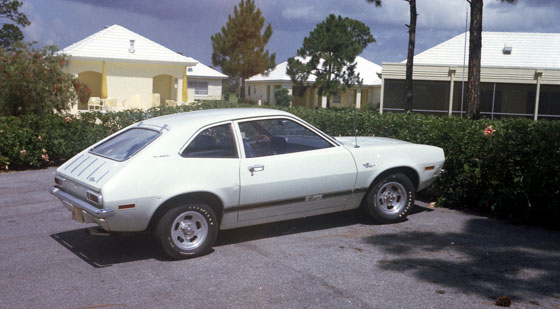
The car in question, a 1971 Ford Pinto Runabout. The truth was, however, that the whole saga of the Pinto was an example of just how stupid two teenagers could be when they put their minds to it.
Back when I looked more like this, my parents offered to give me my grandmother’s large Pontiac, completely equipped, as my first car. But my brother didn’t think it was sporty enough, so he led me on a wild goose chase to find a compact American car (these were a novelty, and my father wouldn’t buy a foreign one) that he liked better. The lots we visited must have put the junior salesman onto us when we arrived. One lot showed my brother a Mercury Capri. While sitting in the driver’s seat, the salesman noted that “This car has reclining bucket seats,” after which he released same, sending my brother instantly back, his flight only ending when his bucket seat impacted the rear seat. (We were convinced he knew what he was talking about!)
After things like this and a lot of negotiating with my father, we ended up with the car you see above. Since it had a stick shift, my brother took me once around the block to master that, changed the tyres to the ones on the car (leaving the old ones in the garage,) took off for his senior year in military school, and left me with the Pinto.
With its 1600 cc engine and no air conditioning, it was too slow to either to rate as a “performance” car or to put enough air through it to beat the South Florida heat. But it got the job done. I referred to it as the “better than nothing” car and that just about said it all.
After two years, the car was sent to California with my brother, who was in maritime academy there. It provided him with enough transportation to take him away from his studies, which meant that his grades went to the bottom and he came home. He went to work for what was then called South Florida Flood Control, at which point the lack of air conditioning was driven home with a vengeance. This saga only ended when my father bought me a Toyota (this time not giving me a choice,) and the Pinto passed out of our family.
Getting back to the skit, the man that died was right not to have stolen the Pinto. Stealing a Pinto is a crime in every sense of the word. But the skit went on to point out that he who died wasn’t in the clear just because he didn’t do things like steal baby blue Pintos. The biggest thing he didn’t do was accept Jesus Christ as his Lord and Saviour, and that failure has awful eternal consequences.
In their work Logic, or the Art of Thinking, Antoine Arnauld and Pierre Nicole note the following:
…the greatest of all unwise things is to use one’s time and life for something else than to work towards and acquire something that never ends, since all of the good things and all of the evils of this life are nothing in comparison to those of the other, and that the danger of falling into these evils is very great, as well as the difficulty of obtaining the good things.
Those that come to this conclusion, and who follow them in the conduct of their life, are prudent and wise, whether they be little correct in all of the reasonings concerning matters of science; and those who do not, whether they be correct in all of the rest…make a bad usage of Logic, of reason, and of life.
What about you? We do a lot in this life, and we think we’re “good people.” But what does it really amount to? Does it bring real happiness? Does it bring real goodness? Is there something really important that you’re aren’t doing? Will it make a difference in eternity? Or does it just add to your carbon footprint? The choice is yours.
If you want more than to add to your carbon footprint, click here
I am indebted to Mark Swank, Youth Missions Coordinator for the Church of God, for inspiring and/or enraging me with the skit.
-
Why Don’t Churches Make Disciples?
Robert Easter at Sanctifusion asks this question, and answers as follows:
- Our world view is all wrong. “Be holy as I am holy” is not a core conviction.
- We prefer the things that are “more exciting” – like worship, harvesting tithes, building buildings, getting on the latest trendy movement of evangelicalism.
- Not intentional enough. We think Sunday school or the regular programming dynamic of the local church will do the trick to transform lives.
- We read the gospels for many reasons but not to find the methodology of Jesus for changing the world.
- Hard to brag about discipleship in the statistics manual of district conference.
- It is hard work.
- We were not discipled therefore we don’t have a clue what is meant by discipleship or how to do it.
- American society is a time stealer, and discipleship, alas, takes time.
All of the above are, sadly, true. However, such a position doesn’t square with what the New Testament teaches. Let me look at this from a (somewhat) Pentecostal perspective. The whole story of the first disciples themselves is a good illustration, and can be broken down into three phases:
- Jesus–God himself–come to earth and invests three years in those whom he has chosen. They’re not the sharpest knives in the drawer and, as Rob Bell notes in Velvet Elvis, may have been turned down by other rabbis, to be stuck in their family business. They frequently don’t get it, especially about being first in the kingdom, about Jesus’ need to suffer and die first, and the like.
- Jesus Christ rises from the dead, and give the first and foremost order to his soon to be apostles: “Therefore go and make disciples of all the nations, baptizing them into the Faith of the Father, the Son, and the Holy Spirit, And teaching them to lay to heart all the commands that I have given you; and, remember, I myself am with you every day until the close of the age.” (Matthew 28:19-20) Making disciples, therefore, is our core mission.
- On the day of Pentecost, the Apostles received the baptism (and the empowerment) of the Holy Spirit to carry out that mission. They additionally “get it” about the nature of Jesus’ mission to this earth, which is reflected in Peter’s confident and informed preaching. But that event of power was preceded by a process of discipleship.
All of this being so, it is amazing that churches try everything but making disciples. But they do. I work in men’s ministries, and we have discovered that making disciples is crucial in sustainable men’s ministries.
Churches’ methods of avoiding a discipleship emphasis break down into three categories.
- Some churches which are the heirs of “the revival” (to use a Finneyesque phrase) have the idea that, if we can just have enough major meetings, we can sweep our churches and the world around us into the kingdom. This is what I call the “Pickett’s Charge” approach to Christianity, and without ongoing discipleship between meetings it won’t work any better than the original charge did for the Confederacy.
- Other churches which have long historical roots (Roman Catholics, Anglicans, Orthodox, Lutherans and the like) have the idea that, if we can set up the culture properly, we can transmit the Gospel via a kind of osmosis. The result of this is cultural Christianity. As one men’s ministry leader tartly put it, such a faith is like a spare tyre: in the trunk, just in case. In the past, this might have worked, but in a culture increasingly hostile to Christianity, it won’t.
- Still other churches which are “seeker friendly” (and that goes back longer than you might realise) think that, if they can involve people in the life of the church, they will become Christians. But again, without the backup of discipleship, the result will be, as J. Vernon McGee put it, people who are as busy as termites and have the same effect. Bill Hybels at Willow Creek has admitted as much.
Discipleship is unavoidable if we want a sustainable church with sustaining believers and members. It’s not easy, but the up-front investment pays both temporal and eternal dividends.
-
Message to Barack Obama: Why My Family Business Left Chicago
Back in May, Steve Sailer quoted the following from Barack Obama’s autobiography, Dreams From My Father:
As we walked back to the car, we passed a small clothing store full of cheap dresses and brightly colored sweaters, two aging white mannequins now painted black in the window. The store was poorly lit, but toward the back I could make out the figure of a young Korean woman sewing by hand as a child slept beside her.
The scene took me back to my childhood, back to the markets of Indonesia: the hawkers, the leather workers, the old women chewing betelnut and swatting flies off their fruit with whisk brooms. I’d always taken such markets for granted, part of the natural order of things. Now, though, as I thought about Altgeld and Rose-land, Rafiq and Mr. Foster, I saw those Djakarta markets for what they were: fragile, precious things. The people who sold their goods there might have been poor, poorer even than folks out in Altgeld. They hauled fifty pounds of firewood on their backs every day, they ate little, they died young. And yet for all that poverty, there remained in their lives a discernible order, a tapestry of trading routes and middlemen, bribes to pay and customs to observe, the habits of a generation played out every day beneath the bargaining and the noise and the swirling dust. It was the absence of such coherence that made a place like Altgeld so desperate, I thought to myself; it was that loss of order that had made both Rafiq and Mr. Foster, in their own ways, so bitter. For how could we go about stitching a culture back together once it was torn? How long might it take in this land of dollars?
Longer than it took a culture to unravel, I suspected. I tried to imagine the Indonesian workers who were now making their way to the sorts of factories that had once sat along the banks of the Calumet River, joining the ranks of wage labor to assemble the radios and sneakers that sold on Michigan Avenue. I imagined those same Indonesian workers ten, twenty years from now, when their factories would have closed down, a consequence of new technology or lower wages in some other part of the globe. And then the bitter discovery that their markets have vanished; that they no longer remember how to weave their own baskets or carve their own furniture or grow their own food; that even if they remember such craft, the forests that gave them wood are now owned by timber interests, the baskets they once wove have been replaced by more durable plastics. The very existence of the factories, the timber interests, the plastics manufacturer, will have rendered their culture obsolete; the values of hard work and individual initiative turn out to have depended on a system of belief that’s been scrambled by migration and urbanization and imported TV reruns. Some of them would prosper in this new order. Some would move to America. And the others, the millions left behind in Djakarta, or Lagos, or the West Bank, they would settle into their own Altgeld Gardens, into a deeper despair
His phrase of “once sat along the banks of the Calumet River” brought back to my mind something that changed my own life very deeply: the fact that my family business, the Vulcan Iron Works, left Chicago after 108 years there. The reason why that took place, and the effect of an Obama presidency would have both on events such as that and our whole economic paradigm, is something that needs to be discussed this election year, because the value of his promise to “fix” the economy depends upon how he means the word “fix.”
It’s interesting to note that this year’s Democrat nominating race turned into a Chicago “cross-town” rivalry. Hillary Clinton was always introduced as the “Senator from New York,” but in reality she’s a product of North Side Chicago suburbia, opposing a South Side Barack Obama. It’s been a long time since the Windy City took such centre stage, but it has. Both Clinton and Obama are disciples of Chicago community organiser and radical Saul Alinsky. So a Chicago story like this has relevance.
 My great-great-grandfather founded Vulcan in 1852. You can see that story here, but by the time the company reached its centennial it had already relocated to the plant you see at the right. By that time it had participated in the American success story by its manufacture of pile driving equipment. It had its ups and downs, but the Warrington family’s aversion to debt helped to get it through the 1930’s. It had both supported and benefited from World War II and entered its second century looking towards the future with promise, and no immediate plans to leave the city it had called home for a hundred years.
Why, then, did it leave only eight years later? At its simplest, there are two reasons.
The first related to the changes in American industry in general and Vulcan’s market in particular. Until World War II Vulcan was the model of vertical integration. It had its own foundry and pattern shop; it even generated its own power. Vertical integration, especially for a company as small as Vulcan, has become progressively more and more impractical as the sophistication of the industrial and economic base has developed. Loosening vertical integration makes location a more flexible business if suppliers can be found in a wider variety of places. That in turn depends upon a reasonable transportation and communication infrastructure.
The transportation part helped Vulcan in many ways, because the beginning of the Interstate Highway System (promoted by, among others, Al Gore Sr.,) coupled with postwar demand, initiated a boom for Vulcan’s product, not only in quantity but also in size. More and larger hammers pushed the facility’s capacity to the limit, and the size trend was pushed upward further by the nascent offshore oil industry (another bête noire of Obama and his liberal friends.) So the facility became inadequate for its task.
The second related to Vulcan’s labour situation. Vulcan’s workforce had a trade union, and trade unions played a larger role in the 1950’s than they do now. They were able to take advantage of the postwar boom to push wages up and help flatten the income distribution. In Vulcan’s case, however, labour costs were never a large component of its cost structure relative to other industries. Vulcan’s workforce, far from an unskilled, low-wage group, was for the most part skilled.
The problem Vulcan found getting progressively worse were the non-economic objectives of trade unions: the end of employment at will and assuming control of the shop floor through work rules and the classification system. Once this takes place, it is very difficult to either eliminate inefficiencies or make structural changes in response to changed business conditions. As the decade progressed, the inefficiencies of the operation (coupled with the inefficiencies of the facility itself) made it progressively less profitable, and management found itself unable to increase that efficiency.
Something had to give, and give it finally did. In 1960 Vulcan moved its operations to Chattanooga, TN, to a more modern and efficient facility. Part of that motivation concerned the economic electric power wrought by that great New Deal “Colossus of Socialism,” the Tennessee Valley Authority. Another part was the generally high cost of doing business in Chicago. The move itself, however, brings up two important points.
The first is that, as Obama mentioned in the quote above, we usually think of moving a manufacturing operation in terms of moving it from the U.S. to a Third World country. But in the 1960’s and 1970’s the “third world country” of choice for “Rust Belt” operations was the Old Confederacy. Had Obama’s fellow Ilinoisan Abraham Lincoln opted out of forcibly returning the Confederate states to the Union, it would have made such a transition more difficult. But unintended consequences are the stuff that history is made of.
The second is that Vulcan’s move to Chattanooga was helpful in many ways but not an unalloyed success, owing to the peculiarities of the region it moved into. These peculiarities haunt both Obama’s liberalism and John McCain’s “Theodore Roosevelt” conservatism. But such are the nature of corporate decisions: management makes them and management must live with the consequences, especially when management is made up of the corporation’s principals.
However, in a world where the state explicitly enforces the perpetuation of “traditional” society–necessary to prevent the problems that Obama describes in the quote above–corporations will lose the power to make such decisions. They will be forced to perpetuate operations such as Vulcan’s in Chicago in the manner they’ve been operated until the company is forced to close them without a sequel or face nationalisation, which only stalls the inevitable.
And such “traditional” societies have a strong appeal to Obama’s latté liberal core constituency, not only for purely sentimental reasons (the loss of a way of life, the lamenting of which drove Obama’s mother for so many years) but also because such societies favour the perpetuation of established elites, be those elites hereditary aristocracies or bureaucracy-ensconced mandarins. And, to be honest, such a scenario has a strong appeal to the end product of multi-generational success like myself.
But I know that this kind of economic management would destroy the dynamism that has made this country great, even if it doesn’t suit my personal sentiments. As my grandfather explained on the occasion of Vulcan’s centennial:
The occasion is somewhat of a story of one man from England, who came to this country, then to Chicago in 1847, worked hard and built a successful industry. We have heard such stories many times before. The one about the Detroit mechanic who put a nation on wheels. One about the brooding genius from Milan, Ohio who heated carbon filaments with electricity to produce the most brilliant illumination man had known. One about two bicycle mechanics of Dayton who were obsessed with the idea that man could fly.
We read them in school books, reread them in newspapers and magazines. We got a bit bored with success. Where, doubters asked, had it gotten us. We forgot too readily that these stories were the very fabric of America, a living history of events which built a great nation. We forget that they made us materially wealthy — that they furnished the means with which to nourish a precious heritage of liberty. They and countless others, before and after them, inspired and inspiring the precepts and philosophy of a great and growing era of free enterprise.
For all of the crises that we face in the U.S. today, with receding dollar hegemony and wealth sinking into ratholes of debt, slowing down the economy to preserve a romantic ideal–and the established authorities that rule over it–is a recipe for disaster.
-
Thoughts on the Upcoming Church of God General Assembly: “I don’t know if my church loves me any more or not”
Around the time of the 2006 Church of God General Assembly in Indianapolis, I began writing my last novel, The Ten Weeks. At the core of the plot is the story of one French Catholic high school senior, Madeleine des Cieux, who performs a series of miracles. This generates a number of reactions, but her church, for reasons related to secular politics, conducted a campaign to attempt to force her to recant those miracles. Her frustration with the Church came to a head when she blurted out the following to a Baptist friend:
As for myself, I don’t know what to do either. I know that Papa loves me, and Maman loves me. . .but I don’t know if my church loves me any more or not…Since the miracles, our bishop has put pressure on everyone he could—including my own father—to have me deny that the miracles took place when it is undeniable that they did…But I cannot understand why they have treated me in this way.
Now that’s a decidedly "girlie" way of putting it, as one would expect. But if there’s one thing I’ve learned in the years I’ve been in the Church of God, it’s that for many, under the complaints about money and governance, there runs a deep love in clergy and laity alike for the Church of God. One pastor (I think it was Travis Johnson) likened it to a father-son relationship.
Christianity is unique in many ways, but one that Protestants in particular overlook is that the whole story of God’s relationship with people is driven by his love for us, which reached its highest expression in the life, death and resurrection of his Son Jesus Christ. In turn Jesus Christ calls us to love God first and foremost. That love-driven aspect is one reason why men hate going to church, because in churches where women hold the majority that relationship is generally posited in a "lover-loved" paradigm, something that men have serious problems with. But our relationship with God transcends human analogy, which is why the Bible also describes it using parental and fraternal terms, something to keep in mind when connecting with men.
But I digress. Since our love relationship with God is a two-way street, it makes sense that the same would hold with our church. We can certainly love our church. But can an institution love anyone? The answer is no. Institutions of any kind are incapable of love. That’s one reason why I cannot accept the argument of the proponents of same sex civil marriage that it’s necessary for the institution of the state to affirm the love of two people. Any two or more people whose love for each other needs to be affirmed by the state are in serious trouble, no matter how you look at the issue.
The Church of God, however, has been depicted as an organic reality, not just an institution. That organic reality consists of two parts: the presence of God in our midst, and the people of the church itself. Both are eminently lovable. In return the love that needs to come back is from a leadership that loves the people of the church more than the people love it. That love by the leadership needs to be manifested at all levels: the local church, our regions and states, our nations and ultimately at the international level. That love has to transcend the every day problems that arise when you deal with people. After all, didn’t Christ die for us while we were yet sinners?
My challenge to my colleagues in the leadership of this church (I am on the Board of Church Ministries) is for us to have that love for our church and its people. I’ve been a part of the International Offices for over a decade and have seen that love in action in the past. I know it’s important to "get the job done;" our church is good at that. But our love for each other is an essential part of our mission. Without it, most of what makes us different from the world goes away, and these days in particular it takes a very compelling reason for people to be a part of a church.
Beyond that, if those in our midst get the idea that their love for this church is a one way street, they’ll get the same "empty pit" feeling that Madeleine showed in the quote above. They’ll start blurting things like that out to their Baptist friends. For Pentecostal and Catholic alike, that’s an act of desperation. On a more serious note, over the long run the life and work of the church will be damaged beyond repair, and we will end up leaving the mission God has for us to others.
May God bless and guide us as we meet in San Antonio!
Note: hopefully Tom Sterbens, who recently met with the Executive Committee, will not have to think too hard about this.
-
Reply to Alan Munday on “The Traditional Anglican Communion considering swimming the Tiber”
I recently received a message from +Alan Munday regarding both the recent decision by the Church of England to ordain women bishops, the Traditional Anglican Communion’s ongoing discussions with the Vatican, and my article Think Before You Convert. I’ll reproduce this in its entirety (it was broadcast in a couple of newsgroups) along with some comments:
Following the events where the General Synod of the Church of England has voted to allow for Women’s consecration to the Episcopate, I have learnt that the Traditional Anglican Communion, which is a Continuing Anglican body, has petitioned Rome for corporate union. I am not sure to what extent the events within the Anglican (Lambeth) Communion have prompted this, but it is interesting to know.
There have been some inaccurate reports on the matter, but the TAC have made a statement clarifying the situation at http://www.acahome.org/petition_facts.htm. For easy reading I have given the non-frames page, but if you want to see more information about them, the main (framed) url is http://www.acahome.org.
Some of that inaccurate information may be embodied in my article on the subject. My attitude until recently about this has been "it’s a nice idea, but…" because I didn’t see the RCC taking anything other than unconditional surrender (and they’ve gotten just that out of a number of TEC bishops.) They’ve also gotten it out of a good number of lay people also, some of whom were influenced by my own article. However, the situation may have changed with the current Pontiff and the CoE’s recent decision.
I’m not a big fan of TAC, but in this case they may have been both prescient and proactive, seeing the trends on both sides of the Atlantic and also noting that the African provinces–who are leading the charge with things like GAFCON–tend to be Protestant in emphasis. (It’s interesting to note that the Province of the West Indies, a very Anglo-Catholic province while at the same time conservative, did not support this effort as the Africans did.)
They seem to be seeking union with Rome on the basis of the Special Pastoral Provisions (see
http://www.pastoralprovision.org/ also The Anglican Use Society’s page http://www.anglicanuse.org. I do not know if they will necessarily want to adopt the Book of Divine Worship or propose use of the 1662 or 1928 Books of Common Prayer alone, presumably adapted to some Roman requirements, but no doubt time will tell. The Book of Divine Worship is basically an adapted version of the Book of Common Prayer 1979, but it looks to me as if the Anglican Use Roman Catholic Churches already particularly favour the traditionally worded Rite One as opposed to the modern worded Rite Two, so perhaps the TAC will be happy to follow suite.Just in case you want to see the BDW text Rite One can be seen at http://www.atonementonline.com/orderofmass/Rite1.html. You can also download a copy, free of charge from http://stores.lulu.com/cdburt . That same page also has other related service books available for purchase, either as downloads or hard copies. The complete BDW itself (ISBN: 0970402260) seems to be out of print at the moment. I don’t know if they are going to produce pew versions, but the book as it is weighs a ton, even for liturgical use, and is expensive so if you already have BCP79 you might want to save your money and just adapt bits that may need it. Hopefully a more civilised lighter, smaller, less expensive copies will be produced at time goes on and the extracts published by Lulu are a step in the right direction.
I cannot resist a plug for my own LuLu store, http://stores.lulu.com/vulcanhammer. I deal with many of the issues in conflict in the AC in my fiction.
I seem to remember that the Charismatic Episcopal Church, which I was with for a while, had plans to produce their own version of the BCP79 which they presently use with adaptations. I don’t know if that is still proposed or if they may have opted to use the BDW. If anyone knows the present situation I would be interested to know.
I would have some reservations about returning to the RCC myself, even though I quietly attend their services sometimes. I notice that someone else has similar ideas at http://www.vulcanhammer.org/anglican/convert.php , (although I do not agree with some of his historical points where he seems not to be aware that the Anglican Rite is based on the Sarum Rite, which of course used to be the main RC rite used in England at one time before Rome suppressed it. That was the rite used by the RC Martyrs of our Isle and for which they partly died for). I owe a lot to my pilgrimage as a lay member of the RCC, but his warning strongly echoes in my heart, "Think before you convert".
When I wrote this, I certainly wasn’t aware that the Anglican Rite was based on the Sarum Rite. If fact, I may not have been aware that the Anglican Rite existed! The process in which I wrote the article has been an ongoing education for me.
Nevertheless, one thing that I have learned is that the whole concept of Anglican breadth has been broken by the two issues of women’s ordination and homosexuality. In a world where choices are myriad in so many ways, those who want a Biblically sound church with the Apostolic succession but without some of the "baggage" that tripped up medieval Christianity are, at this point, in a decidedly disadvantageous position. They have three choices: a) abandon the Christianity of the apostolic succession altogether, b) work things through in relatively small, isolated organisations (which doesn’t speak well to the unity issues) or c) give up and swim either the Tiber or the Moscow Rivers. Option (b) may be ameliorated over time by the Africans, but it’s going to take a while, and meantime we have to do the work that Jesus called us to do and raise our families as He would want us to.
I believe that in a certain way the RCC and Orthodox Churches can give other Orthodox Catholic Christians a kind of inferiority complex, including re aspects of Apostolic legitimacy. I think that this may lead some to join them for mistaken reasons. As much as the RCC and Orthodox Churches are worthy of our profoundest respect and honour, the fact remains that since 1054 and following, in their divisions, including divisions between the Orthodox Churches themselves, they are dysfunctional and disobedient to Christ’s call to unity and the world suffers as a result. While some lifeboats, including those of the Protestant Reformation have lost some of their equipment, others of us, as Orthodox Catholics, can do no other than seek to remain true to our vision of how the Church should be. We owe it to the Great Churches to witness according to the way the Holy Spirit seems to lead us. Of course we are not perfect ourselves, (no way), but for those in the Great Churches who are seeking God’s will, hopefully as time goes on, we will be seen not as usurpers, but as victims of their own mistakes that they need to learn from and put right. We must ever pray for Christ’s healing touch to bring us all together in the ways that He wills. Some to join the Great Churches and pray from within them, while others to continue to witness outside. The nub of the situation has to be our personal closeness to God and seeking of His will as well as His deep personal love for each one of us, even though we might stray sometimes. While we do need to be sensitive to God’s voice speaking through others, even churches, where they are truly being used by God, our main point of reference should be His validation of us as His servants. Only when we are rooted and founded in Him and responsive to His power and love in the Holy Spirit and in imitation of Our Lord Jesus Christ will we have our rudders set in the right direction towards His Unity.
I find a lot in this statement to agree with. I’m not the only one who has been on the receiving end of high-handed attitudes on this subject. I should note that this is my attitude on what’s really important in a church.
I have digressed slightly in my comments, but let us pray for the TAC as they follow their leadings. I certainly wish them well.
Pax Caritas
Choices regarding churches are not easy, even when they’re obvious. Like people, to leave is to die a little.
-
If the Term “Black Hole” is Racist, What About “Black Market?”
Things in "Big D" have made a strange turn with this:
County commissioners were discussing problems with the central collections office that is used to process traffic ticket payments and handle other paperwork normally done by the JP Courts.
Commissioner Kenneth Mayfield, who is white, said it seemed that central collections "has become a black hole" because paperwork reportedly has become lost in the office.
Commissioner John Wiley Price, who is black, interrupted him with a loud "Excuse me!" He then corrected his colleague, saying the office has become a "white hole."
That prompted Judge Thomas Jones, who is black, to demand an apology from Mayfield for his racially insensitive analogy.
That reminds me of my second trip to the then Soviet Union, when my wife and I met two Francophone African students. In conversation with them, one of them referred to shopping on the "black market" without hesitation. The reason was simple: in the old Soviet Union, if you didn’t shop on the black market, you missed out on many things. And, if we move in more of a statist direction here, people of all colours will find the "black market" a more attractive place.
That made me think: perhaps the black market needed an advertisement that went like this: "Le Marché Noir..c’est pour nous!" with one of these chaps photos. I’ll leave it to my Francophone readers to catch the drift.
-
But Do They Want “Slow Women Working” Signs?
An Atlanta magazine editor has managed, in one place at least, to eliminate the "Men Working" signs that warn of construction:
Public Works officials are replacing 50 "Men Working" with signs that say "Workers Ahead." It will cost $22 to cover over some of the old signs and $144 to buy new signs, said Public Works spokeswoman Valerie Bell-Smith said.
Good, founding editor of Atlanta-based PINK Magazine, a publication that focuses on professional women, said she’s not stopping with Atlanta.
"We’re calling on the rest of the nation to follow suit and make a statement that we will not accept these subtle forms of discrimination," said Good, 48.
Evidently Atlanta doesn’t use "Slow Men Working" signs, or perhaps this editor would have thought twice about the request. Atlanta is in the centre of the region that brought the "gracious" lifestyle to a country motivated for a long time by the "Protestant" work ethic, so the whole concept of warning people that anyone is working deserves some prior examination.
Years ago, at a trade show, I used the term "unmanned" in reference to a booth. The Department of Commerce trade representative gently corrected me with "unwomaned," which meant that both sexes had the equal opportunity to shirk their duties. (She was originally from Knoxville; her father was East Tennessee Scotch-Irish and her mother was French. I’ll bet the biscuit gravy at her house was awesome.)
Progress?
-
Please Search the Book Again
 This week’s podcast puts this website into a realm few thought we would go: Southern Gospel. The song is Please Search the Book Again, from the Greenville, SC group Southern Joy on their album Over the Next Hill.
If you’re wondering whether a search through this book would turn up your name or not, click here.
The rest of this album can be found here.
Sailing the Last Voyage with Newton and Pascal
 Positive Infinity