-
Notre Dame Response Group Produces Video Against Barack Obama’s Visit
This is an outstanding video (HT to David Brody.)
The one thing that no one seems to want to verbalise is that, if Barack Obama goes ahead and implements his requirements that medical facilities and practicioners perform abortions, that he would be shoving his idea down the throats of the Catholic medical system. The Catholic bishops have threatened to shut down same system in response. If they did, he would probably nationalise the system. (I used to think that I would be thought as crazy for saying something like this in the U.S., but after the financial and auto “bailouts,” I don’t think so.)
Maybe he’s daring the Catholic bishops to shut it down so he can nationalise the system, because that would throw the country a major step forward towards a single provider system, a long standing liberal dream.
-
Direct Derivation of the Equation of Motion for an Undamped Oscillating System in Phase Angle Form
Note: this article was mangled during a site platform transition; however, it was duplicated a while back and you can see it properly here.
And now for something completely different…
The equations of motion for linear vibrating systems are well known and widely used in both mechanical and electrical devices. However, when students are introduced to these, they are frequently presented with solutions which are either essentially underived or inadequately so.
This brief presentation will attempt to address this deficiency and hopefully show the derivation of the equation of motion for an undamped oscillating system in a more rigourous way.
Consider a simple spring/mass system without a forcing function. The equation of motion can be expressed as
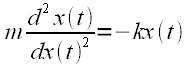
where x(t) is displacement as a function of time, m is the mass of the system, and k is the spring constant. The negative sign on the right hand side of the equation is not an accident, as the spring force always opposes the motion of the mass, and is the result of using a mechanical engineers’ “free body diagram” method to develop the equation.
Solutions to this equation generally run in two forms. The first is a sum of sines and cosines:

But it’s more common to see it in the form of

The latter is simpler and easier to apply; however, it is seldom derived as much as assumed. So how can it be obtained from the original equation?
Let us begin by considering the original differential equation. With its constant coefficients, the most straightforward solution would be a solution where the derivative (and we, of course, would derive it twice) would be itself. This is the case where the function is exponential, so let us assume the equation to be in the form of

(I had an interesting fluid mechanics/heat transfer teacher who would say about this step that “you just write the answer down,” which we as his students found exasperating, but this method minimises that.)
Substituting this into the original equation and diving out the identical exponentials yields

Solving for α yields

The right hand term is the natural frequency of the system, more generally expressed as a real number:

Thus for simplicity the solution can be written as

At this point it is not clear which of these two solutions is correct, so let us write the general solution as

Because of the complex exponential definition of sines and cosines, we see the beginning of a solution in simply one or the other, but at this point the coefficients are in the way.
These coefficients are determined from the initial conditions. Let us consider these at t=0:

Substituting these into our assumed general solution yields

The coefficients then solve to

It is noteworthy that the two coefficients are complex conjugates of each other.
Since the general solution is written in exponential form, it makes sense that, if the coefficients are to be removed so we can enable a direct solution to a sine or cosine, they too should be in exponential form. Converting the two coefficients to polar form yields

Substituting these coefficients into the general solution, we have

Factoring out the radical and recognising that the arctangent is an odd function,

The quantity in brackets is the complex exponential definition of the cosine, since the two exponents are negatives of each other. The solution can thus be written as

If we define

the solution is

which can be rewritten in a number of ways.
If the dampening is added, the problem can be solved in the same way, but the algebra is a little more complicated, and we will end up additionally with a real exponential (decay) in the final solution.
This derivation demonstrates the power of complex analysis as applied to differential equations even in a simple way.
-
George Conger and Kevin Kallsen Put a Wrap on the Anglican Consultative Council’s Process About the Covenant
http://blip.tv/play/AYGAtzOUogk
This is about a succinct take on the failure of the Covenant (for which few tears are shed here, for this reason) as I’ve seen.
In addition to the subject matter, I’m posting this for two reasons.
The first is that I find myself lost in many of the parliamentary and procedural reports I get from the Anglican/Episcopal world. I thought it was just me not being familiar with it all. But when I got lost in this account of my own church’s “Tithe on Tithe” reduction (which I am certainly at the “Ground Zero” of), I don’t feel so bad any more. Church politics can be complicated; no wonder people get frustrated and leave at them!
The second is that George Conger (on the right) was, of course, raised in Palm Beach, which hopefully will add to the honour of the “centre of the universe.”
-
Book Review: Todd Starnes’ They Popped My Hood And Found Gravy On the Dipstick
One of the running “legends” in American life and art (yes, snobs, I know that “American art” is held by the cognoscenti to be an oxymoron) is that of what I’d call the “rube moving to town,” or better the big city. He or she leaves the farm or other small places and goes through a traumatic transition to urban life. In the process they lose all kinds of things: their virginity, their money, their religion, but most significantly their “illusions.”
Personally I’ve always found this tale hard to take. My father came from a successful family who hadn’t seen a farm in a long time. My Arkansas raised mother, like Bill Clinton, proved more than a match to the “city slicker” family she married into. In my family, it was the urban bunch who came out on the short end of the stick!
In the case of Mississippi raised Todd Starnes, anchor and reporter for Fox News Radio, the loss of moving to town was 150 pounds.
He describes his adventure in his book They Popped My Hood And Found Gravy On The Dipstick
. Starting with a stint at a talk radio station in Jackson, TN, he hits the “Rush Limbaugh” trail, first in Sacramento (at the same station Rush was at) and then onward to Fox News Radio in New York. (Todd, if you keep following Rush, call me before you hit Palm Beach, it’s my hometown.) But while just a few kilometres away from Rio Linda he discovered that a) he had a genetic defect in his heart and b) his rich Southern diet had pushed him with in conjuction with (a) to within a few weeks of death.
Most of the book is taken with the process of coming back from that. He tried to be a bad patient, but the outstanding support network from his Baptist church wouldn’t let him do that. Then he was faced with the task of weaning himself from the gravy he found on the dipstick and adopting a leaner (and certainly meaner) diet, a struggle for any Southerner. While he was becoming half the man he used to be, he moved to New York, participated in the Marathon, adjusted to life in the Big Apple, and lost both of his parents.
The multiple transitions he faced would have been enough to disorient just about anyone. But Starnes, in a hilarious and laid back way, shows how faith in God makes a difference in one’s life, irrespective of the fact that many of the bad habits he had to break were acquired in church.
It’s a joyous trip to take, and you will want to find out what happened after They Popped My Hood And Found Gravy On The Dipstick.
-
Blessed are the Merciful

My first semester at Texas A&M University, I was required to take Analytical Geometry. My teacher was a former seminary student (come to think of it, so was my Calculus teacher!) Generally it wasn’t a difficult course but it had its moments.
One of them came with a particularly difficult problem we had for homework. I really didn’t know how to solve it, so I bluffed my way through it the best I could. At the top of the page I placed the following, from my Latin-Greek New Testament:
Needless to say he picked up on it immediately, and wrote “NO MERCY: 8.” Fortunately it was 8 out of 10; that result exceeded my expectations.
Evidently he was quite impressed with this show of Greek, so, in handing the papers back, he wrote my heading out on the board, pointing out that it appeared on my paper, and informing the class that he had in fact shown no mercy. One of the students, obviously unaware that any Aggie would know Greek, asked, “How did he manage to write that?”
“It was said by a very famous man,” the teacher replied.
That “very famous man,” of course, is Jesus Christ, and the passage in English is “Blessed are the merciful, for they shall obtain mercy.” (Matthew 5:7.) It is one of the Beatitudes, which open His Sermon on the Mount. The theme of being merciful and of forgiveness runs through the Gospel; in the next chapter, after the Lord’s Prayer He says again, “For and if ye shall forgive other men their trespasses, your father in heaven shall also forgive you. But and ye will not forgive men their trespasses, no more shall, your father forgive your trespasses.” (Matthew 6:14-15, Tyndale) Forgiveness is not just a nice thing to do; for the Christian, forgiveness is mandatory for eternal life.
And forgiveness is in short supply these days. When Eric Rudolph pled guilty and received the death penalty for bombing an abortion clinic, the liberals mourned that he had “dodged the bullet,” and called his crime “unforgivable.” Used to be that any liberal worth his (or her) salt opposed the death penalty, but evidently that’s gone out of fashion. (Wonder if they felt the same way about the “Unabomber,” Theodore Kaczynski?) Today we live in a society with a record incarceration rate and creeping euthanasia. Schools call the police for acts that, a generation or two ago, would occasion a call to the parents. Makes one think of Thomas Hobbes’ characterisation of life as “brutish and short.”
God’s standard for forgiveness–from Him and from us–has not changed. If we do not forgive, we are tormented in this life and the life to come. There are certainly earthly consequences for the things that people do, but these should not be confused with our response of forgiveness. And what others do should never obscure the need for us to seek forgiveness of our own sins from God. Our “zero-tolerance” society teaches us that no one is free from mistakes. But our God sent His Son to eradicate those mistakes and make us a way to eternal life.
-
Getting Rid of TEC Money Favouring, and Apologising to Ridiculed Persons
Mark Harris transmits a splendid proposed resolution for GC 2009 about TEC’s participation in the Anglican Communion:
Given our current relation to the Anglican Communion, a proper application of PAP (Principle of Anglican Progress) would require that The Episcopal Church declare a moratorium on funding the Anglican Communion until such time as the mind of the Communion is settled on how it is going to treat The Episcopal Church and the “innovations” it sees our church as having instituted. Financing the subversion of our church is but another Episcopal Church innovation.
This would be the greatest thing that could happen to the whole debate. Their funding of the AC has drug out the whole affair; it has bought the silence of some provinces and funded such conversation-lengthening exercises such as the indaba process (ironically titled, since TEC’s main opponents are the Africans.) Getting rid of this kind of money-favouring would make a North-South split in the AC come much sooner and save everyone a lot of trouble.
But another of his “proposed resolutions” piqued my interest:
Resolved, that the House of Bishops and the House of Deputies fully, completely and sincerely apologize to all those who have been marginalized by the Episcopal Church including…those whose culture and person have been ignored and ridiculed…
He may not want to go there.
Does he really think that only liberals are “ignored and ridiculed?” Try standing up for the traditional Christian sexual ethic and see what kind of reaction you get! Or, on a personal note, perhaps such an apology would include me, who was subject to a good deal of ridicule right under Bethesda’s nose.
It’s the politically correct line these days that people are only downtrodden because of their gender, race, sexual orientation and the like. But, in a culture like ours, you only need to be different to feel the opprobrium of the world around you. And who’s “different” only depends on who is defined in the “mainstream.”

Sailing the Last Voyage with Newton and Pascal
 Positive Infinity