-
Why Do Muslims Choose Jesus?
In brief, from Abu Daoud (he links to the full article from Mission Frontiers):
- A sure salvation
- Jesus
- A Holy Book: the power of the Bible
- Then you will know the truth (Christianity teaches the truth about God, humanity and ethics)
- Dreams and visions (you can find out more about that here)
- The love of God manifest in Christ and the Church
- I have called you friends: relationship with God
- Persecution (both being persecuted and seeing others persecuted)
-
Ten Years After, Love Like a Man
 I’m taking a leaf from legendary Anglican blogger Baby Blue’s notebook and posting the first of what (hopefully) will be several videos of character-defining videos from my novel The Ten Weeks.
The first is Ten Weeks After’s “Love Like a Man,” the defining song of novel vamp Denise Kendall. Long before the devil wore Prada, Denise terrorised her enemies in whatever she wore (or didn’t.)
This video comes from a live performance in Switzerland in 1997.
Both YouTube videos have been deleted or made private.
For more information on The Ten Weeks, click here
-
Praying to Oneself
At the end of G.K. Chesterton’s (whom atheist Bill Maher thinks is a smart guy) classic Orthodoxy, he states that the one thing Jesus never showed in his earthly life is his mirth. I’ve come to realise that the problem is that, in one place at least, Our Lord’s humour was too dry to readily pick up on. That place is this:
“Two men went up into the Temple Courts to pray. One was a Pharisee and the other a tax-gatherer. The Pharisee stood forward and began praying to himself in this way–‘O God, I thank thee that I am not like other men– thieves, rogues, adulterers–or even like this tax-gatherer. I fast twice a week, and give a tenth of everything I get to God.’ Meanwhile the tax-gatherer stood at a distance, not venturing even ‘to raise his eyes to Heaven’; but he kept striking his breast and saying ‘O God, have mercy on me, a sinner.’ This man, I tell you, went home pardoned, rather than the other; for every one who exalts himself will be humbled, while every one who humbles himself shall be exalted.”
(Luke 18:10-14)Both Pharisee and tax-gatherer were in the Temple Courts, the place in Judaism where God met man through the sacrificial system. Both thought they were praying to God, in the optimal place, no less. But only one was, and it wasn’t the Pharisee. He was “praying to himself.”
I can’t help but believe that at least one of his hearers cracked a smile at the thought.
The Pharisee, with all of his knowledge of the Scriptures, should have had an “inside track” to God. His mistake was that he was totally self-focused, and his self-focused nature made his praying a “closed loop,” starting and ending in himself. He starts by thanking God for who he is, but after that it goes downhill.
The slide starts when he adds who he isn’t–a thief, rogue, or adulterer, and certainly not a tax-gatherer like the one he sees out of the corner of his eye. It never occurs to him that he cannot take credit for this. We think of Judaism as being a “works salvation” business, but Jews aren’t “God’s chosen people” for nothing. God chose them. He did the mighty works to get them out of Egypt and into the Promised Land. The cooperation was frequently minimal. It didn’t get better after they were in the land, either. A round trip to Babylon wasn’t instructive, not in his case. The initiative was God’s. The Pharisee hadn’t learned the concept of “there but for the grace of God, go I.”
Worse than this, his works gave him a sense of entitlement. This was a man who was “doing business with God.” He fasted and tithed, so he expected a payback. He had no idea that a finite creature could not presume–let alone be compared with–an infinite God.
The tax-gatherer had a different perspective. He knew he had a sin problem. Roman tax gatherers were contractors whose job it was to collect a certain amount of taxation and keep the rest. Needless to say, they were zealous in getting their share and more! Given the brutal ways of the Roman world, tax-gatherers were even more unpopular than IRS agents are today.
The tax-gatherer knew he had no reason to presume on God. All he could do was to ask for mercy and forgiveness.
But that’s all any of us can ask. We have no reason to presume that God must love us, or smile on us, or relieve us of our suffering. That he does is a result of his love and his mercy, which he exercised to the Jews and ultimately to all of us through the sacrifice of His Son Jesus Christ on the cross. But it was enough for the tax-gatherer and it’s enough for us.
-
Mike Oldfield, Hergest Ridge, And…
My brother and I were committed Anglomaniacs. This was inevitable. Growing up in Palm Beach can be a decidedly unAmerican business; being raised in the “English” church only made matters worse. When he died, the only cash he had on his person was a pound note. (My mother had squirrelled away one too.)
 People talk about the 1960’s “British invasion” of rock music; in our case, and especially mine, the conquest was complete. This was important; as Allan Bloom pointed out in The Closing of the American Mind, our literature didn’t do much for our self-identification but our music did. By the time I graduated from prep school, virtually everything I listened to came from the U.K.
When I got to college, I was confronted with contemporary Christian music, in one of two forms. The first was the post-Vatican II folk liturgical music such as we used in our folk masses (I had become a Roman Catholic by then.) The second was the Maranatha style coffee house music.
Contemporary Christian music was in its infancy — and a glorious infancy it was — but I was put off by it. For one thing it was too simplistic and not “heavy” enough. But another serious problem with it was that it was all American. After years of British rock, what came from this side of the Atlantic just didn’t cut it. Never mind that the messages coming out of all this British stuff was not what I needed to hear and that I knew it; old habits were hard to break. (This was of course before I discovered the wonder of Adrian Snell, Cloud, Bill Atwood, Sheila Walsh, Reflections and the like.)
This was a serious challenge; fortunately, there was an answer and a diversion.
The answer was to be found in contemporary Christian music that took the calibre of performance beyond its beginnings. Probably no artist could do this better than Phil Keaggy, who was by Jimi Hendrix’ admission the greatest rock guitarist ever. His What a Day album — a masterpiece even years after its first issue — forced me to take a new look both at Christian music in particular and American music in general.
The diversion was Mike Oldfield. He burst upon the scene with Tubular Bells, whose fame on this side of the Atlantic was fuelled by its use in the move The Exorcist. This work was intriguing; best of all, it had no lyrics (except for Vivian Stanshall’s!) So conflicts in that field were eliminated.
But Oldfield’s album that really blew me away was Hergest Ridge (the original mix; the remix that appeared in the Boxed set and all CD’s is a disaster.) That rendition was an intensely pastoral work. At the time I was living out in central Texas. I was surrounded by and lived in a bucolic rural environment. Although it was birthed in a physical environment that was different from mine, the pastoral appeal was intense.
In the middle of all of this the call of God to take a serious step higher with Him was getting louder all the time. The music may have had some deficiencies but what the Christians around me were saying and living looked like an improvement to me. It took some time to get past all of the obstacles I threw in their way but when the crunch came to make a change I did so; as Chuck Girard would sing, I went from the front seat to the back seat and left “all the driving to the Chief.”
In 1976 the opportunity came to travel outside the U.S., and where else to go but the UK? So I spent a month there. In addition to the usual sites that people go to in Great Britain, I really wanted to find out about Hergest Ridge. It took some digging through the Ordnance Survey maps but I found it.
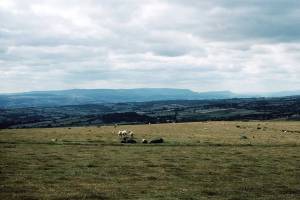
And so on that day in early August 1976 I ascended Hergest Ridge. Having not spent much time in hilly country up to then, I found it breathtaking; perhaps the photographs in the video here will do some justice to that. It was also surprising that it was so treeless; the sheep did a commendable job in keeping it mowed as well.
One of the effects of any media production is to make things larger than life. When I got to the top I realized that, for all the hype, this was in reality just a hill, albeit a beautiful one. It could go no further, but the God who had made it could, and there He crystallized my understanding of where I was going in Him, and that I had a real purpose and place in His plan. The realization of that has taken a long time; this web site is a part of that. Things looked a lot better after the descent then before I went up. I lost track of Oldfield’s music after Exposed (except for Islands), but what I brought back from Hergest Ridge was far more important.

And as for my brother? Well, his life took a different turn from mine. Things went along for him in an ordinary way for a while, but things that weren’t right in his life eventually caught up with him. His health never was the best, with heart trouble and colon cancer; only his rigorous physical exercise compensated for this. He smoked and drank heavily, both of which had serious precedent in our family. His wife eventually left him. He turned to love with a live in girlfriend. When financial ruin arrived and kidney cancer struck, his girlfriend dropped him off — in every sense of the word — at a rehabilitation centre.
Destitute, broken in health, mental state and finances, he had an out of body experience in which he was taken before a hall full of “elders.” The message he heard there was simple: “You must obey God’s way.” He then realized what had been underscored for me atop Hergest Ridge; that salvation in Jesus Christ was the only way out of the morass of this life.
After his time in the rehabilitation centre life started to come together again; he got a job (click here for a story related to that) and he, through a program, put his alcohol program behind him. But it was cut short with the discovery that he had pancreatic cancer. Not even the excellent M.D. Anderson clinic could help him; three months after diagnosis he was dead.
It’s not been easy to lose him, even though it’s been about a quarter of a century since that happened. But I know that he, having made Jesus Christ his Lord and Saviour, has eternal life, a life that will know no end and a life that is always with God. One of these days I look forward to the day when we can be together again in that eternal life, and that will be the best mountain top experience of all.
For more information click here
-
Hoisting China’s Flag Over the White House: Hard to Avoid
The Chinese are proud of this:
The national flag of the People’s Republic of China (PRC) will be hoisted at the South Lawn of the White House in Washington on September 20, media reported Sunday.
Chinese associations in the United States had applied to hold a ceremony in front of the US President’s residence to celebrate the 60th anniversary of the founding of PRC.
Chen Ronghua, chairman of Fujian Association of the United States, told reporters that their application was approved not only because of the sound Sino-US relations but also because China is a responsible country.
“Many Americans admire China due to the success of last year’s Beijing Olympics,” said Chen.
I’m sure that many Americans will resent it, but face it: as much money as we owe these people, how can we avoid it?
“The rich ruleth over the poor, and the borrower is servant to the lender.” Proverbs 22:7, KJV.
Below: the Chinese flag flying over Tian an Men Square in 1981, in its native environment. Back then I was working to have the money flow our way, successfully I might add.


Sailing the Last Voyage with Newton and Pascal
 Positive Infinity