-
On Christmas in New Orleans, Latitudinarians and Evangelicals

This is the time of year when we think of, amongst other things, all the things we were doing and experiencing at this time of the year in days past. For me, this Christmas is a milestone in one respect: forty years ago now, I was in New Orleans, along with my entire family, on a most un-Christmaslike mission.
Although people have definite associations with why to visit the Crescent City, for me and my family New Orleans has always loomed large for other reasons. My father’s mother was from there, and she came too, lamenting what a dump the place had become since she had grown up in the Garden District. A good deal of our family business’ sales went to New Orleans and South Louisiana, so there were business calls to make (we even made a side trip to Morgan City, see photo below.)

This trip, however, was in a league of its own: after four months of traction and messing around back home, the doctors had decided that drastic action was needed on my mother’s intense back pain. So off we went to the Ochsner Hospital, and two weeks before Christmas she had a spinal fusion. Initial recovery from this was simple but excruciating: she had to be completely immobile while the fusion started to heal into the spine. So we retained round the clock duty nurses and waited until the fusion was strong enough where she could be flown home.
My mother was never one to expect (or really want) the “24/7” family room vigil that is ingrained in Southern culture, so when we weren’t seeing Dad’s customers, dining at Commander’s Palace (as my great-grandparents had done,) hitting the Café du Monde or experiencing our first microwave oven (at Ochsner’s automat) we were out in our dad’s rental car. My brother believed that there were three types of cars made in the U.S.—Pontiac, Pontiac and Pontiac—so the fact that we had a Bonneville was a special treat. South Louisiana isn’t the best place to really put the pedal to the metal, but we did our best, and we were amazed at just how fast the car would go. Evidently oblivious to the kind of hurts Judge Perez’ boys could put us in, after another fast run we pulled over, our curiosity getting the best of us. We were incredulous when we popped the hood and discovered that the car had a 455 cu.in. engine. Amazed they would equip a rental car in this way, we now understood the performance.
That Christmas, unique in many ways, was a “last Christmas” for several reasons. It was my brother’s last Christmas before graduating from military school. It was our last Christmas to live in Palm Beach. It was also my last Christmas as an Episcopalian. Before we celebrated our Lord’s birth again, my brother graduated and went on to maritime academy, we moved down the coast, and I swam the Tiber, where I stayed for most of the decade.
It’s only been in the last decade when I meaningfully reconnected with my Anglican/Episcopal roots, and part of that has been a recent reading of L.P. Curtis’ Anglican Moods of the Eighteenth Century. It’s an interesting look at the two major threads of Anglican life and spirituality in the century the British Empire became the greatest in the world, even with the independence of the American colonies. It’s also before the Oxford Movement and the emergence of “unEnglish and unmanly” Anglo-Catholicism in the following century. On the Evangelical side, the central figure was John Wesley, whose Methodist movement eventually made its exit from the Church of England (and ultimately spawned the Wesleyan, Holiness and Pentecostal movements.) For the most part the figures on the Latitudinarian side such as Joseph Butler and John Tillotson are mere names to most other than Anglican specialists, but one is immediately familiar to political conservatives: John Locke.
The Methodists’ departure in England, and even more so the stampede out the narthex in the newly independent United States, left Latitudinarianism with the upper hand in the Anglican world. That was very much in evidence in the Episcopal Church I was raised in; in fact, it was one of the appeals the church had. It’s hard for Evangelicals outside of the Anglican/Episcopal world to think of growing the church via the determined apathy that one found in traditional Episcopalianism, but until the upheavals of the 1960’s, that’s exactly what happened.
It’s tempting to think that the Latitudinarians’ chief mission in life was to give the “box checkers” (to use a Catholic term) comfort, but that’s not entirely justified. The aforementioned champions of nice English religion were very interested in defending Christianity against the attacks present at the time, principally deism at home and atheism across the Channel. Their defence tended to run in an intellectual way, albeit nowhere near as rigorous as their Roman Catholic counterparts. But defence it was. They (especially Locke) were concerned with the proper ordering and conduct of society, and the principles traditionally associated with American polity bring us to owe a debt of gratitude for this if nothing else.
So why could I not bring myself to continue in a Latitudinarian way? There were and are several reasons for this.
The first is that the New Testament I read demands a lot more from a person than the Latitudinarians would allow. That was especially evident in a place like Palm Beach.
The second is that the Episcopal Church, or at least the “radicals” I started to run into in prep school, had stopped believing in it and were more attuned to “social justice” issues, to say nothing of “situational ethics” and other new causes. An institution which abandons its core beliefs and then demands institutional loyalty is asking too much.
The third is that the world around me couldn’t be survived with just a “nice” religion. To really work, Latitudinarianism or other belief and practice like it requires ideal conditions. Those ideal conditions weren’t to be found in a world which had (and still has) lost its senses. Such a religion also lacks “cred” in lower economic strata, which is why Wesley and his successors have made such headway there.
I still get the feeling that, in spite of—or maybe because of—all of the hard stands and institutional chaos of the last decade, many Anglicans inwardly yearn to return to the church of Butler, Tillotson, Locke or even Anthony Trollope. But that’s not the world we live in. Like the Bonneville that my brother and I cruised around our ancestral homeland in, the church needs spiritual horsepower to get where we are going, and that’s best found in the churches and movements that are Wesley’s progeny.
Let me take this opportunity wish all my visitors at Positive Infinity—especially those from the Anglican/Episcopal world, and of course my Roman Catholic and Orthodox friends, along with my fellow Wesleyan Pentecostals—a very blessed Christmas, as we celebrate our Saviour coming into the world.
-
Do We Have Nestorians Teaching in Our Seminaries?
During the first centuries of the church the greatest theological controversy sought to answer the question, “How is Jesus of Nazareth God?” A full discussion of the Christological developments can fill a library with books. I want to briefly address only one issue – the significance of Theotokos, which says that Mary is “God-bearer.” I remember this discussion in my theology class in seminary. Our professor insisted that Theotokos was improper and it is better to think of Mary as “mother of our Lord.” I must challenge that statement and affirm Mary as Theotokos.
Those who haven’t pitched 1500-2000 years of church history in order to make them feel singular about themselves know that one of the ways Nestorius propounded his broad-based dualism of the divine/human nature of Jesus Christ was to object to Mary being referred to as Theotokos, or Mother of God. Nestorius was shown the door over this, although churches which followed his idea flourished for many centuries from Iran to China.
The church’s apprehension about Nestorian dualism were justified. If we really believe that Jesus Christ is God in the flesh, that he is both human and divine, and that he is not spiritually schizophrenic, then we must proclaim that Mary is indeed the Mother of God, whether we believe that devotions to her are proper or not. This is true whether we are Chalcedonian or not.
Daniel Tomberlin, who wrote the quote cited above, has a more seminary proper explanation without naming the usual suspects:
During the Christological debates of the 3rd and 4th centuries the many controversies can be expressed in two words – Theotokos or Christotokos. Is Mary the mother of the Christ, or is Mary the mother of God? If Mary is Christotokos, the mother of the Christ, then when did Jesus become Christ? Maybe, Jesus was not God incarnate, but was later adopted or anointed as the son of God. If so, then Jesus is not of the same divine essence of the Father. To suggest that Mary is “mother of our Lord” falls into the same theological trap – that Jesus may not be the eternal Son. Christotokos cannot fully express the meaning of Jesus Christ. Mary is Theotokos – the mother of God. Theotokos affirms the fully divinity of Christ, that Jesus, the son of Mary, is of the same essence with the Father and Holy Spirit; that Jesus Christ is the union of eternal divinity and humanity. The union of God and human took place in the womb of the Virgin.
For those who are wondering what relevance this has in a day when the main focus seems to be on attendance and income, it can be shown that Islam is, in many ways, Nestorianism taken to its logical conclusion. The Qur’an is a document that shows a serious relationship with Nestorian concepts. This is especially true with Jesus Christ; Nestorius’ neat separation of Jesus’ human and divine natures ends up with Jesus losing the latter (sort of) in the pages of the Qur’an. A long running objection to Nestorianism is that it leads back to the complete denial of the divinity of Christ; Islam is the fulfilment of that objection.
That, of course, exposes one of the key weaknesses of Islam from a theological standpoint. It’s something I beat to death in My Lord and My God, but ultimately there is a great gap between an uncreated God and his creation. There must be something to connect the two. For Christians, the incarnate Christ is the ultimate connection, the connection that gives us a way back to God. With Islam, there is no such connection, thus there is no apparent rationale why or how God would care or interact with us.
Those who would emulate Nestorius in order to combat Marian devotions, as Nestorius did, are taking Christianity in a direction that we (and they) really don’t want to go. Can we excise this kind of thinking? If Allah wills it…
-
Publix: Still the Event of the Season

Some things don’t change in Palm Beach:
Before sunrise Thursday, just a handful of customers were waiting outside the new Palm Beach Publix, scheduled to open at 7 a.m.
By 6:50 a.m. the crowd had grown to about 50 people.
That’s when store manager Nick Abiusi decided to let the throng in, handing them the latest Publix circulars and greeting many of the shoppers by name. “We’re happy to be back,” he said to many of them. “It’s great to see you.”
A half-hour later, there were lines at all 10 checkout stands and at least 500 people were making their way around the new super market.
I know I spend way too much time on this, but Publix has become a Palm Beach institution almost as much as the Everglades Club. The fact that the nation’s richest zip code should have such a love affair with a chain grocery store–one that started with its original opening in 1971–is a lesson to everyone, as I noted five years ago in The Event of the Season.
It really is, isn’t it?
-
Some More (unAmerican) Thoughts on Rwanda, AMiA and Chuck Murphy
A few days ago, as this story was breaking, I made some comments based on my experience with African oversight and church politics. Since that time AMiA Bishop Chuck Murphy has made the break and there is all kinds of back and forth on this issue, I keep feeling compelled to say more, because this in many ways is bigger than just the AMiA or North American Anglicanism in general.
What I am about to say isn’t going to sit well with many people. It’s based on some very deep convictions of mine regarding the whole course of Christianity these days which have developed both in my years of involvement in the whole Anglican blogosphere and in my work for the Church of God. But it’s time to lay some things out.
It’s instructive to go back to the end of the last millennium, when it became apparent to some in the Episcopal Church that they were headed to a dead end re being in an orthodox church. (Why this took so long is beyond me, but I digress…) The AMiA was the first tangible organisation in this round of North American Anglican churches started to address this problem. Unlike previous churches, it had the advantage of, via the two primates (one from Rwanda and one from Singapore,) of being in communion with the Archbishop of Canterbury, which is a necessary prerequisite for being a part of the Anglican Communion. The AMiA has been successful up to now in fulfilling its mission, and it has had many who have followed its pattern by seeking communion with other provinces in communion with Canterbury.
In the course of this process, which has dominated the Anglican/Episcopal world for more than a decade and is arguably the most compelling story going on in Christianity these days, the whole strength of African Christianity, Anglican and otherwise, became apparent to everyone. North American Anglicans have used this to construct what is still very much a work in progress: the creation of an Anglican province on these shores that is in communion with the Archbishop of Canterbury.
The actions of same Archbishop, however, should have given pause to the enthusiasm. It’s not difficult to show Rowan Williams’ lack of commitment (and that’s putting it politely) for a truly orthodox-centred Anglican Communion. And even if he were so inclined, his government is not. As the official state church, the Church of England is about to get equality legislation shoved down its throat. The Anglican Communion has a doctrinally unstable centre, and coupled with the obvious orientation of the Episcopalians, the whole concept of an orthodox Anglican communion (even with the over-rated Covenant) centred in the “First World” is marginal at best and delusional at worst.
What should be the centrepiece of any Anglican organisation in North America that wants any connection with the rest of the Communion is the connection with the Global South. Implicit in that is the realisation that the centre of Christianity has moved. Also implicit in that is the idea that, if the centre of population of Christianity has moved, the centre of authority should move also, if not immediately in a process facilitated by those of us in what is now “the mission field” (a concept embodied in the AMiA’s name and original purpose.) Unfortunately this is where Murphy’s move shows itself in its worst light.
There are many complex issues that remain to be unravelled here, but it seems to me that some unfortunate attitudes have surfaced along the way. There are issues of financial accountability; these should be sorted out in a methodical manner. Murphy’s language of being Moses leading the children of Israel out of Egypt says more than he probably wants it to. It shows a creeping messianic complex in the making, and it also says that his Rwandan opponents are Pharaohs. His reference to reverse colonialism is equally unfortunate. Face it: the Anglican Communion was brought to Africa as part of the British colonial effort, even though it’s spilled over into the colonies of others (Rwanda was a Belgian colony before its independence.) The simple fact–and one that Murphy and others conveniently forget–is that a colonial experience is an unpleasant one for those who are being colonised. It’s amazing that Anglicanism has done as well as it has in Africa with that kind of legacy. (The West Indies, with the additional legacy of slavery, is another story altogether.) A friend of mine from a former British colony complained about British colonial rule; my response was, “You see how much we thought of it.” Evidently Murphy has forgotten that part of American history in his quest to lead the “British church” on these shores out of “Egypt.”
The fact is that a little “reverse colonialism” is appropriate in this situation. Didn’t the Rwandan connection allow the AMiA to say that it was in communion with Canterbury? Where has the abandonment of the faith been proceeding at an accelerating rate? Why is it that, just because we have the money and tend to be full of ourselves, that we should automatically assume to have the right to be autocephalous? Isn’t it time to face the fact that we as Christians (putting the Anglican part aside for a second) are part of what is now a Third World religion? The last questions aren’t just for Murphy and his colleagues, but for every Christian denomination and organisation who still thinks that the rest of the world is the “mission field,” with concomitant, U.S. centred organisation.
At this point the best thing that Murphy could do is to integrate the AMiA into the ACNA. At least it would give some higher, unifying purpose to a move which only looks to divide at this point. That isn’t a simple business either; North American Anglicanism is divided over WO and even more over women bishops, but I think there are other less noble motives behind continued balkanisation.
As for the Rwandans, I’m inclined to think they are deeply hurt over this episode. I can’t much blame them. They’re finding out that both gratitude and loyalty are scarce commodities on these shores, something that those of us who live here have known for a long time. The impression this leaves is that the orthodox Anglicans in North America are no more reliable than their revisionist counterparts, and that’s an unfortunate legacy. It’s one that will come back to haunt us. In a society whose upper reaches are firmly in the driver’s seat and who really don’t want us any more, we need all the friends we can get, and this isn’t a good way to get them.
-
Of Bomb Threats, Stained Glass Windows, Truthers, Old Books and College Students
This is the time of year when many academic institutions wind down their semesters. That’s certainly the case with UTC where I teach. It’s time to reflect on a couple of things that have transpired during the calendar year which, in their own way, deflect a good deal of conventional wisdom about those who are “coming up.”
The first took place last Spring. The reality of violence on campus is one of the sadder aspects of college life, but administrations have to take it seriously. Just before an end of class, the alarm went off: it was a bomb threat. The general result of this is that the building is evacuated and the faculty and students that need to re-enter the building in the foreseeable future stand in the parking lot and wait until the all-clear sign. Mercifully UTC has not had a bomb go off in living memory, although we had one threat called in by a student who was afraid they would bomb an exam!
There’s one big upside to all of this: standing in the parking lot turns into a social event. It’s easy in academia to put on blinders and only interact with the same group of people all of the time. A bomb threat is an opportunity to catch up with people you don’t see very often, or in the case of students do so outside of the classroom. I had a student who went to an old-line, downtown church that has morphed into something of a “mega-church” (“mega” relative to the size of the community it’s in.) As a result of this they built a new multi-million dollar complex in a more suburban setting. But my student wasn’t all that pleased. As we were standing around, he confessed to me that he preferred the old church they were in because it had stained glass windows and he could look at them and enjoy them during the service.
Stained glass windows were, for centuries, Christianity’s visual presentation for most church goers. In an age of illiteracy, they taught the truths of the faith to many. They’ve been lampooned as stodgy and “churchy,” but it was interesting to hear a member of a generation raised online longing for stained glass windows. It may not put the lie to a lot of calls for “relevance” these days amongst church leaders, but it certainly puts things in a different perspective.
The second event I want to touch on wasn’t a bomb threat but was nevertheless explosive in its own right. The university’s diversity department sponsored a panel discussion entitled The Science of 9/11. When it quickly became evident that this was turning into an advocacy session for the “Truthers,” and the main target was our former civil engineering department head (who was on the panel, largely agreeing with our government’s assessment of the causes of the collapse of the WTC) my students who were there became the main opposition to the procession of Truthers, whose main comeback was “Google it.”
Subsequent discussions revealed that my students took a more critical view of what came up in a search engine than many of my contemporaries. The Internet is a tremendous–essential really–tool for research and news gathering, but my students took a more “trust but verify” type of approach. I suppose my contemporaries, triumphant in successfully turning on a computer, are more gullible about the quality of the information found therein.
A few weeks later our library had a surplus book sale. We are about to get a new library, and the library department wanted to trim the collection of books with little interest, some of which hadn’t been checked out in twenty years. For a seasoned engineer, there were some real gems to be found, but I have spotted stacks of books which some of my (and other engineering) students had bought.
Why would they do this, other than the books were cheap? Engineers are, on the whole, a cautious group. They want their designs to be successful (and the legal system gives them plenty of additional motivation as well.) They understand that a) science and technology does march forward, but b) many of the underlying principles are still the same, and c) old material contains experience that may be “lost in the shuffle” now. Engineers, to the greatest extent possible, want to avoid the mistakes of others or, put otherwise, want to benefit from the wisdom of others. If an old book contains an idea or a caution that saves money or prevents failure, it’s worth remembering, even if the newer material overlooks it.
My office at the university is in what I refer to as the “Textbook Museum.” It’s filled with old textbooks, but they’re still valuable reference materials and, as some of my students have pointed out, better written and edited than what is out now. Unfortunately too much of our educational establishment is mesmerised with the newness of technology and the fear of looking old that, once again, we risk losing a great deal of accumulated wisdom that our students really need–and want–to have on hand.
The generation that was raised not to trust anyone over 30 is now far past that, but we’re still locked into the fear that we’ll be thrown into the trash can of history if we don’t always present the newest thing. What we need to present is that which endures, has meaning and works, and that’s especially important when we turn to the greatest “old” book of all.
-
AMiA Bishop Chuck Murphy's Moment of Truth
Seems another wearer of the purple shirt is getting an offer he can’t refuse:
The head of the Anglican Mission in America has been threatened with ecclesiastical discipline for contumacy. Unless Bishop Chuck Murphy repents of his disobedience and apologizes for his offensive statements within seven days, the Rwanda House of Bishops will assume that he has “made a de facto choice to withdraw as primatial vicar” of the AMiA.
In letter from the Rwandan House of Bishops to Bishop Murphy dated 30 Nov 2011, the AMiA leader was chastised for disobedience and abuse of office.
This issue is of special interest for me for a simple reason: in my teaching at the University of Tennessee at Chattanooga, all of the three full-time civil engineering faculty–including the Kenyan department head–are African. They are great people to work for, I could not ask for better. But they like team players; indeed, they expect it, as I implied in They Tell Us What to Do and We Do It. Murphy should have known that when he signed up to be a bishop in the AMiA. He needs to come to terms with them ASAP.
It’s true that the ACNA, birthed out of the efforts of several (mostly) African provinces, has its work cut out for it integrating all of these into one North American whole. Everyone who had any experience with church politics knew this going in. But let’s ask the stupid question: if Chuck Murphy can’t be a team player with those in Rwanda, how can he be one with his colleagues here?
After chronicling the sorry trip to the bottom by TAC Archbishop John Hepworth, it’s tempting to say that there’s something leeching out of the purple shirts of Anglican prelates that’s affecting their style of mind. Unfortunately that’s not the case; “egos inflatable to any size” is a disease that affects many of our Christian leaders, especially the Boomers who currently dominate the scene. The obsession with leadership is something that cuts across churches of all types and doctrinal tastes. But I don’t think that the “take the bull by the horns” style that’s so admired in this country is what Jesus had in mind when he used the shepherd analogy for a leader as opposed to a cattleman.
-
Mitt Romney Joins the Bologna Club
When asked his favorite novel in an interview shown yesterday on the Fox News Channel, Mitt Romney pointed to “Battlefield Earth,” a novel by L. Ron Hubbard, the founder of Scientology. That book was turned into a film by John Travolta, a Scientologist.
 There’s a little family history behind this connection. My grandfather, Chet Warrington (right) was a major figure in Washington, DC aviation during the 1930’s. He was evidently a big talker, too: Ernie Pyle, who later became famous as a correspondent in World War II, declared that those who met to talk about aviation at Washington-Hoover Airport were the “Bologna Club” and that “Chet Warrington is chairman of the board of the Bologna Club…The club’s insignia is a bologna sausage, equipped with wings.”
Lafayette Ron Hubbard, who went on to found Scientology and write Battlefield Earth, was also a reporter covering the Washington aviation scene, and did an article about my grandfather for the October 1933 issue of Sportsman Pilot. I spend some time discussing the relationship between the two here, but it struck me that, given his subsequent career, Hubbard himself assumed the chairmanship of the Bologna Club.
Now Mitt Romney is taking up the torch…or the sausage. Either way, it’s à propos.
-
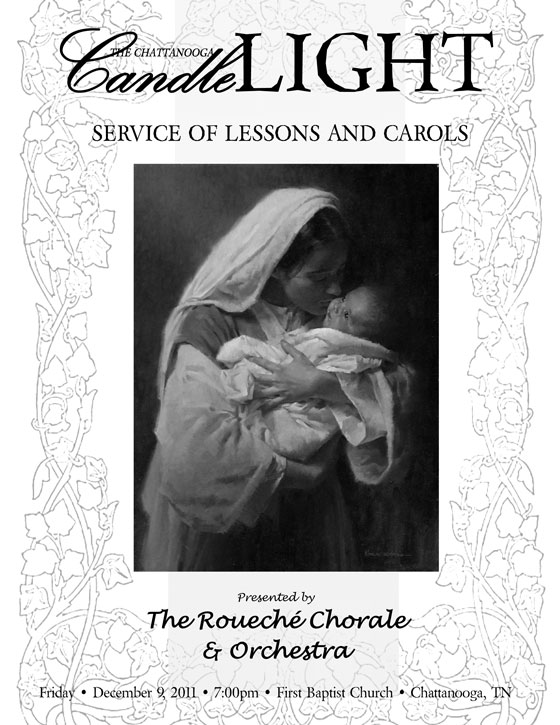
Candlelight Service of Lessons and Carols
This year’s Chattanooga Candlelight Service of Lessons and Carols will be presented by the Roueché Chorale and Orchestra on Friday, December 9 at 7:00 pm at First Baptist Church, 401 Gateway Avenue, down-town Chattanooga. Prelude music will begin at 6:40 pm.
The only way to describe this performance is jaw dropping. You’ll need to get there early to get a seat.
-
TAC Archbishop John Hepworth's Tough Trip to the Bottom
The Catholic Church will allow him to come to Rome as a layman:
John Hepworth, the Archbishop of the Adelaide-based Traditional Anglican Communion (TAC), will be received back into the Roman Catholic Church, but only as a layman.
Sources say Hepworth was given a letter from Rome by the hand of Melbourne Archbishop Denis J. Hart. This was to have been kept quiet to allow the Archbishop a reflection period of several weeks.
VOL broke the news Tuesday in a story “PRIMATE PLUMMETS” saying that he had been denied a return to the Roman Catholic fold as a bishop or priest.
Hepworth has been the Anglican/Episcopal world’s loosest cannon, from an institutional standpoint at least, for a long time. He’s accused Catholic priests he grew up under of sexually molesting him, and that’s certainly something that needs to be looked into. But it doesn’t justify the years of manoeuvring that he’s engaged in to try to get the RCC to swallow the TAC whole with him as its head. That last point is a major sticky wicket: not only did he take orders from the RCC to start with, but also he is divorced:
However, the Complementary Norms attached to Anglicanorum Coetibus are clear in (Article 6 §2): “Those who have been previously ordained in the Catholic Church and subsequently have become Anglicans may not exercise sacred ministry in the Ordinariate. Anglican clergy who are in irregular marriage situations may not be accepted for Holy Orders in the Ordinariate.”
That almost sounds like they wrote the Norms with him in mind. Now Rome has signalled that it has had enough. So have the people in the TAC; they’re calling for a new primate, one perhaps (or perhaps not) that could get the TAC into the Ordinariate without him being the chief obstacle.
I suspect that the RCC is trying to make Hepworth an offer he can’t refuse so they can get him out of circulation. My advice to Hepworth: take it. There’s life after ministerial credentials, to use the broad term. These days it’s not hard to make an impact on the Christian world without credentials/ordination, just look at the Anglican blogosphere. More importantly, though, your relationship with God is more important than the position you hold in the church or the colour of the shirt you wear. Don’t blow the former for the sake of the latter, for you or anyone else.
-
A Couple of Things Worth Remembering About Advent
Today is the First Sunday in Advent, and along with all of the coverage of Black Friday, Cyber Monday and the plethora of Christmas stuff around, we’re also presented with another way of celebrating the time before the birth of Our Saviour: Advent. The first season in the liturgical calendar, this year promises to be a special one for Roman Catholic as they, extensive preparation notwithstanding, stumble through their “new” revised liturgy. (This happened the last time a major change took place, it’s the tradition in the RCC.)
On a more Anglican/Episcopal note, Advent is always something presented in church but not always easy to implement in our culture. Nevertheless in recent years we’ve seen a greater consciousness of the celebration, thanks in no small measure to people like Lisa Robertson, who gave us the executive summary late last week:
http://dl2.cbn.com/cbnplayer/cbnPlayer.swf?s=/mp4/ADVENT01v1_WS
Lisa has been a stalwart of the Episcopal Church for many years, both in her own family and elsewhere. Personally I don’t think TEC is worth the trouble and have basically told her so, but the institutional loyalty the denomination of the “chosen frozen” has engendered is always an amazing thing; sadly it has carelessly squandered that more than once.
In any case, her presentation of the subject left out two things about Advent that deserve mention as we get into the season.
The first is that Advent, like Lent, was intended as a penitential season. It’s interesting to note, as Hughes Old does in The Reading and Preaching of the Scriptures in the Worship of the Christian Church, Vol. 2: The Patristic Age, that Lent–the penitential season par excellence–wasn’t really penitential until the church went over to infant baptism as the norm. Before that the time leading up to Easter was the time when the catechumens were prepared for baptism and chrismation, a subject I discussed at length in my series on St. Cyril’s Catechetical lectures. Once infant baptism became the norm, then Lent became a penitential season for everyone and not just for those becoming Christians.
The idea for Advent is that, with the coming of Jesus Christ in the flesh, it is our obligation to prepare for his coming through repentance and obtaining forgiveness for our sins. Thus, traditionally, Advent is a sombre season. The purple colour that used to deck out every Episcopal church (until they started sneaking in blue) spoke to that penitential call; it’s the same colour used in Lent. All of the Advent candles are purple until the end because we are supposed to be in a state of repentance until his coming, at which point we can look past a rose-coloured candle at the world.
The second thing is that Advent, while leading up to the first coming of the Saviour, also speaks about us preparing for the second. People raised in the Episcopal Church will recall hearing Charles Wesley’s hymn Lo, he comes with clouds descending–an old Anglican favourite, and justifiably so–but in recent years Our Lord’s second coming has become such an inconvenient truth that many of us who sang it were hard pressed to understand why we were doing this so near Christmas. (A similar analysis should be applied to the better known “Joy to the World.”) Although Evangelicals are generally triumphalistic about the whole business, a little humility and repentance wouldn’t be a bad idea, especially since at the end “…in adoration of the Name of Jesus every knee should bend, in Heaven, on earth, and under the earth, And that every tongue should acknowledge JESUS CHRIST as LORD–to the glory of God the Father.” (Philippians 2:10, 11.)
Advent, thus, is a time which runs against many grains, both in our churches and in our society of large. That and that alone makes it worth reviving, if not for everyone else’s benefit at least our own.

Sailing the Last Voyage with Newton and Pascal
 Positive Infinity