-
The Ottoman Tales V: Facing Reality on the Armenians
This continues a series inspired (somewhat) by Noel Barber’s The Sultans.
The previous instalment is here.
The question of the massacres of the Armenians during the Ottoman Empire is one of those poisonous issues that never seems to go away. But what can we learn from it? To find that out, we need to go back to where it all started.
The decline of the Ottoman Empire was a long one that started with the death of Suleiman I and ran all the way until the last Sultan abdicated in 1922. One of those countries which took advantage of decline was Russia. In 1774 one of those wars ended with the Treaty of Kainardji, where the Ottomans almost lost control of the Crimea (the drama over that little peninsula never ends, does it?) But more relevant to the present discussion was the following treaty provision:
Turkey promises to protect constantly the Christian religion and churches and allow the ministers of Russia at Constantinople to make representations on their behalf.
What this basically did was make a large part of the Sutan’s subjects agents of a foreign power. The broad term for this kind of thing, which could also be judicial and economic, is “concessions,” and other European powers, especially the British and French, would pile on the Empire in similar ways. The Ottoman Empire was the first major non-European power to be subjected to this kind of thing, basically colonialism without a colony. The Europeans were so enamoured with the results that they repeated it elsewhere, especially in China, where the Chinese kicked back hard, first with the Boxer Rebellion and ultimately with the People’s Republic.
Like many things, it took a while for the ramifications of this to kick in. And the Armenians within the Empire did their best to be the loyal, productive subjects they were through Ottoman history. Even when the Sultan raised the Banner named Barack and declared jihad on the Russians in 1876, the Armenian religious leadership responded as follows:
Shortly after the declaration of war Monsignor Narses, Patriarch of the Armenian Church, also addressed to his flock a pastoral, in which he called upon them to show, as in the past, their unalterable fidelity to the Ottoman throne. He recalled to their memory how the Armenians had worked for the good of the Fatherland, and had contributed to it by agriculture, commerce, and manufactures, and even by participation in administrative reforms. Pie summoned them to remain, as a Christian people, faithful to their traditions, to “render unto Caesar the things which are Caesar’s, and unto God the things which are God’s.” The Patriarch exhorted his people to give an example of fraternal love, whether to fellow-believers or otherwise, and, above all, to pray that God ” may deliver us from the implacable enemies who come to our attack.” His Eminence further inculcated the duty of assisting by every possible aid and contribution the Ottoman Government, to which they were bound to furnish every moral and material support. His Eminence also directed the Armenians to pray for the success of the Sultan’s arms, ” so that our ecclesiastical liberties, our language, and the free administration of our scholastic and religious establishments, may be preserved to us.” (H.M. Hozier, The Russo-Turkish War, Vol 1)
However, not all Armenians were under the Sultan’s rule. Some had been lost to conquest, but others to emigration, driven by the “Turkification” process (which included military service) and the uninspiring economic state of the Empire. Many of these Armenians, inspired by European nationalism, began to agitate for either their own state or more rights under the one they had.
That played into the paranoia of Sultan Abdul Hamid II. In 1894, following some outbreaks of rebellion, he decided to “give them a box on the ears.” What that meant was the first of the Armenian massacres, which were carried out with precision and direction from the Sultan himself, with help from any non-Armenian population which would join in the slaughter. This included the elimination of the Christian population of Trebizond and the burning of the cathedral in Urfa, which was packed with refugees from the slaughter and who perished with the building.
The massacres went off and on for three years. It helped to wreck the Sultan’s reputation among his own people and earned him the moniker “Abdul the Damned.” It seriously aided the push to do something drastic about the Sultan’s rule. That something came in 1908, when the “sons of donkeys,” led by the Young Turks, forced Adbul Hamid to abdicate and set up a constitutional monarchy–of sorts.
The Young Turks–soon lead by the triumvirate of Enver, Talaat and Jemal after a coup in 1913–found out quickly that taking charge of a nation and making it work were two different things. They actually came to an agreement to reform the Armenian provinces, one worked out with Russian leadership. But having come to power in the midst of the Balkan Wars, they found themselves in the middle of a much great conflict–the First World War–on the side of Germany.
That put them back into war with Russia. Enver Pasha, a parade ground general if there ever was one, decided to invade the Caucasus Mountains at the start of winter, where Turkish armies froze to death and which was a military disaster for the Ottomans. Unable to achieve victory against the Tsar’s armies, and incensed that some of these armies were Armenian volunteers, the “progressives” decided that genocide was in order.
With no more use for Armenians than Woodrow Wilson had for black people, Talaat boasted that “I have accomplished more towards solving the Armenian problem in three months than Abdul Hamid accomplished in three years.” Talaat had the brass to ask American Ambassador Morgenthau the names of the dead Armenians with American life insurance policies so that the Empire could collect the death benefits. Enver even brushed off the Ambassador’s diplomatic attempt to let him shift the blame to his underlings; Enver stated that “…I am entirely willing to accept the responsibility for everything that has taken place.” That, of course, was the death of three-quarters of a million Armenians.
The impending loss of World War I likewise was the end of the rule of Enver, Talaat and Jemal, who left Constantinople in a German torpedo-boat. Turkey stumbled through several years of further conflict and suffering until Kamal Ataturk, who was the military genius Enver was not, deposed the last Sultan and make Turkey a secular republic.
At this point it’s time to pause and attempt to learn some things from this horrific history. A good place to start would be another observation by Thomas Sowell in Black Rednecks and White Liberals:
Past grievances, real or imaginary, are equally irredeemable in the present, for nothing that is done among living contemporaries can change in the slightest the sins and the sufferings of generations who took those sins and sufferings to the grave with them in centuries past. Galling as it may be to be helpless to redress the crying injustices of the past, symbolic expiation in the present can only create new injustices among the living and new problems for the future, when newborn babies enter the world with pre-packaged grievances against other babies born the same day. Both have their futures jeopardized, not only by their internal strife but also by the increased vulnerability of a disunited society to external dangers from other nations and from international terrorist networks.
To be relevant in our times, history must not be controlled by our times. Its integrity as a record of the past is what allows us to draw lessons from it.
One of the most chilling lessons of the history of the twentieth century is how deceptive domestic tranquillity can be in a multi-ethnic society, when it takes only the right circumstances and the right demagogue to turn neighbour murderously against neighbour.
First: the Turks need to simply admit the truth of these massacres. They were bad. To some extent there is a disconnect because the Ottoman Empire was superseded by the Republic of Turkey. The Turks’ ancestors did not pick the Sultan or really the Young Turks for that matter.
Second: the Armenians need to realise that some of the “payback” they seek has already been done. Armenian nationalists assassinated Talaat and Jemal (the Bolsheviks dispatched Enver in combat). And obsessively nursing grievances about this is unworthy of one of the most enterprising people on God’s earth.
Third: we need to realise that the combination of European nationalism and the centralising tendencies of the modern state are, together, poison, a poison that transcends the Armenian tragedy. We live in a world where it’s possible for a variety of people can live the way they want to, especially with the technology we have. But instead we see democratic institutions being used to force a uniformity on society based upon the possible effects that certain groups might have on the rest of society. In that context what could be means of liberation become tools of enslavement.
If we could learn that last lesson, the Armenians who perished in the desert–and all of the other groups who have experienced persecution, suffering and mass death–would not have died in vain.
-
The Ottoman Tales IV: Islamic States, Then and Now
This continues a series inspired (somewhat) by Noel Barber’s The Sultans.
It should be obvious from this post that the Ottoman Empire was an Islamic state. In fact, in its day it was the Islamic state in the Middle East and anywhere else. Yet it’s different in many ways from ISIS. How is this so? And why?
The first thing to remember is that the Ottoman Empire was Turkish, not Arabic. Given the fact that the Qur’an is considered non-translatable (something I agree with) and that Arabic culture permeates the Islamic world, it’s easy to conflate the two. But in fact many of the important Islamic countries today–Turkey, Iran, Pakistan, Malaysia, Indonesia, and even Arabic-speaking (sort of) countries like Algeria are not Arabic. So things can be different.
The Ottomans, as was the case in previous caliphates, imposed a dhimmi system on their non-Islamic subjects (primarily but not exclusively Christian, as the bloodbath in Iraq and Syria reminds us). And the Ottomans could be brutal, although brutality in war was the common currency of the Middle East then and still is now. But once things settled down and they established their control the Ottomans did not wipe out their non-Muslim populations, but sequestered them in their millet system, where they were ruled by their own authorities who in turn answered to those of the Sultan. They lived in divided cities and of course the countryside. And they experienced many restrictions; they had, for example, to dismount from a horse when a Muslim passed.
And the rulers could be reasonable. Grand Vizier Ahmed Kiuprili granted permission to rebuild some churches. When one of his people pointed out that an old law required that they be rebuilt using original stones, he brushed him off with the following:
They were fools who invented that formula and greater fools still are they who follow it. These people desire to repair their temple; if it is so dilapidated that to repair it is impossible, let them build a new one. All that we need care about is, that they do it at their own expense, and not with the money of Muslims; and provided they pay their tribute regularly, the rest does not concern us.
(Egypt has a similar law, probably an Ottoman inheritance; they could use this Grand Vizier, who also laid down the principle of free trade based on the silence of the Qur’an.)
And the Sultan Mahmud II stated that “I distinguish among my subjects Muslims in the mosque, Christians in the church, Jews in the synagogue, but there is no difference among them in any other way.”
So how did we get from this state to, say the tragedy of the Armenians? The answer comes from Europe.
The Ottomans divided up their population into their respective groups which lived to varying degrees under their own laws and customs. In a society where the locus of power is at the centre and autocratically held, various groups are useful to the power holder because they can be used as counterweights to other possible power challengers in the society. In this way the religious and ethnic lack of “purity” can be used by the ruler as a way of perpetuating his or her control.
The Enlightenment established the principle that all people should be equal under the law and that the law should apply uniformly to everyone. This concept was central to both the American and French Revolutions, but it spread to other parts of Europe, both before, during and after Napoleon’s time. An example from the Christian side of the Balkan border is instructive.
In 1781 the Austrian Emperor Joseph II issued an edict of toleration for the Jews, but at the same time began the process of bringing the Jews into a legal, social and educational system where the special authority of their own religious leadership was no longer recognised. The idea was that the Jews would be more useful to the Empire, albeit in a way different from before. The Ottoman Empire went through this same process, albeit with lags both in time and in the depth of penetration of progress.
Parallel with that was the spread of European nationalism, the idea that people groups should have their own national expression. With the spread of more universal education, this resulted in a gradual “Turkification” process in the Ottoman Empire, which didn’t sit well with many of the ethnic and religious groups which lived there. The beginning of the modern exodus of Christians from the Middle East can be traced to this process, coupled with the desire for economic opportunity.
In relatively homogeneous countries like the UK, France, Spain, Germany and Italy, this process was considerably smoother than in multi-ethnic and religious amalgams such as Austria-Hungary and the Ottoman Empire. The first major rush for the exits in the latter was the Greek revolt, which resulted in the re-establishment of that nation. (I wonder if Europeans are now sorry they helped that…) From then to World War I there was a procession of nations outgoing: Bosnia (which got scarfed up by the Austrians, fatally for many,) Serbia, Montenegro, Romania, Bulgaria, and finally Albania.
The European Union, formed as it was after the two bloodbaths of the World Wars, is a tacit admission that European nationalism is poison. The break-up of another attempt at multi-ethnic union, Yugoslavia, made the point at its worst, and Europe’s nations still struggle with separatist movements, especially the Catalans and the Scots. Although Austria-Hungary and the Ottoman Empire were rickety edifices that ultimately collapsed, finding a better way has proven a difficult process.
Part of the downside of European nationalism are attempts to “clean up” ethnic diversity. The best known of these is the Holocaust that the Nazis perpetrated, although the mass migrations resulting from border shifting weren’t pretty either. But before most all of this was the tragic massacre of the Armenians, and to this we will turn in our next post.
-
It Really Does Matter What You Believe
I mulled long and hard what I’d put up as a reflection of the terrorist shootings here in Chattanooga last Thursday. Given that the shooter was an electrical engineer and graduate of the same institution where I teach, I think it proper to repost–with a few updates–my piece Coming Home from Heathrow, which I first posted nine years ago. The title refers to the return from the month long trip I took to the UK the summer before I graduated from Texas A&M. Although it focuses on the air transport system, it’s just as applicable to terrorism on the ground, too.
Any time terrorism or its threat strikes our air travel system, things turn into a mess, with long lines, cancelled flights, and a lot of precious cargo ending up as rubbish. Our security agencies keep “moving the goalposts” on what’s contraband on board and what’s not in response to the latest threat, successful or not. Because of the drastic change in security wrought by 9/11, we’re conditioned to start our “security clocks” at that date.
In reality, things really got going on airport security in the late 1960’s and early 1970’s in response to two events. In North America, people were hijacking planes and taking them to Cuba. In Europe and the Middle East, the Palestinians were hijacking planes and blowing them up. Zero Halliburton tried to capitalise on this: their advertisements showed their aluminium luggage surviving the plane’s demolition. So, when it was time for me to make my first overseas jaunt to the UK, I trotted off with Zero Halliburton case.
I spend some time—probably too much—on this site about my first trip to the UK. From going atop Hergest Ridge (the photos from which now enjoyed by the Goths) to watching a film about Mohammed with a theatre full of his followers, the trip was fabulous. But it was also at an important point in my walk with God. I had grown up in a church and society which tended to set definite limits on how transforming the power of Jesus Christ in one’s life could be, and now those limits could be discarded without retreating into a monastery.
In this quest I was not alone. As an engineering student, I had many friends who were experiencing the same kind of thing. Some experienced renewal; others were simply reborn in Jesus Christ for the first time. For me, I had concluded that ridding our country of those who were destroying it was beyond the existing political process. (That turned out to be right, but fixing it is beyond the limits the New Testament sets for the followers of Jesus). Living in love with fellow Christians deflected my thinking from that. Many of those watching us thought we had gone off of our individual and collective rockers. But the aftermath has been singularly boring: most have married and raised families in the intervening years, complete with gloriously bourgeois careers in industry or government.
Thinking about engineering students in the 1970’s should make a person think about one in particular. The scion of a successful family, he wandered about his native region as a student, visiting various places of sin on the way (sangria at the Mexican restaurant was about as far as most of us got in that.) At one point, this engineering student had a religious experience that changed his life and catapulted him in a trajectory that ended up crediting him with a well-publicised “engineering” feat: the destruction of two of the world’s tallest buildings. The student, of course, is Osama bin Laden, and the buildings were the World Trade Centre, destroyed on 9/11. The religion is Wahhabi Islam.
Liberals, of course, would be unhappy with both of the courses taken on either end of the oil patch (they weren’t happy with the oil patch either.) But they need to have a serious, collective reality check and come to the understanding that all religion isn’t the same. There’s a significant difference between people who’s most potent political weapons are prayer and the ballot box and those who are willing to kill themselves if they can take enough “infidels” with them. Christianity has, in some ways, been too kind to its mortal enemies. Think, for example, what the result of l’affaire Dreyfus would have been in an Islāmic state and not Catholic-secular France? Dreyfus wouldn’t have made it to Devil’s Island, let alone back.
Getting liberals to see daylight isn’t easy. In the meanwhile we must go on, hoping that our civilisation has enough grit to stand down its most serious rival this century without throwing Christians into jail to satisfy their leftover hatred from the last one. The stakes are high because, if the West fails, all of these baubles we count as necessities will vanish and there will be no coming home from Heathrow—or anywhere else.
If you want to see the message that made the difference, click here.
-
The Ottoman Tales III: The Banner Named Barack
This continues a series inspired (somewhat) by Noel Barber’s The Sultans. The previous instalment is here.
When Benito Mussolini broke with the Socialists and began his journey towards Fascism and taking over Italy, his newspaper, The People of Italy, screamed with this headline for its first issue in 1914:
The Banner of the Prophet in the Wind: All of Islam in Arms!
The Ottoman Empire was the last great Islāmic state lead by a Caliph, something we will discuss in due course. But the immediate question is this: what was this “Banner of the Prophet”?
The answer to that can be found in the following dispatch from the Daily Telegraph, probably posted by Drew Gay, the Telegraph’s man in Constantinople at the time. It has a decidedly contemporary feel to it, but since both Ottoman Turkish and Arabic have variable spellings in English, I have clarified these and other things in parentheses, along with the citations of the Qur’an. It appeared in–of all places–the July-December 1877 issue of Godey’s Lady’s Book, which happens to be the last issue under Godey’s direction.
On April 25 (1877), the Sultan Abdul Hamid (II), addressing the Turkish army, said: ‘The fatherland is in danger. It is my duty to take in my hand the banner of the Caliphate and go into the midst of my soldiers—to sacrifice, if necessary, my life for the independence of the Empire, and the honor and life of our women and children.’ Many of the readers of the Daily Telegraph would like, perhaps, to know some details of this banner, and of its wonderful influence upon the mind of those who believe in Mohammed and his ‘Koran.’ It might interest them, therefore, if I give here some observations on the subject.
The banner of the Caliphate, to which the Sultan alludes in his speech, is that which the Turks call ‘the Heavenly Standard,’ and, in their language, ‘Bairack.’ (Barack) Its color is green, and they believe it to have been the banner of the Prophet Mohammed, delivered to him by the angel Gabriel, through the medium of Ayesha, as an indubitable token of victory over their enemies. This standard was formerly laid up in the Treasury of the Sultan of Constantinople, but Is now kept in the Mosque at Eyoob (Eyub), where the new Sultans on the day of their coronation gird on the sabre of the Caliphate. In case of any serious struggle, a religious duty compels the Sultan to give orders to the ‘Mullas,’ (Mullahs) or Mohammedan clergy, to display the Prophet’s standard before the people and army, and proclaim ‘Al Jehad,’ (Jihad) or the holy war, by exhorting the Moslems to be faithful to their religion and defend their Kingdom. ‘This is the Prophet’s banner,’ the Sheikh-al-Islam exclaims: ‘This is the standard of the Caliphate: it is set up before you, and displayed over your heads, oh, true believers, to announce to you that your religion is threatened, your Caliphate in danger, and your life, wives, children, and property exposed to be the prey of your cruel enemies! Any Moslem, therefore, who refuses to take his arms and follow this holy Bairack, Is an infidel, and must, therefore, suffer ‘condemnation.’ Such an expedient has always produced wonderful effects among those who profess the Mohammedan religion. All good Moslems are considered as being divorced from their wives, ipso facto, if they refuse to make haste, take up their arms, follow the banner of the Caliphate, and light against the enemy of their religion and Kingdom. It is confirmed by trustworthy historians that the standard of the Caliphate has been always kept with extraordinary care and reverence—that even the Janissaries, who were often disrespectful to the Sultans, trembled at the sight of this holy ensign. Only one instance of disrespect to the heavenly standard Is related in the Turkish annals. This happened in 1658, when Hassan Pasha, at the head of a seditious faction, waged war with his legitimate sovereign. The Sultan gave orders, as usual, to display the banner of the Caliphate, with a view to induce Hassan Pasha and his parties to obey and respect the Head of Islam. Hassan Pasha seems to have been of little faith, inasmuch as when he saw the sacred banner displayed he turned his back to It and to the exhorting Mullas, and gave orders to his soldiers to light fiercely and carry on the war to the end.
I will not encroach upon your time with tiresome discussions on the genuineness of this green banner of the Caliphate. I only observe that, in the first place, all the biographers of Mohammed, and also the reliable historians of Islamism, both Orientals and Occidentals, make no allusion, whatever, to a green banner used by Mohammed in his military engagements. Elmacin mentions only two flags, which were constantly carried before Mohammed in the 25 campaigns in which he was personally engaged. One was black, and was called ‘ Al ‘Okab,’ i. e., the Eagle ; the other was white, and was called ‘ Al-Lewa,’ i. e., the standard par excellence In the second place, the banners used In former times during the Sultans wars as the standard of the Caliphate were of different colors, and had different mottoes inscribed on them. Several banners of the Caliphate have been also taken in different wars by the Christians. One of these was captured by the King of Poland in the year 1683, and sent to Rome to be presented to the Pope. The centre-piece was of gold brocade upon a red ground, and its borders were of silver brocade upon a green ground. Upon one side was embroidered in Arabic the Mohammedan formula, ‘There is but one God, and Mohammed is his apostle.’ On the other side was the following motto In Arabic, ‘Have confidence in God, oh faithful, and strengthen your faith.’ Another standard of the Caliphate was captured by the Venetians in the year 1685, with 17 other banners, 300 horses, 28 guns, and other spoil. This standard was, by the order of the Venetian Senate, exposed in the church of the Theatin Monks at Venice. On one side of it the following words were inscribed in Arabic: ‘In the name of God, the Most High and Almighty, God the Lord of all things, and the honorable prophets and saints, Mohammed. Abu-bekir, Omar, Othman, and Ali.’ On the other side was written, also in Arabic: ‘There is but one God, and Mohammed is his apostle. O God. our Lord Thou are great In Goodness, and Thou art the Lord of all nations.’ It appears, therefore, from these historical facts, that the green standard now in the Mosque of Eyoob, at Constantinople, is not the same one used by Mohammed in his military engagements. And this accords with the tradition that says that when the Prophet was dying, Ayesha, his favorite wife, tore down the green purdah from the door of the death chamber, and, giving it to the assembled chiefs, bade them make it the flag of future victory. The Moslems, therefore, call this green banner ‘Bairack-un-nabi,’ as being used as the standard of the Kingdom and the religion of Mohammed.
Notwithstanding all historical facts with regard to the non-genuineness of the ‘green’ banner, the Moslems have always believed, and still believe, that the green banner which they possess is the true’ Lowa,’ or standard, delivered to Mohammed by Divine ordinance as an ‘indubitable token of victory.’ This strong faith compels them In conscience to carry their arms, and follow it whenever they see it displayed; nay, the Sultans themselves are bound, as good Moslems and successors of Mohammed, to accompany the banner of the Caliphate, and go into the midst of their troops to light against their enemies. War is, indeed, not only a political expedient to the Moslems, as it is to the Christians, but it is a religious duty enjoined upon them by the precepts of the Koran. I beg to quote here only a few texts from the book of Mohammed, to show that the Mohammedans are not only allowed to wage war with their enemies but are even commanded by the Koran to do so. In the 47th chapter, entitled ‘Mohammed,’ it is said: ‘Oh, true believers, if you assist God by fighting for his religion, he will assist you against your enemies.’ (47:7) In the 11th chapter, entitled ‘The Cow,’ it is also said : ‘ War is enjoined to you against those who fight against you. . . . Fight for the religion of God.’ (2:190) And in the chapter entitled ‘The Spoils,’ ‘O Prophet, stir up the faithful to war!’ (8:65) etc. Thus, the Koran knows nothing of protocols, but enjoins Moslems to wage war and light against their enemies: hence they are justified by the precepts of their religion in displaying the banner of the Caliphate, and in stirring up the nation to war.
Notes:
- The event that occasioned this call to Jihad was Russia’s declaration of war on the Ottoman Empire the day before, something the Ukrainians will appreciate.
- The closest flag now in use to the “banner called Barack” is the flag of Saudi Arabia, which has what Gay called the “Mohammedan formula” emblazoned on it along with a sword.
- Evidently ISIS didn’t think the Ottoman banner was right either, because they adopted a black flag for their caliphate, as Wal-Mart found out the hard when they made a cake with the flag on top, having rejected the Confederate flag as hateful.
-
Still Needing a Native Guide, Fifty Years Out
Today is the fiftieth anniversary of the incident that inspired a long-time post on this site: When You Need a Native Guide. It doesn’t seem that long since we almost replicated the Titanic’s fate in the Bahamas, but it has…
The simplest way of depicting this cruise without too many details is to overlay the legs of the cruise on a chart, which is below.

About the only time we ran at night was on the first leg of the cruise, when we crossed the Straits of Florida and saw West End with the first light.
From there we crossed the Little Bahama Bank to the Abacos. Some home movies of that and elsewhere are here:
Nasty weather came up on the stern as we headed for the Grand Cays, 7 July.

With a cruising speed of only 10 knots (18.5 km/hr) the only kind of cruise we knew was “leisurely”. Given its age (it predated World War II, old even at that time) it had it problems too. While at Treasure Cay, we had to take a side cruise to Marsh Harbour to get the refrigerator fixed.
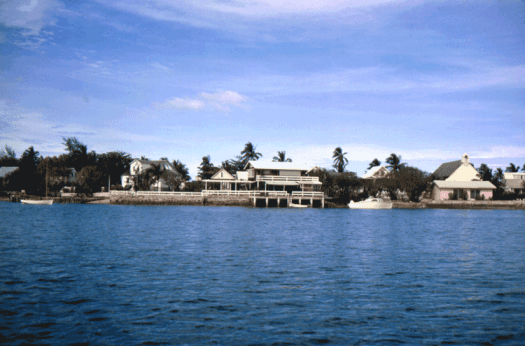
One especially picturesque port of call was Hope Town, on Elbow Cay. Below is a shot of our boat, along with some other harbour photos (sorry for the colour issues).



We finally left the Abacos on 16 July to head to Spanish Wells, in northern Eleuthera. The tricky part was to get past the Big Egg Reef and into the harbour. There is a passage on the west end of the reef; the problem was to find it. The best way then was to hire a native guide in the region who knew the waters and could guide a ship through that passage.
Thirty years layer, my brother, dying of pancreatic cancer, who went to quartermaster school in the U.S. Coast Guard, noted that my father’s navigation was rather primitive and left something to be desired of. Coupled with some alcohol-fuelled hubris, he opted to try to pick his way through the reef. He picked it, all right; about 1800 our hull sounded an unsatisfying thud and we had hit the reef. Once we checked the bilge and satisfied ourselves that it wasn’t filling with water, we called the native guide and got into Spanish Wells.
Our boat was almost too large for the drydock there, but large and dry enough to find out that we could get back to the States without incident. We went on to Nassau and returned to Palm Beach, where we had the ship repaired and relaunched, as you can see below:
A half century has come and gone since our eventful cruise. Today, of course, we have GPS to help us navigate, although that too can be divorced from reality when the situation calls for it. But GPS cannot get us into eternity; only Jesus Christ, who himself navigated the barrier reef between death and eternal life, can do that, and when we trust him, we too can avoid the reefs that would rob us of endless happiness.
-
The Ottoman Tales II: Why All the Movie Eunuchs are Black, and Some Thoughts on Slavery
This continues a series inspired (somewhat) by Noel Barber’s The Sultans
Ottoman culture has seeped into ours in ways we’re not aware of. When we hear words such as divan, caftan and ottoman itself, we’re hearing about things that came from that culture. Like most people, I like to take in the old movie. Ever wonder why, when the movie involves a harem, the eunuch is always black?
The reason for that is simple: in the Ottoman Sultan’s palace, the head eunuch–the Kislar Aga, literally the head of the women–was always black, as were his underlings. How he got to Constantinople and his high position was not a pretty process, as Thomas Sowell describes in Black Rednecks and White Liberals
:
By a variety of accounts, most of the slaves who were marched across the Sahara toward the Mediterranean died on the way. While these were mostly women and girls, the males faced a special danger–castration to produce the eunuchs in demand as harem attendants in the Islamic world.
Because castration was forbidden by Islamic law, the operation tended to be performed–usually crudely–in the hinterlands, before the slave caravans reached places within the effective control of the Ottoman Empire. The great majority of those operated on died as a result, but the price of eunuchs was so much higher than the price of other slaves that the practice was still profitable on the balance.
The British, with their newly found aversion for slavery in the first half of the nineteenth century, found that their appeals to the Ottomans to end the institution went over like a lead balloon:
When the British ambassador to the Ottoman Empire first raised the issue of abolishing slavery with the sultan in 1840, he reported this response:
…I have heard with extreme astonishment accompanied with a smile at a proposition for destroying an institution closely inter-woven with the frame of society in this country, and intimately connected with the law and with the habits and even the religion of all classes, from the Sultan himself on down the lowest peasant.
The Ottomans eventually “officially” abolished slavery, an abolition largely honoured in the breach. The British for their part tried to help out, but sometimes it backfired. Gen. Charles “Chinese” Gordon tried to stop the 80,000-100,000 slave trade through the Sudan, and the Sudanese responded with the revolt of the Mahdi. Gordon was killed and the British sent Lord Kitchener to finally put down the revolt.
As the British ambassador was told, slavery was interwoven into society from top to bottom. In addition to the eunuchs, all of the harem women were slaves. The Ottomans invented the devşirme whereby young Christian men, mostly from the Balkans, were taken, forcibly converted to Islam, and became the feared Janissaries of military fame. The white Circassians contributed generously to the harem slaves; they had pride of place there.
And slavery was there at the end. When Abdul Hamid II abdicated in 1908 as the Young Turks revolted, his Kislar Aga was executed for cruelty. When the last Sultan, Mahomet VI, abdicated, a eunuch helped him aboard the HMS Malaya for his voyage into Italian exile, and followed his five wives who came later.
The Ottomans’ reluctance to part with involuntary servitude should give us pause about how “obvious” it was to eliminate it. As Sowell notes:
While slavery was common to all civilisations, as well as to peoples considered uncivilised, only one civilisation developed a moral revulsion against it, very late in its history–Western civilisation. Today it seems so obvious that, as Abraham Lincoln said, “If slavery is not wrong, nothing is wrong.” But the hard fact is that, for thousands of years, slavery was simply not an issue, even among the great religious thinkers or moral philosophers of civilisations around the world.
We may wonder why it took eighteen centuries after the Sermon on the Mount for Christians to develop an anti-slavery movement, but a more profound question is why not even the leading moralists in other civilisations rejected slavery at all. “There is no evidence,” according to a scholarly study, “that slavery came under serious attack in any part of the world before the eighteenth century.” That is when it first came under attack in Europe.
Themselves the leading slave traders of the eighteenth century, Europeans nevertheless became, in the nineteenth century, the destroyers of slavery around the world–not just in European societies or European offshoot societies overseas, but in non-European societies as well, over the bitter oppositions of Africans, Arabs, Asians and others. Moreover within Western civilisation, the principal impetus for the abolition of slavery came first from very conservative religious activists–people who would today be called the “religious right.” Clearly, this story is not “politically correct” in today’s terms. Hence it is ignored, as if it never happened.
-
The Ottoman Tales I: The Hem of His Garment
This is the first in a series inspired (somewhat) by Noel Barber’s The Sultans
Although it’s largely forgotten these days (along with most important history, especially by Americans) for five centuries the Ottoman Empire loomed large in every sense of the word. In its highest days (under Suleiman the Magnificent/Lawgiver) it threatened Christian Europe, a threat made more credible by Europe’s own religious and political divisions. As Winston Churchill said, the Turks challenged the world; dismissing them then and now is unwise.
Until the opening of India and later China, the Ottoman Empire, which encompassed all the Middle East except for Persia/Iran, was “the Orient” for Europeans, thus when rail service ran from Paris to Constantinople/Istanbul it was the “Orient Express”, and their view was an interesting one. For present day Christians, because of the current copyright expiration date of 1923 (the year after the Empire ended) much of the public domain commentaries and Bible study materials were produced in Ottoman times (such as this) and thus their view of the Middle East was different from the one we have today.
In some ways, it was clearer; although Middle Easterners don’t change as much as we or they would like to think they do, with stuff like this, the Ottoman world was, in many ways, close in technology and custom to the one we see unfold in the pages of Scripture. The Turks, like the Romans, were better adapters than originators; they borrowed deeply from both Byzantine (itself a descendant of Rome), Persian and Arab civilisations. They also lived in an autocratic society; democracy is still no mean feat in the Middle East, as the Arab Spring reminded the world.
To look at one good aspect of this, let’s start with a familiar passage of Scripture:
And, behold, a woman, which was diseased with an issue of blood twelve years, came behind him, and touched the hem of his garment: For she said within herself, If I may but touch his garment, I shall be whole. But Jesus turned him about, and when he saw her, he said, Daughter, be of good comfort; thy faith hath made thee whole. And the woman was made whole from that hour. (Matthew 9:20-22 KJV)
I say “familiar”; for Pentecostals, it’s mind-numbingly so, it’s a favourite of Pentecostal preachers. And it’s not the only place in the New Testament where someone got the idea of touching the hem of Our Lord’s garment:
And when they were gone over, they came into the land of Gennesaret. And when the men of that place had knowledge of him, they sent out into all that country round about, and brought unto him all that were diseased; And besought him that they might only touch the hem of his garment: and as many as touched were made perfectly whole. (Matthew 14:34-36 KJV)
The Ottomans put fair stock in touching or kissing this hem. When Sultan Abdul Hamid II was enthroned in 1876, he went in procession to the Eyub Mosque (the Friday procession of the Sultan and his retinue to the mosque for prayers was one of the highlights of the week for residents of Constantinople). Once the dervishes had girded him with the sabre–the Turks were and are a military people–the Sultan took three steps towards his Grand Vizier (prime minister) who kissed the hem of his garment in the name of the people. This gesture was done even under duress; in 1808, when Sultan Selim III was murdered and Mahmud II ended up as Sultan, his soon to be Grand Vizier Bairactar kissed the hem of the new Sultan’s robe. (Bairactar didn’t last long; he was murdered by the Janissaries, but ultimately they came to the same end).
Although most of our ministers focus on the woman with an issue of blood desiring healing from Jesus, her choice–and others’–of the hem of the garment suggest that they were additionally making a declaration of Jesus’ royalty. Such declarations were not lost on the Jewish leadership, who feared that Jesus’ objective was to become a secular king in opposition to both Rome and themselves. (For a take on this with another Ottoman illustration, click here).
But although the woman’s declaration was certainly correct, Our Lord had another kind of kingdom in mind:
Jesus answered, My kingdom is not of this world: if my kingdom were of this world, then would my servants fight, that I should not be delivered to the Jews: but now is my kingdom not from hence. Pilate therefore said unto him, Art thou a king then? Jesus answered, Thou sayest that I am a king. To this end was I born, and for this cause came I into the world, that I should bear witness unto the truth. Every one that is of the truth heareth my voice. (John 18:36-37 KJV)
And that’s something that many in the world–both Jesus’ followers and his opponents–still do not understand.
-
The Firm That Facilitated an American "Aliyah" Calls It Quits
The Claude Reese real estate company comes to an end:
Founded at the end of the Roaring ’20s, Claude D. Reese Real Estate — often referred to as the island’s oldest real estate firm — has sold the office condominium it had occupied for about 10 years at 140 Royal Palm Way. The agency has no plans to reopen, said David Reese, its longtime broker and son of the agency’s namesake, the late Claude D. Reese Sr…
David Reese acknowledged that much had changed in Palm Beach real estate over the years. The entrance to the marketplace of major corporate-owned real estate companies in particular has made it more difficult for independent boutique agencies to compete, he said.
“There are so many big firms here,” he said.
The Shiny Sheet overlooked the fact that David’s dad facilitated what was perhaps the key real estate transaction in the history of the town:
Mentioning the Palm Beach Country Club brings up another ongoing transformative aspect to Palm Beach life: the island’s Jewish community. Jews have come to Palm Beach since the beginning, in the early years readily mixing with their Gentile friends. (For numerous reasons I prefer my mother’s term for the non-children of Abraham, Isaac and Jacob over Leamer’s “WASP.”) The whole saga of a Jewish community that is socially (and to some extent physically) separate from its Gentile counterpart began in 1944, three years before the founding of the State of Israel. At that time Jewish entrepreneur A.M. Sonnabend offered to purchase a large tract of land and buildings which included the Biltmore Hotel and the original Flagler mansion. Just as their Zionist counterparts needed an Arthur Balfour to facilitate their return to the Promised Land, so also did the Jews who wished to come to the island. They found one in Claude Reese, scion of a pioneer family in Palm Beach County and an eminent realtor. (The Southern Scots-Irish have always been the great interlopers between Jew and Gentile, and always with unexpected results.) The Gentiles were furious at such an invasion, so Reese, mindful of his commission, came up with a plan. Knowing that Sonnabend was undercapitalized, he offered to the residents the option to buy out his contract before he could come up with the money. They could not bring themselves to do so, and Sonnabend was able to make the purchase.
The subsequent quasi-two-state history has pretty much paralleled its Middle Eastern counterpart, albeit with more money per capita on the table and less bloodshed. (My brother did get a fractured jaw out of the conflict.) The Gentiles fulminate and moan about the Jews and their ways, but with each passing year the Jewish presence in Palm Beach increases and the Gentile decreases. Without enough fresh Gentile blood and money (and without the Palestinians’ death penalty for selling property to the Jews, we sold our house to a Jewish couple when we left in 1972) Palm Beach is transformed into a predominantly Jewish town, gripes about the Shiny Sheet looking like the Jerusalem Post notwithstanding. (Personally I think that the paper’s coverage of Jewish holidays and other religious events is one of the best things they do.) In the meanwhile Palm Beach life goes on with separate clubs, charity balls and other social events. It’s a situation that doesn’t fit into anyone’s “politically correct” paradigm and Leamer has received criticism for discussing it. But he is spot-on in his description. I first commented on this state of affairs in 2005; its perpetuation isn’t really a credit to anyone on the island.
Sometimes you make money, and sometimes you make history. It’s the rare bird that does both.
-
The Episcopalians Go From Smashmouth to Mealymouth
That’s one way of looking at Sarah Hey’s assessment of TEC’s new Presiding Bishop:
2) Presiding Bishop-elect Curry has a lovely speaking voice and will continue to offer nice sermons. This will serve, no doubt, to assuage some of the embarrassment that moderates and not a few liberal Episcopalians felt when they heard Katherine Jefferts Schori’s sermons.
3) Presiding Bishop-elect Curry will say quite a number of pretty things about “Jesus.” This will be a great relief, again, to those who have had to struggle to defend or explain away the frank and rather coarse unbelief of Katherine Jefferts Schori.
This should, however, be put in the larger context of the Anglican-Episcopal world. One thing Curry will become is a tool in Archbishop of Canterbury Justin Welby’s attempt to put the Humpty-Dumpty of the Anglican Communion back together again. As I noted last year in discussion Welby’s snubbing of the ACNA:
In addition to centralising what it means to be in the Communion, Welby, for his part, is probably stalling for time until TEC elects a new Presiding Bishop to replace Katharine Jefferts-Schori next year. While it’s unlikely that TEC will choose a less heterodox leader than KJS, their new choice may revert to a more traditionally Episcopalian mealy-mouth style and not KJS’s smash-mouth style. If they do that, Welby may try to achieve a reconciliation while “holding the keys” to the communion.
TEC has done just that. And there’s no doubt that they’ll peel off a few here and there, as Tory Baucum is evidence of. But, in addition to the yawning chasm between the revisionists and the orthodox, we have one more factor at work: institutional inertia. It’s hard to believe that, having put together their own province with their own army of bishops and one Archbishop, that they would simply revert en masse to TEC. Sorting out ecclesiastical jobs has always been the bane of Christian institutional unity; it’s torpedoed denominational mergers even when issues such as divide TEC and ACNA are not on the table.
But one should never underestimate the power of Anglican Fudge. Eternal vigilance is the price of liberty.
Sailing the Last Voyage with Newton and Pascal
 Positive Infinity